Deep-dive AI research reports on individual stocks, powered by our proprietary signals. Every report carries a direction (Bullish or Bearish) and a conviction level(Strong or Speculative). We track stock performance since each report's publication date — because we believe great analysis should be held accountable.
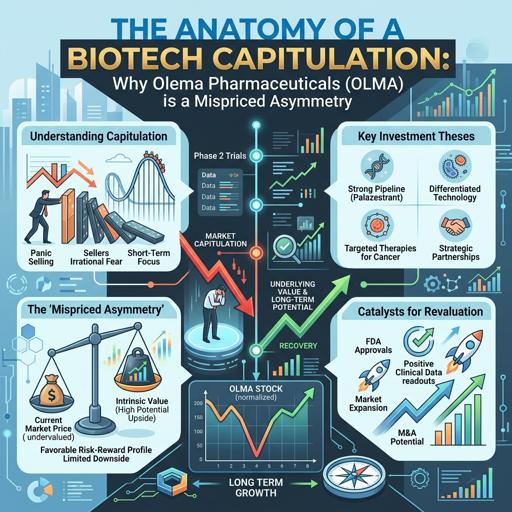
The Anatomy of a Biotech Capitulation: Why Olema Pharmaceuticals (OLMA) is a Mispriced Asymmetry
Olema Pharmaceuticals (OLMA) stock fell 60% on retail panic over insider sales and a CFO departure. However, sophisticated institutions like Fidelity doubled their stakes, buying heavily into the selloff. The company's fundamentals remain strong with a solid cash position.

An In-Depth Investment Analysis of Olema Pharmaceuticals (NASDAQ: OLMA) - Pioneering a New Endocrine Backbone in Breast Cancer
Olema Pharmaceuticals is a clinical-stage biopharmaceutical company focused on developing therapies for women's cancers, with its lead candidate, palazestrant (OP-1250), targeting ER+/HER2- breast cancer. Palazestrant features a dual mechanism of action as both a complete estrogen receptor antagonist (CERAN) and a selective estrogen receptor degrader (SERD), designed to overcome resistance seen with current endocrine therapies. Early clinical data has shown promising efficacy and safety, supporting its advancement into two pivotal Phase 3 trials: OPERA-01 (monotherapy) and OPERA-02 (combination therapy). The company has secured strategic collaborations with Pfizer and Novartis, validating its approach and positioning palazestrant as a potential partner for CDK4/6 inhibitors. However, Olema faces significant risks, including its heavy reliance on the success of palazestrant, intense competition from larger pharmaceutical companies, and a high cash burn rate with financial runway extending only into 2026. While analyst consensus is bullish, the investment remains highly speculative, suitable only for risk-tolerant investors with a long-term horizon. Key catalysts include the initiation of OPERA-02 and the critical top-line data from OPERA-01 expected in late 2026.