In This Article:
OLMA
Sponsored
The Anatomy of a Biotech Capitulation: Why Olema Pharmaceuticals (OLMA) is a Mispriced Asymmetry
BullishStrongChange from report: -36.8%1M: +9.9%3M: -24.6%
Published on 2026-03-23 by TradeFomo
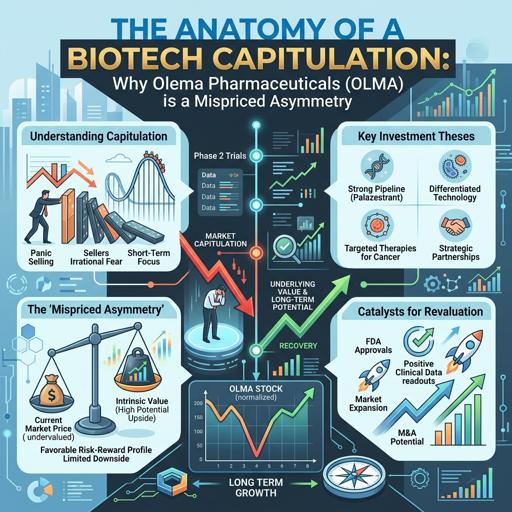
If you want to find generational asymmetric bets in the market, you have to look where the crowd is panicking. You look for the forced liquidations, the misunderstood corporate filings, and the exact moments when "smart money" is quietly accumulating while retail investors are throwing their shares into the abyss.
Right now, that setup is flashing bright red in a clinical-stage oncology company: Olema Pharmaceuticals ($OLMA).
Over the last three months, OLMA has been a textbook example of biotech boom and bust. In late 2025, the stock was flying high, touching the mid-$30s on the back of spectacular Phase 1b/2 data for its breast cancer drug, palazestrant. Today, the stock is trading at $14.08. A nearly 60% haircut in less than a quarter.
But if you look under the hood—at the SEC filings, the cash position, the institutional ownership changes, and the extreme technical capitulation we just witnessed—you'll see a coiled spring. Here is why the market is dead wrong on OLMA.
The Retail Panic vs. Institutional Reality
Retail investors are notoriously bad at parsing corporate events in the biotech sector. Two things happened recently that sent weak hands running for the exits:
- Insider Selling at the Top: In December 2025, Chief Medical Officer Naseem Zojwalla heavily exercised options and sold shares in the $27 to $28 range.
- CFO Departure: On January 30, 2026, the company announced the departure of its CFO, Shane Kovacs.
To the untrained eye, a selling executive and a departing CFO equal a sinking ship. The market dumped the stock. But let's look at the institutional tape.
While the retail crowd was dumping shares under $20, Fidelity (FMR LLC)—one of the most sophisticated asset managers in the world—was aggressively buying the blood. According to their March 6, 2026, Schedule 13G/A filing, Fidelity nearly doubled its stake in Olema, increasing its ownership from 6.3% to a massive 12.5% (holding nearly 10 million shares). Bain Capital, Paradigm, and BlackRock are all sitting on massive positions.
The smart money isn't just holding; they are accumulating into the panic. Why? Because the underlying fundamentals of the business have actually improved.
The $505 Million Floor and the Offering Arbitrage
Let's talk about the balance sheet, which is the ultimate gravity for a pre-revenue biotech.
In November 2025, Olema executed a brilliantly timed follow-on public offering, raising over $218 million at $19.00 per share. Today, you can buy the stock on the open market at $14.08—a steep 25% discount to what institutional heavyweights paid just four months ago.
More importantly, as of the latest March 16 earnings release, Olema is sitting on $505.4 million in cash and cash equivalents. The company's market cap is currently hovering around $1.2 billion. This means almost half of the company's valuation is entirely backstopped by cash. In the cash-burning furnace of clinical biotech, a $500+ million runway that extends beyond their first potential commercial launch in 2027 is a massive derisking factor. They have the capital to cross the finish line without diluting shareholders at these depressed levels.
Technicals: The March 9th Washout
If you are a student of market microstructure, you live for days like March 9, 2026.
On that Monday, OLMA gapped down and traded almost 14 million shares—more than 11 times its 20-day average volume of 1.2 million. The stock plunged over 25% on peak fear, driving the Relative Strength Index (RSI) down to an extreme oversold level of 20.4.
This wasn't just a sell-off; it was a pure, unadulterated capitulation washout. The algorithms flagged abnormal volume and multiple time-frame bottoms. When you see 14 million shares change hands on a stock with an 85 million share float, and the price stabilizes shortly after, you are witnessing the exact moment where weak retail hands transfer their holdings into the firm grips of institutional block buyers. The technicals have been screaming "oversold" for two weeks, printing quarterly lows and forming a textbook potential bottom.
The Real Value Driver: Palazestrant
The market has been so distracted by executive shuffling and macroeconomic noise that it has entirely forgotten why this stock was in the $30s just months ago.
Olema is targeting one of the most lucrative and historically underserved markets in oncology: women's ER+/HER2- breast cancer. Their flagship asset, palazestrant (OP-1250), showed a remarkable 15.5 months median progression-free survival (PFS) in its Phase 1b/2 trial when combined with ribociclib. To put it simply: the drug works, and it works well. It was well-tolerated with no new safety signals.
They are currently running the pivotal Phase 3 OPERA-01 trial, with top-line data expected in the fall of 2026. They have also initiated the Phase 3 OPERA-02 trial and are collaborating with Pfizer to test combinations with atirmociclib. The pipeline is expanding, and they are gearing up for a commercial launch in late 2027.
The Verdict: A Mispriced Asymmetry
Investing is about finding a divergence between price and reality.
The Price: $14.08, crushed by a CFO exit, standard insider profit-taking, and market impatience. The Reality: A $1.2B biotech with a massive $505M cash pile, a top-tier Phase 3 oncology asset with proven Phase 2 efficacy, top-tier institutional backing doubling down at these prices, and a 25% discount to the recent $19 secondary offering.
The downside is heavily buffered by the cash position. The upside is a successful Phase 3 readout in Fall 2026 that could fundamentally reshape the standard of care in a multi-billion dollar breast cancer market.
Fidelity is buying the fear. The technicals show total capitulation. The cash is in the bank. For those willing to look past the short-term noise, OLMA presents one of the most compelling risk/reward setups in the biotech sector today.
Sponsored