The AI Optics Value Chain: From Switch Silicon to Optical Engines
Published on 2026-05-24 by TradeFomo
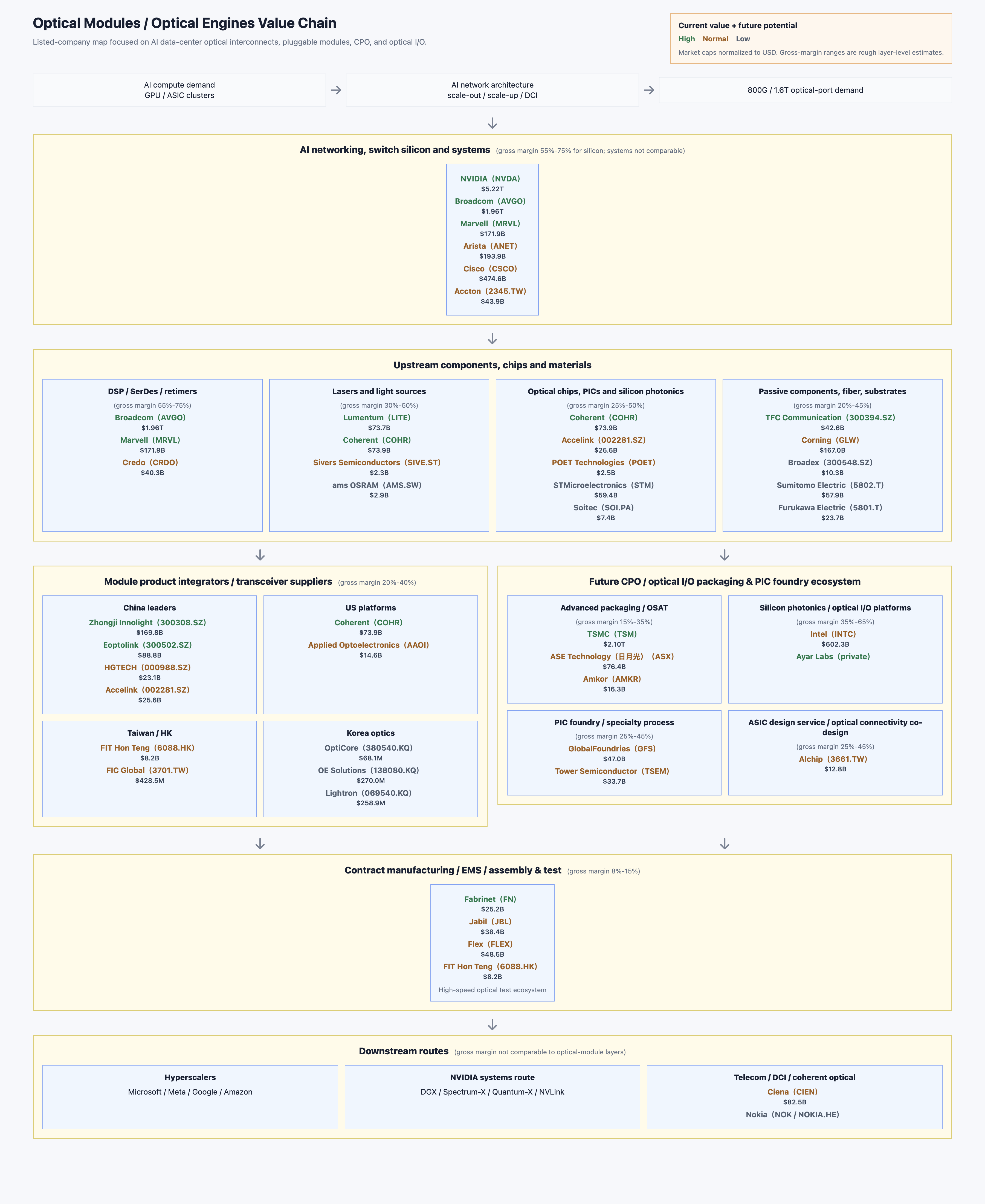
AI clusters are becoming optical systems as much as compute systems. The visible winner is still the GPU, but the hidden constraint is increasingly the network: switch radix, SerDes speed, optical-port density, power per bit, fiber management, and the ability to move from 800G to 1.6T without letting the interconnect budget explode.
This map frames the optical-module and optical-engine value chain around one core question: where does the economic value sit as AI data-center networks migrate from pluggable optics toward LPO, CPO, and optical I/O?
The answer is not a single layer. Today, value is concentrated in high-speed pluggable transceivers, DSPs, lasers, switch ASICs, and qualified module suppliers. Over time, some of that value may migrate toward switch silicon vendors, advanced packaging, silicon photonics platforms, PIC foundries, external light sources, and optical-engine integration.
How to Read the Map
The color coding represents value-chain relevance, not stock recommendation.
High means the company has direct or strategically important exposure to AI optical interconnects, high-speed optical modules, optical engines, CPO, or enabling components.
Normal means the company has meaningful exposure, but the optics revenue pool may be diluted by other businesses, earlier-stage commercialization, or less direct positioning.
Low means the company is relevant to the broader optical ecosystem, but current pure-play AI optical-module exposure is limited or still needs verification.
Market caps are normalized into U.S. dollars and should be treated as a working snapshot rather than a valuation conclusion.
AI Networking, Switch Silicon and Systems
This is the demand-formation layer. AI training clusters require high-bandwidth, low-latency communication across GPUs, switches, NICs, and optical links. The system vendors and switch silicon companies do not always sell optical modules directly, but they shape the architecture that determines module demand.
The gross margin range is shown as (gross margin 55%-75% for silicon; systems not comparable) because switch ASICs and high-end silicon tend to carry very different economics from complete networking systems.
NVIDIA (NVDA) sits at the center of AI networking through GPUs, Spectrum-X Ethernet, Quantum InfiniBand, NVLink, and LinkX optics. Its future architecture choices could strongly influence whether optical value stays in pluggables or moves closer to the package through CPO and optical I/O.
Broadcom (AVGO) is one of the most important switch ASIC and connectivity silicon suppliers. It is not a pure optical-module company, but its exposure to switch silicon, DSP, SerDes, and silicon photonics makes it a core optical-interconnect enabler.
Marvell Technology (MRVL) has strong positioning in PAM4 DSPs, SerDes, custom silicon, and AI connectivity. It is attractive in this map because it appears in multiple value nodes rather than relying on one product category.
Arista Networks (ANET) is a leading AI data-center switching vendor. Its direct relationship to optics is mostly through switch platforms and customer architecture choices, but it is an important demand signal for 800G and 1.6T optical ports.
Cisco Systems (CSCO) has broad networking and optical exposure, including switching and optical transport. Its optics relevance is real, but diluted by a much larger enterprise and service-provider networking business.
Accton Technology (2345.TW) is a major switch ODM and system supplier. It is downstream from optical modules, but its hyperscale customer relationships make it useful for reading AI networking demand and architecture transitions.
Upstream Components, Chips and Materials
This layer is the component base underneath transceivers and optical engines. It is not one homogeneous market. DSPs, lasers, photonic chips, substrates, fiber, and passive optical parts have different margin structures, bottlenecks, and competitive dynamics.
The key point is that the module is only the visible box. Inside that box are many high-value components, and some of them may become even more important in CPO and optical I/O architectures.
DSP / SerDes / Retimers
This sub-layer handles high-speed electrical signaling and signal integrity. A DSP does not emit light; it processes electrical signals through functions such as equalization, clock recovery, error correction, and high-speed interface management.
The economics are attractive because the design complexity is high and the value per module can be large. The map uses (gross margin 55%-75%) as a rough range.
Broadcom (AVGO) is a core supplier in switch ASICs, DSPs, and high-speed connectivity silicon. Its role is central because it participates both in the switch silicon layer and the optical-electrical interface.
Marvell Technology (MRVL) is a major PAM4 DSP, SerDes, and custom silicon supplier. Its ability to span DSP, custom AI silicon, and optical-interconnect architecture makes it one of the more strategically positioned names.
Credo Technology (CRDO) is relevant through SerDes, retimers, active electrical cables, and AI connectivity silicon. It is not an optical-module vendor, but it benefits from the broader need to solve high-speed interconnect problems.
Lasers and Light Sources
This sub-layer provides the light. Laser chips, laser diodes, laser arrays, and external light sources are different levels of integration, but all sit around the same problem: silicon is excellent for logic and waveguides, but poor at generating light.
The map uses (gross margin 30%-50%) as a broad estimate. Margins can vary widely depending on scale, product type, customer mix, and whether the company sells chips, packages, light engines, or full modules.
Lumentum (LITE) is a key laser and optical-component supplier. Its opportunity includes high-speed datacom, CW lasers, and possible external light source demand for CPO and silicon-photonics platforms.
Coherent (COHR) is a vertically integrated optics platform with lasers, InP devices, optical components, datacom modules, and silicon-photonics exposure. It appears in multiple places because it spans more of the optical stack than most companies.
Sivers Semiconductors (SIVE.ST) is best classified as a light-source company in this map. Its Sivers Photonics business is focused on InP DFB laser chips, laser arrays, and high-power light sources for silicon photonics, CPO, and optical I/O platforms.
ams OSRAM (AMS.SW) has optical semiconductor and laser capabilities, but current AI data-center optics purity is lower. It remains a potential enabler rather than a direct high-conviction AI optical-module play.
Optical Chips, PICs and Silicon Photonics
This sub-layer handles optical-electrical conversion and photonic integration. It can include photonic integrated circuits, modulators, photodiodes, waveguides, couplers, optical interposers, and related integration platforms.
The map uses (gross margin 25%-50%) as a rough range. This area can be strategically important, but commercial maturity varies significantly across companies.
Coherent (COHR) is important here because it combines InP, optics, lasers, modules, and silicon-photonics-related capabilities. It is one of the broader platforms in the optical component ecosystem.
Accelink Technologies (002281.SZ) has exposure to optical chips, components, and modules. It is relevant to the broader Chinese optical supply chain, though its exact high-end AI datacenter mix needs continued diligence.
POET Technologies (POET) is a high-optionality photonic integration platform company. Its Optical Interposer is better understood as a heterogeneous optical-engine integration platform rather than a standard silicon-photonics PIC foundry.
STMicroelectronics (STM) is a broad semiconductor company with photonics-capable technology. It has strategic relevance, but the current purity of AI optical-module exposure is low.
Soitec (SOI.PA) provides engineered substrates that can matter for silicon photonics and specialty semiconductor platforms. Its role is upstream and indirect.
Passive Components, Fiber and Substrates
This layer covers the less glamorous but essential physical infrastructure: fiber, glass, FAUs, lenses, isolators, precision passive components, substrates, and connectivity materials.
The map uses (gross margin 20%-45%) as a wide range because the category mixes high-precision optical components with more mature fiber and cable products.
TFC Communication (300394.SZ) is a high-relevance upstream optical component supplier with exposure to precision parts used in high-speed modules. It is one of the more important A-share names in this layer.
Corning (GLW) is foundational in optical fiber, cable, datacenter connectivity, and specialty glass. It is not an optical-module company, but the optical infrastructure layer cannot be mapped properly without it.
Broadex Technologies (300548.SZ) has optical component and module exposure. Its AI datacenter positioning and high-speed product competitiveness need more verification.
Sumitomo Electric (5802.T) is important in optical fiber, cable, devices, and compound semiconductor capabilities. Its AI short-reach module exposure is less direct.
Furukawa Electric (5801.T) is another important Japanese fiber and telecom infrastructure company. It is relevant to the optical ecosystem, but less levered to AI datacenter pluggables than the module leaders.
Module Product Integrators / Transceiver Suppliers
This is the current visible center of the AI optics cycle. These companies integrate lasers, DSPs, drivers, TIAs, optical components, packaging, firmware, and test into complete optical modules and transceivers.
This layer is not necessarily low-tech. Qualification, thermal design, optical alignment, manufacturing yield, high-speed testing, and hyperscaler certification are real barriers. But compared with switch ASICs, DSPs, and certain laser or photonic platforms, long-term gross margin pressure can be higher. The map uses (gross margin 20%-40%).
Zhongji Innolight (300308.SZ) is one of the leading Chinese high-speed optical module suppliers for AI datacenters. It is a core 800G and 1.6T beneficiary, while also needing to defend its position if CPO shifts profit pools over time.
Eoptolink (300502.SZ) is another major Chinese datacom optical-module leader. It is highly relevant to the 800G/1.6T upgrade cycle and should be tracked for share, margin, and customer mix.
HGTECH (000988.SZ) has optical module and laser equipment exposure inside a broader group. The key diligence question is how much of its revenue and profit is tied to high-speed AI datacenter optics.
Accelink Technologies (002281.SZ) has a broader optical chips, components, and module platform. Its map position reflects meaningful optics exposure, but high-end AI mix still matters.
Coherent (COHR) is not merely a module integrator. It is a broad optical platform with lasers, InP components, silicon-photonics-related assets, datacom modules, and optical engines.
Applied Optoelectronics (AAOI) is best viewed as a vertically integrated optical-component and transceiver supplier. It manufactures many of the laser chips and optical components used in its products, but it should not be classified as a dedicated CPO external-light-source company.
FIT Hon Teng (6088.HK) is part of the Foxconn ecosystem and has interconnect, optical module, and manufacturing relevance. It may matter both as a transceiver supplier and as an assembly/manufacturing participant.
FIC Global (3701.TW) provides Taiwan-listed exposure to optical transceivers and networking systems. Its high-speed AI module progress and customer quality need continued tracking.
OptiCore (380540.KQ) is a Korean optical transceiver and component company. It is relevant, but current AI datacenter exposure appears less proven.
OE Solutions (138080.KQ) has historical strength in telecom, wireless, and front-haul optics. It is less directly tied to short-reach AI datacenter optical modules.
Lightron (069540.KQ) has optical communication module exposure. The open questions are product mix, financial quality, and whether it can participate in higher-speed AI datacenter demand.
Future CPO / Optical I/O Packaging and PIC Foundry Ecosystem
This layer is the future profit-pool migration layer. It exists because pluggable optics may eventually struggle with power, density, signal integrity, and front-panel bandwidth as AI networks scale.
CPO, optical I/O, and external light source architectures could move part of the value from module boxes into advanced packaging, silicon photonics, PIC foundries, co-designed ASICs, and optical engines located near the switch ASIC or accelerator package.
Advanced Packaging / OSAT
The map uses (gross margin 15%-35%) because advanced packaging economics are generally lower than high-end silicon design but higher and more strategic than commodity assembly.
TSMC (TSM) matters through CoWoS, advanced packaging, COUPE-related concepts, and potential silicon-photonics platform participation. It is not a module company, but it could become a central manufacturing platform if optical I/O moves into advanced packages.
ASE Technology (ASX) is a leading OSAT company. Its relevance comes from advanced SiP, photonics packaging, and possible CPO assembly flows.
Amkor (AMKR) is another major OSAT with advanced packaging and SiP exposure. It could participate if optical-engine packaging becomes more outsourced and standardized.
Silicon Photonics / Optical I/O Platforms
The map uses (gross margin 35%-65%) to reflect the potential platform and IP value in optical I/O, while recognizing that commercialization models can vary.
Intel (INTC) has deep silicon photonics, EMIB, and optical I/O technology. It is more of a platform and self-use technology owner than a merchant optical-module supplier.
Ayar Labs (private) is one of the key private companies in optical I/O. Its TeraPHY and SuperNova positioning makes it important to watch even though it is not a listed equity.
PIC Foundry / Specialty Process
This category is different from a generic logic foundry. A PIC foundry or specialty photonics process needs optical waveguides, couplers, modulators, photodiodes, low optical loss, process stability, and packaging compatibility, not just transistor density.
The map uses (gross margin 25%-45%).
GlobalFoundries (GFS) remains a foundry, but it is not trying to compete at the most advanced generic logic nodes. Its relevance here is specialty and differentiated manufacturing, including silicon photonics through platforms such as GF Fotonix.
Tower Semiconductor (TSEM) is a specialty analog and photonics-capable foundry. It is relevant because optical engines and PICs often need specialty process integration rather than leading-edge logic.
ASIC Design Service / Optical Connectivity Co-Design
This layer exists because optical I/O may require tighter co-design between ASICs, packaging, photonics, and system architecture.
The map uses (gross margin 25%-45%).
Alchip (3661.TW) is an ASIC design-service company. It is included because of its optical connectivity co-design relevance around the TSMC COUPE and Ayar Labs ecosystem.
Contract Manufacturing / EMS / Assembly and Test
This layer turns designs into manufacturable products at scale. It includes optical assembly, high-speed testing, module build, systems integration, and potentially optical-engine or CPO-related assembly.
The map uses (gross margin 8%-15%), which is structurally lower than most chip or IP layers. The strategic value is not in headline margin, but in qualification, yield, capacity, customer trust, and operational execution.
Fabrinet (FN) is the strongest pure optical manufacturing services name in this group. It has deep optical communications manufacturing experience and is likely the cleanest EMS exposure to high-speed optical assembly.
Jabil (JBL) is a large EMS provider with networking, optical, and datacenter hardware exposure. It is broader and less pure than Fabrinet, but operationally capable.
Flex (FLEX) is a broad EMS and systems integration company. It is relevant to networking equipment and datacenter hardware, although its optical purity is lower and its business mix is broader.
FIT Hon Teng (6088.HK) also appears here because it can be viewed as both an interconnect/optical product supplier and a manufacturing participant within the Foxconn ecosystem.
Downstream Routes
The downstream layer shows where optical demand is ultimately consumed. Gross margins are marked as not comparable because hyperscalers, networking system vendors, and telecom optical systems operate under different business models.
Hyperscalers such as Microsoft, Meta, Google, and Amazon are the ultimate demand source for AI datacenter optical modules. Their architecture choices drive supplier selection, qualification cycles, and the speed of 800G and 1.6T adoption.
NVIDIA systems route includes DGX, Spectrum-X, Quantum-X, NVLink, and broader AI networking platforms. NVIDIA matters not only because it buys or sells optics, but because it can influence the architecture of future AI interconnects.
Ciena (CIEN) is more tied to coherent optical systems, telecom, and DCI than short-reach AI datacenter pluggables. It remains useful for understanding coherent optics and long-haul/DCI demand.
Nokia (NOK / NOKIA.HE) has optical networking systems exposure, mostly on the carrier and transport side. Its direct AI short-reach module leverage is lower.
The Main Investment Lens
The current optical-module cycle is led by 800G and 1.6T pluggable demand, which benefits module leaders, laser suppliers, DSP suppliers, and optical component companies. In that world, Zhongji Innolight, Eoptolink, Coherent, Lumentum, AAOI, Broadcom, Marvell, and Fabrinet are among the most directly relevant names.
The future CPO and optical I/O cycle may shift some value away from traditional transceiver integration and toward switch silicon, photonic integration, external light sources, advanced packaging, PIC foundries, and optical-engine platforms. In that world, companies such as Broadcom, Marvell, NVIDIA, TSMC, Intel, GFS, Tower, ASE, Amkor, Ayar Labs, POET, Sivers, Coherent, and Lumentum become increasingly important to monitor.
The practical conclusion is that the optical value chain should not be researched as one basket. It should be split into four questions:
- Who wins the current 800G/1.6T pluggable module cycle?
- Which upstream components are true bottlenecks?
- Which companies can defend margin as hyperscalers pressure module pricing?
- Which players gain value if CPO and optical I/O move the profit pool closer to silicon and packaging?
That is why this map separates module vendors, DSP/SerDes suppliers, lasers, PICs, passive components, EMS, downstream systems, and future CPO infrastructure. The same AI optical boom can create very different outcomes depending on where each company sits.