In This Article:
ZYME
Sponsored
The Invisible Hand Strangling ZYME's Shorts: A Deep Dive into Biotech's Quietest Squeeze
BullishStrongChange from report: -2.3%1M: -10.2%3M: -11.1%
Published on 2026-04-16 by TradeFomo
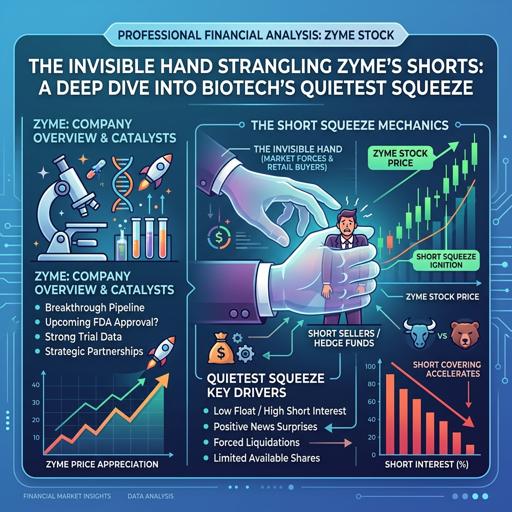
Wall Street loves a convenient narrative. If you ask the average analyst why Zymeworks Inc. (ZYME) is up over 160% in the past year, currently sitting at a fresh yearly high of $27.73, they will regurgitate the press releases. They will point to the stellar Phase 3 Ziihera data from November 2025, the recent $250 million royalty-backed financing from Royalty Pharma that extended their cash runway beyond 2028, and the corporate restructuring bringing in new CFO Kristin Stafford.
But fundamental milestones only tell you why a stock should move; they do not explain how it moves. To understand the mechanics of ZYME's relentless, grinding ascent—and why I believe the pain for bears is far from over—you have to look beneath the surface. You have to look at the plumbing. We are witnessing a systematic, mathematically verifiable cornering of the float, engineered in the dark pools.
The Dark Pool Crucible: Decoding the Four-Metric Anomaly
To truly read the tape, we must look beyond standard exchange data and examine the interplay of four critical market microstructure metrics: the TRF ratio (trf_pctile, representing off-exchange dark pool execution), off-exchange shorting percentage (short_pctile), volume anomalies (vol_z_score), and the rolling close position value (rolling_cpv, measuring intraday buying resilience). When combined, these metrics strip away the illusion of retail trading and expose the raw, hidden actions of institutions.
If we look at the data from the second week of April 2026, a glaring structural divergence emerges that telegraphs a massive institutional pivot. On April 8, ZYME experienced a significant volume surge (vol_z_score of +1.65) paired with extreme off-exchange shorting, pushing the short_pctile to the 96.6th percentile. Historically, throwing this much dark-pool short volume at a stock signals a violent top as institutions cap the breakout. Yet, the rolling_cpv remained stubbornly resilient at 0.66, meaning that despite the relentless shorting, net buying pressure consistently overpowered sellers by the closing bell. This was the smart money throwing the kitchen sink at ZYME, and failing. The exact breaking point arrived just days later on April 13, when the trf_pctile hit an absolute maximum (100th percentile) while the off-exchange shorting completely collapsed (short_pctile plunging to 13.3%). When a TRF ratio hits a peak extreme concurrently with a collapse in short percentage and a highly elevated rolling_cpv, it is the ultimate footprint of institutional capitulation. It signals that the hidden liquidity has aggressively flipped from suppression to unbridled accumulation. This simultaneous metric inversion is not just a footnote; it is the ignition of a new, reflexive trend, providing the invisible rocket fuel that has pushed ZYME to its current 52-week highs.
The Float is Cornered: A 13F Death Trap
The capitulation we are seeing in the dark pools makes perfect sense when you map out the ownership structure. The short sellers who haven't covered are trapped in a shrinking room, and the walls are closing in rapidly.
Look at the institutional ownership data. EcoR1 Capital has ruthlessly amassed a staggering 30.7% of the company (nearly 23 million shares). This isn't just an investment; it's a structural chokehold. Add in Rubric Capital Management quietly increasing their stake to 7.68% at the end of 2025, and Perceptive Advisors dropping a Schedule 13G just yesterday (April 15, 2026) revealing a new 5.4% passive stake.
Between just a handful of massive funds, the tradable float has been decimated.
The Short Squeeze Math
Let's look at the actual short interest evolution. In mid-November 2025, right around the time of the Phase 3 readout, short interest stood at a bloated 8.54 million shares (over 18% of the float). Fast forward to the end of March 2026, and that number has been ground down to 4.46 million shares (9.46% of the float).
The shorts have been forced to cover over 4 million shares in a market where the top institutions refuse to sell and are, in fact, adding to their positions. The volume anomalies we discussed above—the massive TRF spikes with zero short participation—are the frantic footprints of these remaining bears trying to source liquidity off-exchange where none exists.
Technical Confirmation of the Fundamental Squeeze
The technical analysis aligns perfectly with the microstructure data. We saw a classic "potential bottom" signal confirmed in early February at $22.72, right as the macd generated a golden cross below zero. Since then, the stock has marched higher, triggering monthly, quarterly, and now yearly high signals in April.
More importantly, every minor pullback is being bought aggressively. The 5-day EWMA of the rolling_cpv hasn't dipped below the neutral 0.50 mark since the beginning of April. The market is bidding the stock up into the close, day after day. This is not retail FOMO; this is algorithmic accumulation and forced covering.
The Contrarian View: The Top is Not In
The conventional wisdom dictates that after a biotech stock runs 160% in a year and signs a massive royalty deal, the upside is priced in. The "smart" mainstream move here is to take profits and wait for a pullback.
I argue the exact opposite.
The fundamental derisking of the company (cash runway to 2028, Ziihera Phase 3 success) was merely the catalyst. The real trade now is a market structure trade. You have an asset where nearly half the company is locked up by high-conviction healthcare funds, the company itself is running a $125 million share repurchase program (further reducing the float), and off-exchange data proves that institutions are failing to cap the price and are actively capitulating.
The 4.46 million shares held short are underwater, bleeding carry costs, and facing a liquidity desert. The anomalous dark pool prints from this past week indicate that the final, violent leg of this squeeze is just beginning. ZYME is not just a biotech success story; it is a meticulously constructed bear trap.
Sponsored