In This Article:
ZLAB
Sponsored
The Anatomy of a Washout: Why Zai Lab (ZLAB) is Hiding in Plain Sight
BullishStrongChange from report: +22.4%1M: -5.9%3M: -7.9%
Published on 2026-04-07 by TradeFomo
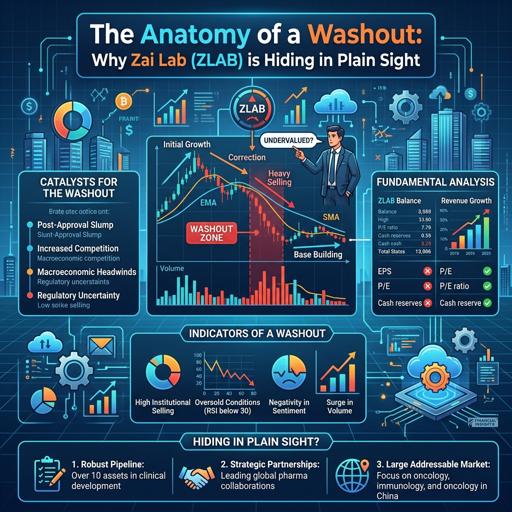
The consensus on biotech right now is painfully predictable: stay away from cash-burning companies, avoid regulatory risk, and never try to catch a falling knife. But the market's obsession with macro narratives often blinds it to the micro-mechanics of liquidity and institutional capitulation. Zai Lab Limited (ZLAB) has spent the last year bleeding out, dropping from the mid-$30s to a capitulatory low of $16.30 in early 2026. The crowd sees a broken chart. I see one of the most violent, mathematically verifiable institutional accumulation events of the year.
The smart money is leaving fingerprints all over the tape. You just have to know which data points to cross-reference.
The Great Institutional Puke
To understand the opportunity in ZLAB, you first have to understand the capitulation that created it. In late 2025 and early 2026, we saw a classic institutional washout. Mega-funds were forced to de-risk, regardless of the underlying fundamentals. FMR LLC dumped millions of shares, reducing their massive 6.4% position down to 3.9% by early 2026. Wellington Management Group followed suit, paring their 6.0% stake down to 4.3%.
When index-hugging institutions puke millions of shares into a low-liquidity tape, the price action becomes entirely divorced from the company's enterprise value. Retail panics, momentum algorithms short the breakdown, and the stock is driven into the dirt. But the selling wasn't based on a broken thesis; it was based on balance sheet mechanics. And right at the point of maximum despair, a new predator entered the water.
On April 6, 2026, RA Capital Management—one of the sharpest biotech funds on the street—filed a Schedule 13G revealing a brand-new 5.2% passive stake in ZLAB. The event date for the filing? March 30, 2026. They stepped in and absorbed the exact absolute bottom of the market while everyone else was looking the other way.
Peering into the Dark Pools
To truly map the plumbing of this market, we must analyze the structural interplay between four specific metrics: the TRF ratio (off-exchange volume proportion), short volume percentage (short_pct/svr_ewma), volume Z-score, and rolling CPV (Closing Position Value). Merging these four indicators exposes the hidden institutional behavior, off-exchange accumulation/distribution, and severe price-volume divergences. From mid-to-late March, we witnessed a brutal markdown where the short volume percentage hovered at extreme levels between 0.80 and 0.84, suppressing the rolling CPV into the low 0.30s—a clear sign that off-exchange shorting was dictating weak daily closes. But the tape fractured on April 1. On this day, the TRF ratio surged to nearly 44% and the volume Z-score spiked to an anomalous +1.49, yet the short volume percentage suddenly collapsed to 0.55 while the rolling CPV rapidly expanded past 0.52. When the TRF ratio and volume Z-score simultaneously hit extreme values—as they did here—it historically signals the violent birth of a new trend. The simultaneous rise in rolling CPV and drop in short percentage definitively proves that the dark pool liquidity had flipped from aggressive shorting to frantic institutional accumulation. The smart money was establishing a massive net-long position off the lit exchanges.
The Options Market Anomaly
If the dark pools weren't enough, the derivatives market was screaming that a structural break was imminent. Let's look back to December 15, 2025. On that day, the options market registered an anomalous volume multiple of nearly 46x its moving average, with an absurd put-call volume ratio of 242.13. Someone was buying massive downside protection—or making a massive downside bet—right before the final leg down.
Fast forward to April 2026. The put-call volume ratio has completely imploded to 0.0, meaning the flow is entirely dominated by calls. The open interest put-call ratio, which had bloated to 3.63 in late March, is now rapidly unwinding. The massive short-gamma trap that kept the stock pinned in the teens has broken. With the TA indicators triggering a MACD golden cross and multi-timeframe bottom signals on April 1, the path of least resistance is now violently higher.
Fundamentals: Ignoring the Noise
While the chart looks like it survived a war zone, the balance sheet and income statement tell a completely different story. ZLAB is executing flawlessly on its commercialization strategy.
Double-Digit Growth and Cash Resilience
In Q4 2025, ZLAB reported total revenues of $127.6 million, a 17% YoY increase, driving full-year revenues to over $460 million. XACDURO and NUZYRA are outperforming, providing a sustainable cash runway. The company ended the year with roughly $790 million in cash and short-term investments. They are not starved for capital, and there is no imminent dilution risk.
A Loaded Clinical Pipeline
The market is pricing ZLAB as if its pipeline has failed, which is demonstrably false. The company is advancing a robust oncology and immunology portfolio. Zocilurtatug pelitecan (zoci) is currently in a Phase 3 registrational study for ES-SCLC and is on track for its first global oncology launch. Meanwhile, KarXT has been included in China’s national-level treatment guidelines for schizophrenia, opening up a massive Total Addressable Market (TAM).
The Conclusion
The market is highly inefficient at the extremes. When forced institutional liquidations collide with structural shorting, you get mispricings like ZLAB at $16. But the data shows the transition has already occurred. RA Capital caught the bottom, the dark pool metrics have violently flipped from distribution to accumulation, and the fundamental business is growing at double digits with nearly $800M in the bank.
You don't get paid to buy what is comfortable. You get paid to buy what the math proves is mispriced. The washout is over.
Sponsored