In This Article:
ZBIO
Sponsored
The Anatomy of a Squeeze: Why ZBIO is the Market's Best Kept Secret
BullishStrongChange from report: +51.2%1M: -15.5%3M: +54.4%
Published on 2026-05-06 by TradeFomo
The biotechnology sector is a graveyard of broken promises, where retail investors are routinely slaughtered by dilution and failed clinical trials. But every once in a while, the market violently misprices a fundamental de-risking event, creating an asymmetric setup so coiled that the smart money cannot help but back the truck up.
Right now, that setup is Zenas BioPharma (ZBIO).
While the broader market looks at ZBIO's recent price action and sees a broken chart, a deep dive into the underlying SEC filings, off-exchange liquidity flows, and extreme short positioning reveals a completely different narrative. The herd is heavily short, but the insiders and institutional whales are stealthily accumulating. Here is why ZBIO is preparing for a massive revaluation.
The "Dilution" Mispricing
To understand the current price action, we have to look back to March 31, 2026. ZBIO announced the completion of a $200 million convertible senior notes offering alongside a 5 million share equity offering priced at $20.00 per share. Predictably, the algorithmic response was brutal. The stock, which had been trading near $24 just weeks prior, was heavily shorted down to the $17-$18 range by late April as the market panicked over perceived dilution.
But the market missed the forest for the trees.
This capital raise generated nearly $300 million in net proceeds, extending the company’s cash runway deep into the second quarter of 2027. More importantly, it fully funds the impending commercial launch of Obexelimab for IgG4-RD. ZBIO has already confirmed they expect to submit marketing applications to the FDA in Q2 2026. We are currently in May. The fundamental de-risking is complete, the balance sheet is fortified, and the primary catalyst is imminent. Yet, the stock is currently trading at $20.76, essentially acting as if the FDA submission and the newly secured cash buffer do not exist.
The Insider Conviction
If the offering was truly a bearish event, the insiders would be quietly heading for the exits. Instead, they are buying with both hands.
On May 5, CEO and Chairman Leon O. Moulder Jr. filed a Schedule 13D revealing he aggressively increased his stake in the company to 5.09%. This wasn't just a grant of options; the filing explicitly notes a series of open-market purchases totaling 271,000 shares between January and late April, executed at prices ranging from $15.82 to $19.58.
When the CEO is heavily buying the dip in the open market directly below the recent institutional offering price of $20.00, it is the loudest possible signal. He is front-running his own impending FDA submission. Add to this the fact that FMR LLC (Fidelity) continues to hold a massive 14.3% of outstanding shares, and you have a clear picture of high-conviction institutional and insider sponsorship.
Unmasking Institutional Off-Exchange Activity
To understand the true institutional mechanics at play, we must look at a confluence of four critical off-exchange and volume indicators: the TRF ratio (the off-exchange trading ratio), the off-exchange short selling ratio, the Volume Z-score, and the rolling close location value. When analyzed together, these metrics expose hidden institutional accumulation and the exhaustion of selling pressure. Historically, when the TRF ratio and the Volume Z-score print concurrent recent extremes, it signals the ignition of a new trend. We saw exactly this phenomenon on May 4th, where the Volume Z-score spiked to a highly elevated 1.10 alongside a massive TRF ratio in the 91st percentile. But the real tell is the divergence in the underlying directional flow. In late April, the off-exchange short selling ratio maxed out at the 100th percentile, reflecting absolute peak dark-pool price suppression. Yet, instead of the stock capitulating further, the rolling close location value—which gauges the strength of closing momentum and underlying multi-day buying support—diverged sharply. It climbed from a deeply bearish 0.26 in late April to a highly bullish 0.64 by early May. This massive volume-price divergence strongly suggests that the recent off-exchange frenzy wasn't new smart-money shorting. Rather, institutional players were utilizing off-exchange facilities to stealthily absorb retail panic, cover existing shorts, and aggressively accumulate shares, setting a definitive concrete floor right around the $19-$20 level.
A Mathematically Unsustainable Short Play
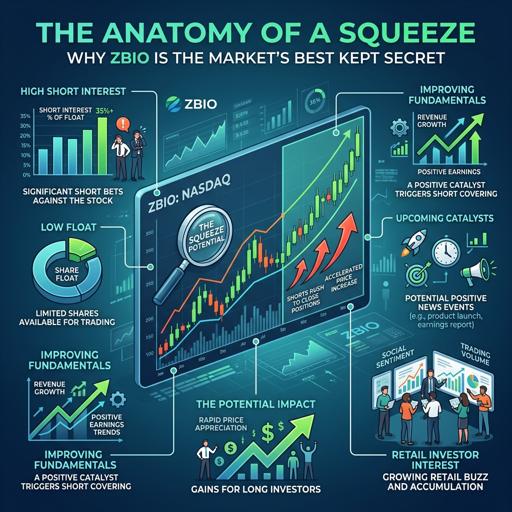
The most explosive element of the ZBIO thesis lies in the short interest data. The bears have overstayed their welcome to a historic degree.
Back in October 2025, the short interest sat at a manageable 4.7 million shares. By the April 15, 2026 settlement date, that figure had ballooned to an astronomical 10.22 million shares. To put that in perspective, 45.14% of the float is currently sold short.
The shorts aggressively piled into the $20 offering, assuming the stock would break lower and stay down. But with the CEO aggressively buying the sub-$20 liquidity, the technicals bottoming out (a confirmed "Golden cross below zero" flashed on May 4, supported by multi-timeframe lows in late April), and institutional accumulation confirmed by the off-exchange metrics, the shorts are completely trapped.
The Catalyst For Ignition
With the stock currently hovering just above the $20 institutional offering line, the downside is incredibly protected. We have a known catalyst approaching: the next earnings report is scheduled for May 21, 2026. This report sits squarely in the Q2 FDA submission window for Obexelimab.
Any positive corporate update regarding the FDA filing timeline will act as a match in a powder keg. When 45% of the float is forced to cover simultaneously in a stock with high institutional ownership and a float that is actively being locked up by the CEO, the resulting price action is violent.
ZBIO is not just another biotech binary event. It is a masterclass in market misdirection. The shorts bet against the financing, but they bet against a fully funded balance sheet, an incoming regulatory catalyst, and a CEO who is personally buying every share they sell. The smart money has already positioned itself off-exchange. The question is, will you be there before the squeeze?
Sponsored