The GLP-1 Myopia: Why Wall Street Just Handed Us Wave Life Sciences at a 65% Discount
BullishStrongChange from report: -36.3%1M: +7.2%3M: -14.5%
Published on 2026-04-01 by TradeFomo
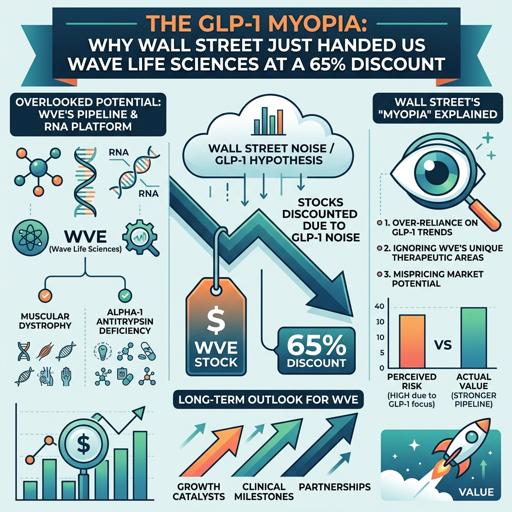
The market has a persistent, almost pathological habit of punishing nuance. When Wall Street finds a shiny new paradigm—in this case, the GLP-1 weight-loss craze driven by Eli Lilly and Novo Nordisk—it grades every other asset on a binary scale. If a new obesity drug doesn't melt off 15% of total body weight in a matter of months, it is summarily executed.
On March 26, 2026, Wave Life Sciences (WVE) faced the firing squad. The stock plummeted nearly 50% in a single session, cratering from $12.30 to $6.20 on a staggering 50.1 million shares traded (more than 13 times its normal volume). The trigger? The interim Phase 1 data for its obesity drug, WVE-007.
Mainstream analysts took one look at the headline—a mere "-1% body weight" reduction at six months—and dumped the stock. But when you look beneath the algorithm-driven panic, a vastly different, deeply contrarian thesis emerges. Wave Life Sciences is not a failed GLP-1 competitor. It is a misunderstood pioneer in RNA editing with a fortress balance sheet, and smart money is quietly buying the blood in the streets.
The Anatomy of a Market Overreaction
To understand the WVE opportunity, we have to look at what the Phase 1 INLIGHT trial actually achieved, rather than what the market wanted it to achieve.
The data showed that a single 240 mg dose of WVE-007 led to a 14% placebo-adjusted reduction in visceral fat and a 5% reduction in total fat, alongside durable suppression of serum Activin E. Most importantly, it achieved a 2% stabilization/increase in lean mass.
Wall Street is grading a scalpel as if it were a sledgehammer. The dirty secret of the GLP-1 miracle drugs is that they strip away muscle mass almost as fast as they strip away fat. WVE-007, an INHBE GalNAc-siRNA, is doing something entirely different: it is prioritizing the quality of weight loss. By preserving lean muscle and aggressively targeting toxic visceral fat, WVE-007 is positioning itself not as a Wegovy replacement, but as the ultimate, necessary adjunctive therapy to incretins.
The market dumped WVE because it didn't win a footrace it was never running.
Follow the Smart Money, Not the Herd
If the data was truly a disaster, the insiders would be the first to quietly exit. Instead, they backed up the truck.
On March 30, just days after the crash, RA Capital Management—one of the sharpest biotech funds in the space, whose Managing Partner Dr. Peter Kolchinsky sits on Wave's board—filed an amended Schedule 13D. Between March 26 and March 30, right into the teeth of the retail panic, RA Capital unleashed its working capital to purchase 7,221,422 ordinary shares for approximately $54.7 million.
Let that sink in. A board member's fund didn't just hold their position; they aggressively accumulated 7.2 million shares on the open market to bring their total ownership to 17.5%. They were providing the liquidity for the panic-sellers. When an insider drops $55 million in three days following a 50% haircut, they are screaming that the market has mispriced the asset.
The Institutional Bedrock
RA Capital isn't alone. The institutional ownership roster is a "who's who" of patient capital. As of recent filings, FMR LLC (Fidelity) holds 8.5% (15M shares), Adage Capital holds 5.35% (9.7M shares), and pharma giant GSK holds a massive 18.2M share stake.
The Balance Sheet Anomaly: Buying Assets for Free
Perhaps the most absurd aspect of the current $6.62 share price is the math. At the end of 2025, WVE reported approximately $602.1 million in cash and cash equivalents.
Just four months ago, in December 2025, Wave completed a massive $402.5 million public offering. The price of that offering? $19.00 per share.
With ~167.1 million shares outstanding today, WVE's market cap sits at roughly $1.1 billion. If you strip out the $602 million in cash, the enterprise value of the entire company is around $500 million. This cash runway extends deep into Q3 2028, completely removing the dreaded dilution overhang that typically plagues clinical-stage biotechs.
You are currently able to buy WVE for nearly a third of what premier institutional investors eagerly paid in December, with a cash cushion that covers half of the current market capitalization.
The Hidden Gem: WVE-006 and the RNA Editing Monopoly
Because the market is myopically focused on the obesity data, it is assigning near-zero value to Wave's core RNA editing franchise.
In February 2026, WVE regained full rights from GSK for WVE-006, their RNA editing therapeutic for alpha-1 antitrypsin deficiency (AATD). AATD affects over 200,000 individuals in the U.S. and Europe, representing a multi-billion dollar total addressable market with severe unmet needs. By taking back this asset, WVE now owns 100% of the upside. They are already engaging the FDA on an accelerated approval pathway, with critical regulatory feedback expected by mid-2026.
Any positive whisper from the FDA regarding WVE-006 will force the market to rapidly reprice the company as a late-stage rare disease play, completely independent of the obesity narrative.
Technical Exhaustion: The Rubber Band is Stretched
From a purely technical standpoint, WVE is experiencing a historic capitulation event.
- Deep Oversold Territory: As of March 30, the 14-day RSI sits at a crushing 22.7, having dipped below 20 on March 26. This is textbook technical exhaustion.
- Abnormal Volume Washout: The 50 million shares traded on March 26 represented an 18x multiple over the 20-day moving average. This kind of volume signifies a complete transfer of ownership from weak hands (momentum-chasing retail) to strong hands (RA Capital and value institutions).
- MACD & Divergence: The MACD lines have been dragged deep below the zero line, setting up the potential for a violent mean-reversion trade once the selling pressure evaporates.
The Verdict: Asymmetry in Action
The greatest investments are born from structural market misunderstandings. The Street wanted a miracle fat-burner; Wave Life Sciences delivered a nuanced, muscle-preserving metabolic modulator. The resulting 50% haircut has created a profound asymmetry.
At $6.62, downside is heavily buffered by $602 million in cash and ravenous insider buying from RA Capital. The upside, driven by the upcoming Phase 2a INLIGHT trials, the mid-2026 FDA feedback on WVE-006, and the sheer mean-reversion of an oversold stock, is asymmetric.
Wall Street threw the baby out with the bathwater. Now, we get to buy the baby at a 65% discount to its December valuation.