In This Article:
VOR
Sponsored
The Great Biotech Heist: How Smart Money Washed Retail out of VOR Biopharma
BullishStrongChange from report: +26.5%1M: -20.4%3M: +5.8%
Published on 2026-04-01 by TradeFomo
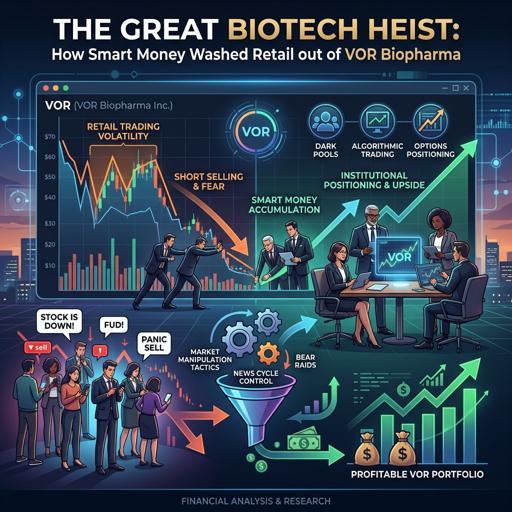
If you want to understand how institutional money extracts wealth from the public markets, you don't need a textbook. You just need to look at the SEC filings for Vor Biopharma (VOR) over the last six months.
To the untrained eye, VOR’s chart looks like a typical biotech bloodbath: a 1-for-20 reverse split in September 2025, a fleeting spike to the $40s, and a brutal, grinding descent back to the $14 range by late March 2026. The retail narrative is that the company is burning cash and diluting shareholders to death.
But if you actually read the filings, a completely different story emerges. What we are witnessing is a masterfully orchestrated cap table cleansing, a "roundtrip" trade by top-tier funds, and the creation of a massive cash fortress that the market is currently mispricing.
Here is why VOR is currently one of the most asymmetric setups in the biotech sector.
The Anatomy of a Cap Table Cleansing
In September 2025, VOR executed a 1-for-20 reverse split. The stock mechanically adjusted into the $30s, temporarily creating an illusion of strength. What happened next was a masterclass in institutional distribution.
Through October, legacy holders began dumping into the liquidity. Form 4 filings show Reprogrammed Interchange LLC (linked to Reid Hoffman) systematically unloading hundreds of thousands of shares between $30 and $37.
But the real tell was RA Capital Management. Between mid-October and late October, RA Capital aggressively sold down their position, unloading massive blocks of shares at weighted average prices between $28 and $31. They reduced their ownership from over 31% to roughly 11%.
Retail investors saw the plummeting price and panicked, assuming the underlying clinical thesis was dead. It wasn't. The smart money was just clearing the deck for the next phase.
The "Roundtrip" Masterclass
By November and December 2025, the relentless selling had crushed VOR's stock price down to the $10 range. Retail was washed out, sentiment was abysmal, and the stock looked radioactive.
Then, the trap snapped shut.
In November, VOR priced a $100M public offering at $10.00 per share. A month later, in December, they announced a massive $150M private placement (PIPE) at $10.81 per share.
Who was the lead buyer in that December PIPE? RA Capital.
They bought back 4.6 million shares at $10.81—the exact same shares they had dumped on the open market at $30 just two months prior. This is the Wall Street "roundtrip." They legally shorted their own book, forced the price down, and bought back in at a 60% discount to recapitalize the company.
At the exact same time, to ensure management didn't jump ship after the brutal price action, the Board repriced over 5.2 million executive stock options down to $8.18 per share. The insiders and the institutions reset their cost basis at the absolute bottom.
The Short Interest Mirage and PIPE Arbitrage
If you look at VOR's short interest today, it looks terrifying. Short interest exploded from a mere 226,000 shares in November 2025 to over 3.4 million shares by mid-March 2026.
A novice looks at a 1,400% increase in short interest and assumes catastrophic fundamental failure. A professional looks at it and sees mechanical PIPE arbitrage.
When hedge funds buy into a private placement (like the $150M December PIPE or the recent $75M March PIPE at $14.05 led by TCGX), those shares are unregistered. To lock in the spread and hedge their exposure, these funds aggressively short the common stock. This creates artificial, mechanical downward pressure on the stock price.
This is not a fundamental bet against VOR's science; it is a structural trade. Once the SEC declares the resale registration statements effective, the arbitrageurs will deliver their PIPE shares to cover their shorts. The short interest will vanish overnight, and the artificial selling pressure suppressing the stock will evaporate.
Trading at a Negative Enterprise Value
Thanks to this aggressive recapitalization, VOR is now sitting on a dragon's hoard of cash.
Per the company's January 8-K, they ended 2025 with $450 million in cash and short-term investments. In late March 2026, they added another $75 million via the TCGX PIPE. That puts their current cash balance north of $520 million.
The company has explicitly stated this cash provides a runway through mid-2028. The existential financing risk that plagues 90% of the biotech sector has been completely removed. Yet, because of the mechanical shorting and retail capitulation, the stock at $14.70 is trading at a deep discount to the intrinsic value of its cash and late-stage pipeline.
The Free Call Option: Telitacicept
The market is pricing VOR as if its pipeline is worthless, which contradicts the actual clinical data.
In October 2025, VOR dropped 48-week Phase 3 data for Telitacicept in primary Sjögren’s disease, showing highly statistically significant and clinically meaningful improvements across multiple endpoints (ESSDAI, ESSPRI). Telitacicept is a dual BAFF/APRIL inhibitor that is showing best-in-class potential in B-cell driven autoimmune diseases.
They are currently running two massive global Phase 3 trials:
- Sjögren's Disease (NCT07404865)
- Generalized Myasthenia Gravis (NCT06456580) - Topline data expected 1H27.
You are effectively buying over half a billion dollars in cash at a discount, and getting a de-risked, late-stage autoimmune pipeline for free.
The Setup
VOR is the ultimate contrarian setup. The retail wash-out is complete. The cap table has been cleansed and handed over to elite biotech specialists like RA Capital, Forbion, Frazier, and TCGX. Management’s options have been repriced to $8.18, aligning their incentives perfectly with a turnaround.
Right now, the stock is being artificially pinned by mechanical short selling tied to PIPE arbitrage. But the spring is coiling. When the registration statements clear and the mechanical shorting ceases, the market will wake up to a fully-funded, Phase 3 biotech trading at an absurd valuation.
Watch the filings, not the chart. The smart money already placed their bets.
Sponsored