In This Article:
TH
Sponsored
The Pickaxes of the AI Gold Rush: Why Target Hospitality (TH) is the Backdoor Data Center Play You Missed
BullishStrongChange from report: +49.6%1M: +9.2%3M: +33.1%
Published on 2026-04-02 by TradeFomo
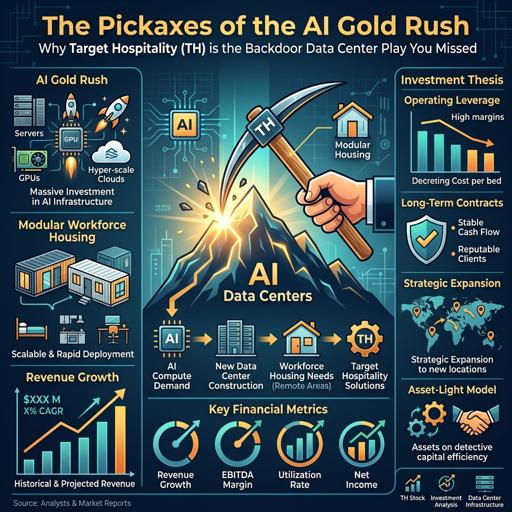
If you want to find generational value in the market, you have to look where the crowd has given up, pack up their spreadsheets, and walked away. For the last eighteen months, Wall Street looked at Target Hospitality Corp. (TH) and saw a decaying modular housing company anchored to cyclical oil patches and lost government contracts. When TH lost the Pecos Children's Center contract, the algorithmic selling sent the stock into the abyss, languishing in the $6 to $7 range throughout late 2025. The narrative was set: a structurally impaired business in terminal decline.
But narratives are often the enemy of math. While retail and passive funds were busy writing the obituary for TH, the underlying mechanics of the company were quietly pivoting toward the most capital-intensive secular trend of our generation: Artificial Intelligence infrastructure.
On April 1, 2026, TH violently broke the narrative, gapping up over 36% to close at $12.66. The street is treating this as an anomaly. They are wrong. This is a structural regime shift.
Left for Dead in the Oil Patch
To understand the magnitude of the shift, we have to look at the setup. By the end of 2025, TH reported a full-year net loss of $37.1 million and saw its revenue drop to $320.6 million. The consensus was bleak. But look at what the insiders were doing while the stock bled. In November 2025, Director Stephen Robertson acquired 145,000 shares on the open market at $6.85, a massive vote of confidence when blood was in the streets.
Why was smart money accumulating? Because data centers, the beating heart of the AI revolution, are facing a critical bottleneck: power and geography. Hyperscalers are being forced to build massive, multi-gigawatt campuses in increasingly remote locations where power grids can handle the load. But remote locations lack housing for the thousands of specialized construction and maintenance workers required to build these modern coliseums.
Enter Target Hospitality.
The April 1 SEC 8-K filing revealed a multi-year contract with a top-five hyperscaler to build a specialized community in North Texas accommodating 4,000 individuals. This single "Data Center Hub Contract" guarantees over $550 million in minimum revenue over five years. Let that sink in. A company with a $1.26 billion market cap just locked in over half a billion in high-margin, committed revenue from a single non-cyclical tech client, completely decoupling its fate from the volatility of crude oil and government border policy.
Peering into the Dark Pools: Institutional Footprints
To truly appreciate the mechanics of this breakout, we must dedicate a specific analysis to the hidden liquidity tape, jointly analyzing the interplay among four critical metrics: the off-exchange trade ratio (trf_ratio), the off-exchange short volume ratio (short_pct), the volume z-score (vol_z_score), and the rolling close position value (rolling_cpv). In the final trading sessions of March, right before the 8-K dropped, these metrics painted a perfect picture of stealth institutional accumulation. On March 31, the trf_ratio spiked to nearly 37.8% (189k off-exchange TRF volume against a total market volume of 501k), yet the short_pct (represented by the smoothed svr_ewma) remained heavily subdued at just 38.1%. This combination is a massive tell: smart money was crossing large blocks off-exchange, completely devoid of the aggressive shorting that typically accompanies high dark pool volume. When the news finally broke on April 1, the vol_z_score violently exploded to an extreme 8.93, a 22x multiple of its 5-day average volume, shattering the quiet accumulation phase. Crucially, the rolling_cpv settled at 0.509. Despite a monstrous 36% intraday gap-up, this neutral-to-bullish close position value indicates that buyers stepped up to absorb any profit-taking, sustaining the premium right into the closing bell. When trf_ratio silently elevates just before vol_z_score hits a historic extreme without a breakdown in rolling_cpv, it is the quintessential footprint of a structural, institutionally backed trend reversal.
The Contrarian Reality: Why the Squeeze is Just Beginning
If you run a basic technical screener today, it will tell you that TH is flashing red. The RSI sits at a blistering 82.6, screaming "overbought." Conventional wisdom dictates that you wait for a pullback to fill the gap.
This is where conventional wisdom gets you killed in a regime-shift market. Overbought is a momentum feature, not a bug, when a stock fundamentally alters its total addressable market.
The Short Fuel
Look at the structural short positioning. Heading into mid-March 2026, short interest sat at roughly 2.64 million shares—about 8.3% of the float. These shorts were heavily entrenched, betting on the continued deterioration of the legacy government and oilfield contracts. Now, they are trapped in a company that just revised its 2026 Adjusted EBITDA outlook to $70-$80 million with a run-rate exceeding $160 million by mid-2027. The scramble to cover 2.6 million shares into a stock where institutions are firmly holding their fresh positions will create explosive upside volatility.
Options Market Dislocation
The options market was caught entirely off-guard. On April 1, option volume exploded to over 5,400 contracts (compared to an average of ~150-300 in the preceding days), heavily skewed towards calls. But here is the catch: open interest across the chain is overwhelmingly concentrated in out-of-the-money puts from institutions hedging the downside risk that never materialized. As market makers unwind these deltas, the forced buying of underlying stock will act as a secondary tailwind.
The Bottom Line
Target Hospitality is no longer a specialty housing company serving oil rigs. It is now an indispensable, backdoor infrastructure play on the hyperscaler AI buildout. The market is currently valuing the April 1 announcement as a one-off "lucky" contract. The contrarian insight is realizing that this is a proof-of-concept. Every major tech giant is facing the exact same logistical nightmare in building remote data centers. Target Hospitality just wrote the playbook for how to solve it.
The volume z-score of 8.93 isn't the climax of this trade; it's the opening bell. The smart money saw the pivot coming, positioned themselves in the dark pools, and are now letting the trapped shorts and momentum algos do the heavy lifting. Forget the overbought RSI—the repricing of TH has only just begun.
Sponsored