In This Article:
TBPH
Sponsored
The Phase 3 Failure That Secretly Saved Theravance Biopharma (TBPH)
BullishStrongChange from report: +12.1%1M: +10.7%3M: +16.1%
Published on 2026-03-26 by TradeFomo
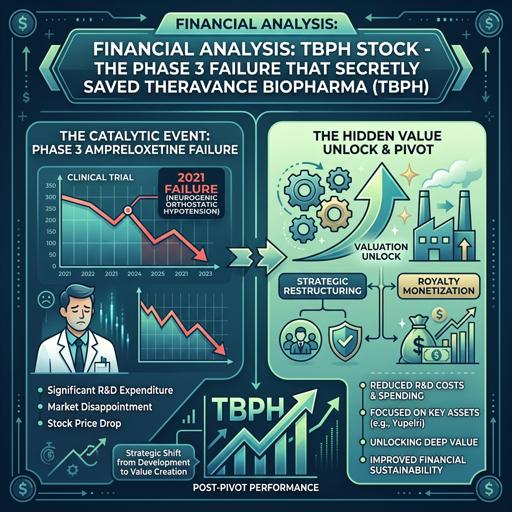
A Biotech Nightmare or a Value Investor's Dream?
On March 3, 2026, the biotech market executed its favorite knee-jerk playbook: dump the stock. Theravance Biopharma (TBPH) announced that its Phase 3 CYPRESS study evaluating ampreloxetine for symptomatic neurogenic orthostatic hypotension (nOH) failed to meet its primary endpoint. Predictably, retail and institutional biotech momentum chasers hit the exits in unison.
The stock cratered 26% in a single day, dropping from $18.95 to $13.96 on a massive volume of 4.39 million shares—nearly 9 times its three-month average. The Relative Strength Index (RSI) plunged to a deeply oversold 23. Wall Street analysts quickly wrote the company off as another clinical-stage casualty.
But if you look under the hood, a completely different story is emerging. The failure of ampreloxetine isn't a death sentence for Theravance; it is the catalyst that forces a massive unlocking of shareholder value. This is a classic case of mistaken identity. The market is pricing TBPH like a busted clinical-stage biotech burning cash to stay alive. In reality, it has just transformed into a highly profitable, cash-generating royalty and commercial holding company trading at a distressed valuation.
The Math That Wall Street is Missing
Let's break down the actual financial reality of TBPH right now, completely ignoring any pipeline hopium.
At the current share price of $15.29, Theravance has a market capitalization of approximately $756 million.
According to their March 2026 filings, management expects to hold roughly $400 million in cash and cash equivalents by the end of Q1 2026, with zero debt on the balance sheet. Subtract the cash from the market cap, and you are left with an Enterprise Value (EV) of just $356 million.
What are you getting for that $356 million?
- YUPELRI: Theravance's commercial asset, YUPELRI, is a cash cow. The drug pulled in $266.6 million in net sales in FY 2025 (a 12% year-over-year increase).
- TRELEGY Royalties: The company's economic interest in GSK's TRELEGY generated a $50 million milestone payment recently, and Theravance is explicitly guiding for another $100 million milestone payment in 2026.
- The R&D Cost Collapse: Because ampreloxetine failed, the company is aggressively winding down its R&D and heavily reducing its G&A functions. This restructuring will slice operating expenses by 60%, removing $70 million in annual cash burn.
With the cash burn eliminated, management projects that starting in Q3 2026, the remaining streamlined operations will generate $60 million to $70 million in annualized cash flow.
If you strip out the impending $100 million TRELEGY milestone from the EV, you are buying a business generating $60-$70 million in free cash flow for an adjusted enterprise value of roughly $256 million. That is a multiple of less than 4x free cash flow. In the pharmaceutical sector, this kind of multiple is almost non-existent unless a company faces imminent bankruptcy—which Theravance, with $400 million in the bank, certainly does not.
Follow the Smart Money and the Activists
Biotech investors flee from failed drug trials, but deep value and activist funds run toward them when the balance sheet is this dislocated.
On March 25, 2026, an amended Schedule 13D filing revealed that Weiss Asset Management LP controls a massive 14.5% of outstanding shares (over 7.45 million shares). When an activist entity like Weiss holds a position this large, management's feet are held to the fire.
We are already seeing the results of this pressure. In tandem with the R&D shutdown, Theravance's Board has accelerated the mandate of its Strategic Review Committee to "explore a sale of the company" or other value-maximizing alternatives.
The options market is catching onto this floor as well. Following the massive put volume that drove the price down in early March, we've seen a stabilization in the underlying price action and a MACD golden cross below zero triggered on March 20. Institutional call writing and heavy open interest around the $15 strike suggest smart money is positioning for a buyout or a massive special dividend.
The Contrarian Verdict
Biotech analysts are trained to model future cash flows based on clinical trial success probabilities. When a lead asset fails, their models break, and they issue downgrades. But Theravance is no longer a biotech company—it is a distressed asset play.
The ampreloxetine failure was actually a blessing in disguise for value investors. It stopped management from incinerating future cash flows on high-risk clinical trials and forced them to pivot to strict capital preservation.
You are looking at a debt-free company with $400 million in cash, a commercial drug growing double-digits, a $100 million near-term royalty milestone, and a mandate to sell itself—all trading for an enterprise value under $400 million. Wall Street is selling the clinical failure. We are buying the balance sheet.
Sponsored