The $7 Illusion: Why Wall Street's Short-Termism Has Grossly Mispriced ARS Pharmaceuticals (SPRY)
BullishStrongChange from report: -48.0%1M: +0.6%3M: +1.5%
Published on 2026-03-25 by TradeFomo
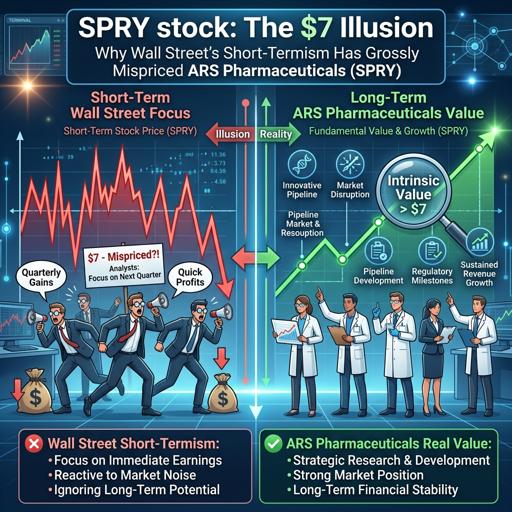
If you want to find generational asymmetric opportunities in the market, look for the point of maximum disconnect between Wall Street's spreadsheet-driven panic and the underlying structural reality of a business.
Right now, ARS Pharmaceuticals (SPRY) is the poster child for this disconnect.
Over the past year, SPRY has been severely punished, enduring a staggering 60% haircut from its mid-2025 highs of over $18 down to $7.54 today. The superficial narrative is easy to digest: the company reported a massive $171.3 million net loss in 2025 as it rolled out its needle-free epinephrine nasal spray, neffy. The algorithms and momentum traders saw the cash burn, saw the lack of immediate bottom-line profitability, and indiscriminately dumped the stock.
But if you look under the hood—at the insider incentive structures, the smart money accumulation, and the fundamental market dynamics—you will realize that Wall Street is falling into the classic "commercial launch trap," pricing a budding monopoly as if it were a distressed asset.
The Classic "Commercial Launch" Trap
It is a tale as old as biotech itself: a company gets FDA approval for a revolutionary product, the stock pops, and then reality sets in. Commercializing a drug requires an upfront explosion in SG&A (Selling, General, and Administrative) expenses to build out a sales force and launch direct-to-consumer marketing.
In Q4 2025, ARS Pharma reported $28.1 million in total revenue ($20.3 million net from U.S. neffy sales), bringing the full-year 2025 revenue to a highly respectable $84.3 million. Yet, the market fixated on the $171.3 million net loss.
Here is the contrarian reality: ARS is spending aggressively because neffy has the potential to completely disrupt the archaic, needle-based epinephrine market (historically dominated by the EpiPen). You do not capture a multi-billion dollar Total Addressable Market by penny-pinching in year one. They are expanding their sales force from 106 to 150 representatives by Q2 2026.
More importantly, they can afford to. The company ended 2025 with $245 million in cash and short-term investments. In September 2025, they secured a $250 million credit facility from RA Capital, pulling down an initial $100 million tranche. Bankruptcy or dilutive equity raises are nowhere on the immediate horizon. At a current market cap of just $745 million, the Enterprise Value of this business is roughly $500 million. Valuing an absolute disruptor at ~6x EV/Revenue during its hyper-growth launch phase is a gross miscalculation by the market.
The $11.49 Strike Price: The Ultimate Insider "Tell"
While retail investors and momentum algos are panic-selling SPRY at $7.50, the company’s management team is quietly setting up for a massive payout at a much higher valuation.
If you dig into the Form 4 filings from January 2, 2026, you will find a highly coordinated and massive grant of stock options to the entire C-suite:
- CEO Richard Lowenthal received 875,000 options directly, plus another 240,000 indirectly.
- CMO Sarina Tanimoto received 240,000 options directly and 875,000 indirectly.
- CFO Kathleen Scott, CLO Alexander Fitzpatrick, CBO Justin Chakma, CCO Eric Karas, and COO Brian Dorsey each received 240,000 options.
Here is the kicker: Every single one of these millions of options was granted with a strike price of $11.49.
With the stock currently languishing at $7.54, these options are deeply underwater right out of the gate. Management gets absolutely nothing from these grants unless they can drive the stock price significantly above $11.49. When the entire executive team locks in an incentive structure that requires a +50% rally just to break even on their compensation, it signals supreme confidence in the commercial trajectory of neffy.
(Note: There was some insider selling in November 2025 by Chakma and Dorsey in the $8.70-$8.90 range, but these were relatively small option-exercise conversions for tax/liquidity purposes compared to the massive January grants).
The "Smart Money" is Accumulating the Blood in the Streets
The smartest players in biopharma are not selling; they are actively loading the boat. The 13G and 13F-HR filings over the past few months paint a picture of institutional accumulation:
- RA Capital Management (the same firm that provided the $250M debt lifeline) is the largest holder with 10.86 million shares.
- Rubric Capital Management filed a 13G in mid-February 2026, revealing they initiated a massive 6.27% stake (6.2 million shares) by the end of 2025.
- Millennium Management just updated their 13G in late March 2026, increasing their stake significantly to 5.4% (5.39 million shares).
- BlackRock crossed the 5% threshold, holding 5.08 million shares.
When heavyweights like RA Capital, Orbimed, Millennium, and Rubric are aggressively accumulating shares of a $7 stock while the technical indicators flash "multi-timeframe lows" and "potential bottom confirmed" throughout February and March 2026, it pays to pay attention. The selling exhaustion is palpable.
The Catalyst Pipeline: Killing the EpiPen
While Wall Street is hyper-focused on the quarterly cash burn, ARS Pharma is quietly preparing the clinical data needed to cement neffy as the gold standard in allergy treatment.
The company is currently running a Phase 4 study directly evaluating the safety and efficacy of neffy versus Intramuscular Adrenalin (the standard EpiPen) in patients experiencing allergic reactions. The estimated primary completion date for this trial is April 2026. If the data conclusively shows that neffy is equal to or superior to an intramuscular needle in a real-world setting, it will effectively destroy the last remaining moat of legacy auto-injectors.
Furthermore, ARS is not a one-trick pony. They are expanding into Chronic Spontaneous Urticaria (CSU) with ARS-2, currently in Phase 2 trials expected to read out in June 2026.
The Verdict
Wall Street hates uncertainty and despises cash burn, which is why they have compressed ARS Pharmaceuticals to a $745 million market cap. But the math and the incentives do not support this bearishness.
You have a company sitting on a quarter-billion in cash, generating an $84 million run-rate in its first real commercial year, backed by a premier biotech hedge fund (RA Capital), with an executive team financially incentivized to push the stock above $11.49, and a catalyst in April 2026 that could definitively prove their product is superior to a legacy monopoly.
The technicals show the stock is completely washed out, forming a deep quarter low. The smart money is buying. The insiders are aligning for a re-rating. At $7.54, the market is offering you a localized bottom on a highly disruptive asset. When the commercial leverage finally kicks in later this year and cash burn begins to narrow, the analysts will suddenly "rediscover" this stock—but by then, the $7 entry point will be a distant memory.