In This Article:
RKLB
Sponsored
Rocket Lab (RKLB): The Stealth Re-Accumulation Following the Great Distribution
BullishStrongChange from report: -3.3%1M: +75.8%3M: +23.7%
Published on 2026-04-09 by TradeFomo
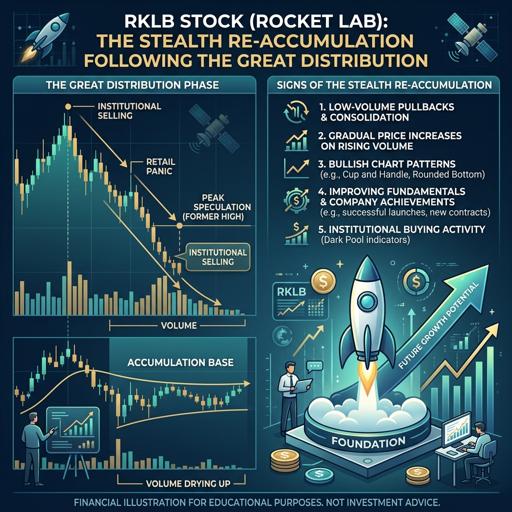
The mainstream financial media loves a simple narrative. For Rocket Lab (RKLB), that narrative has been neatly packaged: massive revenue growth, a staggering $1.85 billion backlog, a monumental $816 million Space Development Agency (SDA) contract, and the inevitable rise of the "next SpaceX."
Retail investors bought this story aggressively, chasing the stock to a multi-year high of $96.30 in mid-January 2026. Yet, by late March, the stock had plummeted to $57.38. The retail crowd is currently scratching their heads, wondering why a company with consecutive record-breaking quarters and 100% launch success is trading 30% below its peak.
To understand why, you have to look past the press releases and the breathless analyst upgrades. You have to look at the dark pools, the insider distribution schedules, and the covert unwinding of institutional short positions.
The Anatomy of a Planned Exit
If you want to know what the smart money is doing, watch the insiders. Not what they say, but what they file.
Between Q4 2025 and Q1 2026, Rocket Lab underwent a massive, perfectly legal distribution phase. Early venture backers like Khosla Ventures distributed millions of shares to their partners, creating a steady stream of structural selling pressure. Meanwhile, C-suite executives—including CFO Adam Spice and COO Frank Klein—were consistently selling large blocks of shares. While much of this was coded as "covering tax obligations," the sheer volume of the distribution provided significant overhead resistance.
But the most fascinating move came from CEO Peter Beck in late March 2026. In a masterstroke of capital efficiency and optics, Beck voluntarily canceled 392,155 of his unvested RSUs to redirect capital to R&D. On the surface, this is an incredibly bullish signal of a founder prioritizing the company's balance sheet over his own dilution. However, on the exact same day, he established a Rule 10b5-1 plan to sell up to 5 million shares (over 10% of his holdings).
The C-suite knows the company is transitioning from a scrappy startup to a mature prime contractor. They used the late 2025 retail hype (driven by the SDA contract) as a liquidity event. But here is the contrarian take: The distribution phase is over.
Decoding the Dark Pools: The Four-Pillar Metric Analysis
To truly understand the hidden mechanics driving RKLB right now, we must analyze the interconnected relationship between four critical market microstructure metrics: trf_ratio (off-exchange trade reporting facility volume), short_pct (off-exchange shorting percentage), vol_z_score (volume anomalies), and rolling_cpv (rolling close position value). Merging these indicators reveals the covert actions of institutional players—whether they are stealthily accumulating or quietly distributing under the radar.
During the stock's January 2026 peak near $96, we saw a classic institutional trap: vol_z_score spiked above 1.1, but it was accompanied by dangerously high off-exchange shorting (short_pct equivalent pushing 0.56 to 0.59) and a rapidly deteriorating rolling_cpv. Institutions were using retail buy volume as exit liquidity, hammering the bid in the dark pools. However, fast forward to late March and early April 2026, and the paradigm has entirely flipped. We recently witnessed high vol_z_score readings (such as the 1.90 spike on March 20 and 1.60 on March 25) converging with high trf_ratio activity. Crucially, this time, the short_pct dropped significantly into the low 0.40s, while the rolling_cpv stabilized and began sloping upward (hitting 0.50 by late March). When trf_ratio and vol_z_score hit extreme levels simultaneously, it signals the ignition of a new trend. Because this volume anomaly is paired with a declining short_pct and a rising rolling_cpv, it confirms that institutions have stopped suppressing the price. Instead, they are actively hiding their bid, absorbing the last of the retail panic selling. This is textbook stealth re-accumulation at the $60-$65 floor.
The Phantom Short Squeeze
If you are holding RKLB calls expecting a massive short squeeze, you are fighting the last war.
In September 2025, RKLB's short interest was sitting at a hefty 12.04% of the float. Shorts were betting heavily against the company's ability to scale Neutron and maintain gross margins. They were wrong. The Q3 and Q4 2025 earnings obliterated the bearish thesis, and the shorts were forced to cover.
Look at the data: Short interest has aggressively cascaded down over the last six months. By January 2026, it was down to 7.85%. As of mid-March 2026, it has collapsed to just 4.47%.
The massive rally from $45 in late 2025 to $96 in January 2026 was the short squeeze. The shorts have already capitulated. The current price action is entirely organic, driven by institutional re-positioning rather than forced buy-ins.
The Fundamental Floor and the Technical Ignition
With the short squeeze over and the insider distribution largely absorbed, RKLB is now trading on pure fundamentals. And the fundamentals are terrifyingly strong for a company currently valued just under $40 billion.
- Revenue Trajectory: Q1 2024 saw $92.7M in revenue. By Q4 2025, that skyrocketed to $179.6M. They are effectively doubling their top line every two years.
- Gross Profit: Climbing steadily, reaching $68.2M in Q4 2025.
- Cash Position: Sitting on an $833M war chest as of Q4 2025, ensuring they have the runway to bring the Neutron rocket to its targeted Q4 2026 launch despite the recent Stage 1 tank hydrostatic test rupture.
The Technical Verdict
The technicals are perfectly aligning with the dark pool data. RKLB triggered multiple "Quarterly Low" and "Potential Bottom" signals in the high $50s and low $60s throughout late March 2026. On March 25 and again on April 6, the MACD flashed a "Golden Cross below zero."
This is the exact setup you want to see for a long-term position. The hype has cooled, the retail tourists have been washed out by the 30% drawdown, and the institutions are utilizing dark pools to build their core positions before the Neutron launch catalysts begin to price in later this year.
Forget the noise. Forget the SpaceX comparisons. Rocket Lab has quietly established a concrete floor around $60, built on a $1.85 billion backlog and the exhaustion of sellers. The smart money is buying the dip. Are you?
Sponsored