In This Article:
PHAT
Sponsored
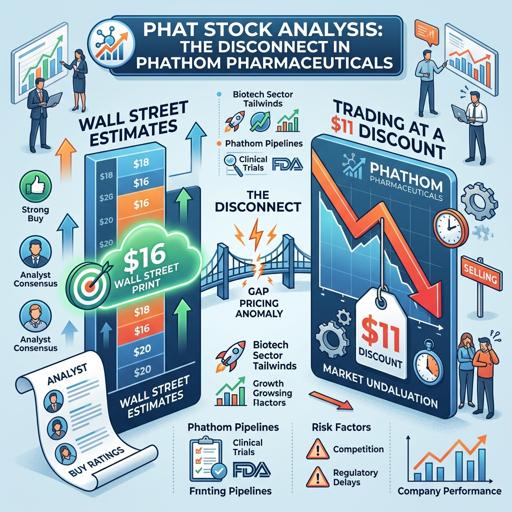
The Disconnect in Phathom Pharmaceuticals: A $16 Wall Street Print Now Trading at an $11 Discount
BullishStrongChange from report: -29.2%1M: +15.0%3M: +2.7%
Published on 2026-03-23 by TradeFomo
If you want to find mispriced assets in today’s market, you have to look where the retail crowd has capitulated, where the technicals look terrible, and where the fundamentals are quietly exploding to the upside. Phathom Pharmaceuticals (PHAT) is currently offering exactly this kind of textbook asymmetry.
In early January 2026, PHAT was trading at $18. Fast forward to today, late March 2026, and the stock is hovering around $11.21. A quick glance at the chart shows a broken stock triggering "dead crosses" and hitting half-year lows. But if you dig into the SEC filings, the institutional ownership, and the options data, a completely different picture emerges.
Here is why the market is dead wrong about Phathom.
The Anatomy of a Capitulation: Why the Price Dropped
To understand the opportunity, you must first understand the drop. On January 8, 2026, Phathom announced a massive $130 million equity offering, pricing 6.87 million shares at $16.00 per share.
Secondary offerings are the ultimate buzzkill for momentum. The market despises dilution, and retail investors, seeing the share count expand, aggressively hit the bid. The technical damage was swift. Moving averages rolled over, and the algorithmic trend-followers began shorting the stock, creating a self-fulfilling prophecy that drove the price down to the $10-$11 range.
But here is the contrarian reality: Institutional underwriters like Guggenheim and Cantor Fitzgerald bought those shares at $16.00. By buying at $11.21 today, you are acquiring the exact same commercial-stage biotech at a 30% discount to the price Wall Street's sharpest players happily paid just two months ago.
The Fundamentals Are Screaming "Growth"
The irony of the current stock price is that Phathom’s underlying business has never been stronger. According to their February 26, 2026 earnings release, the company isn't just surviving; it is scaling aggressively:
- Hyper-Growth in Revenues: FY 2025 net revenues clocked in at $175.1 million, a staggering 217% increase year-over-year. Q4 2025 alone delivered $57.6 million.
- Prescription Volume: VOQUEZNA® prescriptions have surpassed the 1.1 million mark, with 273,000 filled in Q4 alone (a 24% quarter-over-quarter increase).
- The Profitability Inflection Point: Management has guided that they anticipate reaching operating profitability by Q3 2026.
Let’s do the math. At $11.21, PHAT has a market cap of roughly $797 million. Between their $130 million year-end cash balance and the $130 million raised in January, they are sitting on a fortress balance sheet. When you back out the cash, the Enterprise Value (EV) is sitting near $537 million.
You are paying an EV/Sales multiple of roughly 3x for a company growing revenues at >200% year-over-year that is fully funded to profitability. That is an absurd valuation anomaly.
Smart Money is Quietly Gorging on the Weakness
While retail traders panic-sell the technical breakdown, the "smart money" is treating this dip as a generational accumulation zone.
If you read the Schedule 13G filings, the institutional footprint is massive and growing. Frazier Life Sciences continues to hold a monstrous 12.46 million shares. Medicxi Ventures is sitting on 7.46 million shares.
Most tellingly, look at Millennium Management. While the stock was sliding in March 2026, Millennium didn't sell—they bought more. On March 12, 2026, Millennium filed a Schedule 13G revealing a 5.3% stake in the company (4.17 million shares). When one of the most sophisticated hedge funds in the world is aggressively accumulating shares during a technical breakdown, it pays to follow the money.
The Options Market Knows Something
If you want to see what the market really thinks, look at the options chain. The put/call ratios for Phathom are stunningly skewed toward calls.
Looking at recent option summaries from March 2026, the put/call open interest ratios are hovering at a remarkably low 0.06 to 0.07. There is essentially zero demand for puts. Institutional option writers and buyers are overwhelmingly positioned for upside. The volatility premium is low, and the lack of downside protection being purchased suggests that the downside is severely limited at these levels. The options market is pricing in a coiled spring.
The Hidden Catalyst: Expanding the TAM with EoE
Beyond the immediate commercial success of VOQUEZNA for Erosive GERD and Non-Erosive Reflux Disease (NERD), Phathom is quietly building a pipeline that could vastly expand its Total Addressable Market (TAM).
In late 2025, the company initiated the Phase 2 "pHalcon-EoE-201" clinical trial to evaluate Vonoprazan for Eosinophilic Esophagitis (EoE), a chronic immune system disease of the esophagus. This is a high-value, underserved market. If Vonoprazan proves effective here, it transitions from being a standard GERD treatment to a multi-indication gastrointestinal powerhouse. While topline results aren't due until 2027, the market assigns virtually zero value to this pipeline optionally today.
The Verdict
The stock market is a weighing machine in the long term, but a voting machine in the short term. Right now, the votes are being cast by momentum algorithms and panicked retail traders reacting to a secondary offering.
But the weighing machine tells a different story:
- $175 million in revenue growing at 217%.
- Fully funded to profitability in Q3 2026.
- A 30% discount to a recent Wall Street secondary offering.
- Top-tier hedge funds aggressively buying the dip.
At $11.21, the risk/reward ratio in Phathom Pharmaceuticals is violently skewed to the upside. The capitulation has already happened. The fundamentals are catching up. Eventually, the price will too.
Sponsored