In This Article:
OKUR
Sponsored
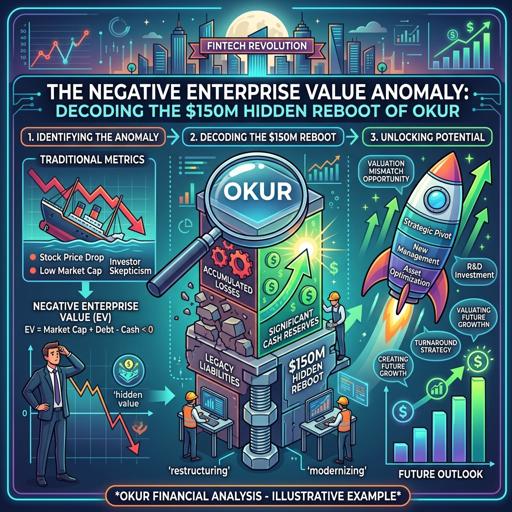
The Negative Enterprise Value Anomaly: Decoding the $150M Hidden Reboot of OKUR
BullishStrongChange from report: -32.6%1M: -10.7%3M: +2.3%
Published on 2026-04-08 by TradeFomo
The Illusion of Failure
In the algorithmic theater of modern biotechnology investing, nuance is often the first casualty. When a clinical-stage biotech announces the discontinuation of a phase-stage asset, the machines are programmed to blindly hit the bid. They lack the capacity to ask why.
On March 27, 2026, OnKure Therapeutics (OKUR) announced it was halting independent development of its PI3Kα H1047R inhibitor, OKI-219. To the untrained algorithmic eye, this looked like a clinical failure. To those of us who read SEC filings with a cynical, calculated lens, it was an act of ruthless capital discipline. OnKure didn't abandon OKI-219 because the science failed; they sidelined it because their next-generation PI3Ka pan-mutant programs (OKI-345 and OKI-355) are displaying vastly superior preclinical dominance, including massive potential in vascular anomalies.
But the real alpha isn't in the clinical pivot itself—it's in the quiet, colossal movement of capital that accompanied it.
The Math That Breaks the Efficient Market Hypothesis
If OKUR was truly a failing biotech, the smart money would be fleeing. Instead, they just bought the company.
Concurrent with the pipeline update, OnKure executed a massive $150 million private placement. The roster of participants reads like a Who's Who of apex predators in the investment world: Len Blavatnik’s AI Biotechnology seized a 19.99% stake, RA Capital locked down 9.9%, StepStone Group grabbed 6.6%, and Acorn Bioventures took 5.0%.
These leviathans cut their checks at exactly $4.15 per share. Today, the stock is trading at $4.29.
Let’s do the math that the broader market is currently too distracted to calculate. Following this private placement, OKUR has approximately 40.38 million shares outstanding, giving it a market capitalization of $173 million at current prices. However, when we add the $150 million in fresh PIPE capital to the $59.1 million in cash OKUR already held at the end of 2025, the company is now sitting on roughly $209 million in cash equivalents.
Enterprise Value = Market Cap ($173M) - Cash ($209M) = -$36 Million.
You are currently able to buy alongside billionaires at a negligible 3% premium to their entry price, while essentially being paid $36 million to take ownership of OnKure's entire next-generation oncology IP, management team, and research infrastructure. This is the definition of deep-value asymmetry.
Microstructure Footprints: The Anatomy of Accumulation
To truly decode the stealth accumulation mechanics at play, we must isolate the interplay between four specific microstructure metrics: trf_ratio (off-exchange volume ratio), short_pct (3-day EWMA of off-exchange shorting), vol_z_score (20-day volume Z-score), and rolling_cpv (rolling closing position value). On March 27, when the pipeline update and PIPE were announced, the vol_z_score registered a violent 5.29 standard deviation anomaly, while the trf_ratio simultaneously plummeted to a microscopic 12.6%—a stark contrast to its historical 35-40% baseline. As any seasoned tape reader knows, when the trf_ratio and vol_z_score simultaneously hit opposite extremes on the same day, it signals the definitive ignition of a new structural trend; the sheer size of the institutional inflow overwhelmed the dark pools, forcing execution onto the lit exchanges. During this explosive transition, the rolling_cpv skyrocketed to 0.77, confirming that relentless buy-side pressure was pinning the stock at its daily highs into the close. Meanwhile, the short_pct remained surprisingly contained around the 0.29 mark, indicating that the off-exchange shorting was merely passive market-maker liquidity provision rather than aggressive predatory selling. In the ensuing days of early April, as the vol_z_score cooled and the trf_ratio normalized back above 30%, the rolling_cpv maintained a stubbornly bullish posture (consistently remaining above 0.50), and the short_pct drifted structurally lower to 0.24. Synthesizing these four metrics yields an irrefutable conclusion: the smart money has ruthlessly absorbed the available public float, liquidity-driven shorting has exhausted itself, and the institutional "markup" phase is currently masked by controlled dark pool consolidation.
The Contrarian Verdict
The market is pricing OKUR as a busted biotech, entirely ignoring that its balance sheet has just been fortified with a nine-figure war chest by investors who generally do not lose money in this sector. The technicals show a stock that has formed a rock-solid base in the $3.90–$4.30 range, shaking out the retail weak hands while holding steady exactly where the institutional accumulation occurred.
We are staring at a negative enterprise value, a fully-funded runway through 2026, and a cap table fortified by elite institutional capital. The algorithmic repricing is coming. Until then, the smart money is quietly eating the float.
It is rarely a bad idea to sit on the same side of the table as RA Capital and Len Blavatnik—especially when the public markets are offering you their exact cost basis.
Sponsored