In This Article:
NXPI
Sponsored
The Silent Squeeze: Why NXP Semiconductors is Coiling for a Violent Reversal
BullishStrongChange from report: -3.5%1M: -3.9%
Published on 2026-08-12 by TradeFomo
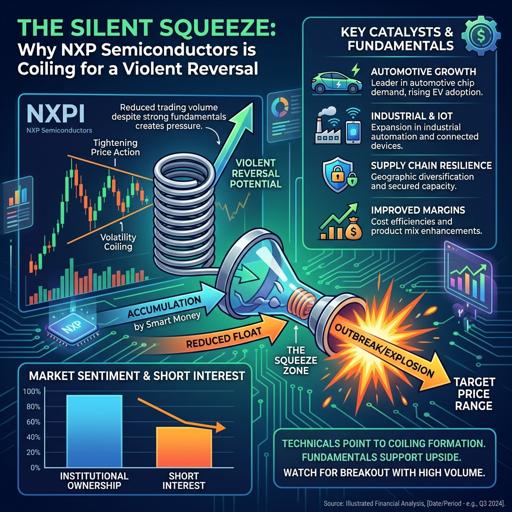
The market is currently treating NXP Semiconductors (NXPI) like a toxic asset. Down from the $330s in late May to the $230s today, retail sentiment is entirely washed out, and momentum algorithms have blindly sold the tape. But if you strip away the noise of the daily price action and look under the hood at dark pool mechanics and options flow, you will see a massive structural dislocation.
While the public was selling in panic, the smart money was quietly setting a trap. On July 27, JPMorgan Chase filed a 13G/A revealing a massive 6.6% stake in the company. Just a day later, NXP reported phenomenal Q2 2026 earnings—delivering $3.5 billion in revenue (up 19% year-over-year) with a highly profitable 35.1% non-GAAP operating margin. The market ignored the fundamentals and continued to sell. This is precisely where retail gets chopped up, and where the data-driven contrarian thrives.
Dark Pools and Hidden Accumulation
Let us peel back the curtain on the off-exchange mechanics by examining the interplay between the TRF ratio, the off-exchange short percentage, the volume Z-score, and the rolling CLV. When we merge these four metrics, they become a polygraph for institutional intent—exposing hidden shorting, covert accumulation, and glaring price-volume divergences. On August 11, we saw the TRF ratio spike to the 100th percentile alongside a severe contraction in the volume Z-score, which plummeted to -1.228. When the TRF ratio and volume Z-score hit recent extremes on the exact same day, it is a textbook signature that a new trend is about to ignite. Meanwhile, the off-exchange short percentage has cratered to the 18th percentile, proving that the dark-pool short sellers have completely exhausted their ammunition. Complementing this, the rolling CLV has sharply pivoted upward, climbing from an abysmal 0.003 in early August to 0.389 today. This ascending trend in the rolling CLV reflects a powerful shift in closing position dynamics, indicating that multi-day structural long accumulation is aggressively overpowering the last remaining weak hands.
The Gamma and Delta Flip
If you want to know exactly when the pendulum swings in modern markets, you look at the Greeks. On August 7, the options market triggered a violent regime change as net GEX flipped from a deeply negative -1.33 million to a massive +10.27 million. This transition from negative to positive net GEX is the ultimate turning point for price action; it means market makers are now in a positive gamma state, hedging by buying dips and selling rips, which naturally suppresses downside volatility and anchors a firm price floor. In lockstep with this, the net DEX underwent a breathtaking reversal, exploding from -138 million to +156 million. This directional shift in net DEX definitively proves that the institutional delta exposure is now aggressively net long. Adding fuel to the fire, the OTM put/call OI ratio has absolutely collapsed from its July highs down to 0.21. This collapse signals a total exhaustion of tail risk—institutions are no longer accumulating downside protection, leaving the market unhedged to the upside and highly prone to a rapid squeeze.
Structural Roadmap: Walls, Skew, and Term Structure
Peering into the current options open interest structure, the market’s pricing expectations for the near term become glaringly obvious. The $240 strike has cemented itself as a massive put wall for both the front-month August 21 and the macro September 18 expirations, forming a concrete support floor that heavily penalizes downside continuation. Conversely, the immediate upside resistance is drawn by the August 21 call wall at $280. Breaking down GEX by expiration reveals that while the near-term maturities are mired in localized negative gamma, the broader market is entirely dominated by far-term positive gamma—highlighted by an overwhelming +10.8 million net GEX sitting out in December 2026. This means the market is looking entirely past the short-term noise and anchoring to a medium-term bullish recovery. Further confirming this is the term structure: front-end implied volatility is wildly skewed (6-21 day put IV at 0.903 versus call IV at an anemic 0.422), reflecting capitulatory near-term panic. Yet, in the 63+ day maturity bucket, call open interest utterly dwarfs put open interest (70,935 calls versus 14,779 puts) with normalized volatility. Structural capital is actively fading the near-term fear and aggressively pricing in a sustained multi-month rally.
The Verdict
The macro narrative and the chart watchers are telling you to fear the semiconductor cycle. The micro-structure is telling you that the downside is mathematically exhausted. The institutional floor is set, the dark pools are accumulating, and the tail-risk hedges have been entirely flushed out. You can follow the momentum algorithms off a cliff, or you can follow the smart money. NXPI is a coiled spring.
Sponsored