In This Article:
NVAX
Sponsored
The Matrix-M Mirage: Why the Market is Mispricing Novavax's Sum-of-the-Parts
BullishStrongChange from report: +18.4%1M: +11.2%3M: +10.1%
Published on 2026-04-09 by TradeFomo
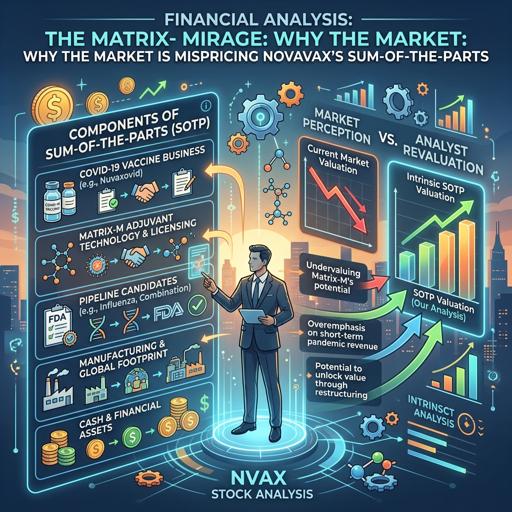
The market has a persistent, almost fatalistic habit of anchoring to a stock's past narrative. For Novavax (NVAX), the mainstream consensus is simple: it was a pandemic darling that arrived too late to the COVID-19 vaccine party, destined to fade into biotech obscurity. Wall Street looks at the chart—a relentless grind down from its euphoric double-digit highs to the current $8.42—and sees a decaying relic.
But if you actually look at the underlying data, SEC filings, and hidden off-exchange mechanics, a radically different picture emerges. Novavax is no longer a speculative biotech growth play. It has transformed into a deep-value, cash-rich, activist-driven liquidation and licensing play. The market is pricing in terminal decline, while smart money is quietly orchestrating a sum-of-the-parts extraction.
The Disconnect: Fundamentals Ignored by the Crowd
If you rely solely on price action, you miss the profound structural shift in Novavax’s financials over the last twelve months. Consider the 2025 full-year results reported in late February 2026: Novavax achieved a net income of $440.3 million, a staggering reversal from the $187.5 million loss in 2024.
Let's do the math. As of today, NVAX has a market cap of approximately $1.37 billion. Yet, it finished 2025 sitting on $751 million in cash and cash equivalents. Over half of the company's valuation is pure cash. Add in the recent deals: a $30 million upfront payment (with up to $500 million in potential milestones) from Pfizer for a non-exclusive license to the Matrix-M adjuvant, $225 million secured from Sanofi, and a $59.8 million cash infusion from selling their Maryland facility to AstraZeneca.
Big Pharma isn't buying Novavax's COVID-19 pipeline; they are cannibalizing its proprietary Matrix-M technology and infrastructure. The company is actively being stripped for its most valuable parts, shedding operational bloat, and shifting to a high-margin, non-dilutive licensing model. Yet, the stock trades as if bankruptcy is imminent.
The Activist Catalyst: Shah Capital Smells Blood
Value traps remain value traps until a catalyst forces the realization of value. Enter Shah Capital Management.
As of their latest Schedule 13D/A filing on April 8, 2026, Shah Capital holds a formidable 9.03% stake (over 14.7 million shares). They are not here to patiently wait for clinical trial results. Their open letter to the Board of Directors is a masterclass in activist hostility. They are openly calling out "value destruction" and "cash hoarding," demanding a 30% reduction in senior management, a shrinking of the board, the retirement of $225 million in convertible debt, and aggressive share buybacks.
When an activist owning nearly 10% of the float publicly demands capital allocation changes in a company trading at a massive discount to its sum-of-the-parts, the downside is floored. Shah Capital is effectively providing a backstop, demanding that the $751 million cash pile be deployed to enrich shareholders, not to fund endless R&D science projects.
Beneath the Surface: The Hidden Mechanics of Institutional Accumulation
To truly understand the coiled spring here, we must analyze the hidden mechanics of institutional order flow by synthesizing four critical metrics: the TRF Ratio (off-exchange trade reporting facility volume as a percentage of lit volume), Short Percentage (the smoothed off-exchange shorting ratio, or SVR EWMA), Volume Z-Score, and Rolling CPV (Closing Position Value). When combined, these indicators reveal a clear picture of stealth accumulation and price suppression. On February 26, 2026, alongside the blowout earnings report, NVAX experienced an explosive vol_z_score of +5.12, trading nearly 24 million shares. On that exact day, the TRF volume hit 11.4 million, pushing the trf_ratio to an extreme 47.7%, while the smoothed short_pct plummeted to a low of 0.35. A simultaneous peak in trf_ratio and vol_z_score is a classic signal of a new regime—institutions were violently absorbing the supply shock off-exchange. Fast forward to the most recent data in early April 2026: the vol_z_score has flatlined back to near zero (-0.02 to -1.5), indicating a drying up of retail interest, yet the rolling_cpv remains stubbornly strong above 0.53, meaning the stock is consistently catching bids into the closing bell. Concurrently, the short_pct (SVR EWMA) has crept back up to 0.53 while the trf_ratio lingers around 35%. This specific divergence—strong rolling_cpv (buying pressure at the close) masked by high off-exchange short_pct on quiet lit volume—is the ultimate footprint of smart money. They are utilizing off-exchange shorting to cap intraday price rallies while quietly accumulating the underlying shares at the close, shaking out retail before the activist endgame unfolds.
The Short Squeeze Powder Keg
The mechanical setup for a violent repricing is firmly in place. As of mid-March 2026, Short Interest sits at an astonishing 31.44% of the float, representing over 48.6 million shares sold short. These are legacy shorts, likely institutions that initiated positions when the stock was much higher, betting on continuous cash burn and eventual insolvency.
They are now trapped in a paradoxical nightmare: shorting a profitable company that has $751 million in cash, non-dilutive licensing revenues flowing in from Pfizer and Sanofi, and an aggressive activist investor pushing for debt retirement and buybacks.
Furthermore, the options market is flashing warning signs. The open interest summaries show immense concentration—over 248,000 contracts open just for the current front months, heavily skewed by puts that are fast becoming worthless as the fundamental floor solidifies. A sudden announcement of a massive share buyback or a strategic sale of the company—exactly what Shah Capital is demanding—would force a panicked covering rally.
The Contrarian Verdict
You don't buy Novavax today because you believe in a massive resurgence of global COVID-19 vaccine demand. You buy it because it is an asymmetric arbitrage on cash value, activist intervention, and high-margin intellectual property licensing.
The market is looking at a biotech chart. Smart money is looking at a balance sheet and off-exchange accumulation. With Big Pharma validating the Matrix-M technology, an activist holding the board's feet to the fire, and a 31% short interest walking blindly into a cash-rich buzzsaw, Novavax is fundamentally mispriced. The divergence between the underlying sum-of-the-parts reality and the legacy retail sentiment is exactly where outsized returns are born.
Sponsored