In This Article:
NKE
Sponsored
The Emperor's New Kicks: Why Nike's Collapse is the Ultimate Deep Value Setup
BullishStrongChange from report: -32.6%1M: -15.0%3M: -19.6%
Published on 2026-03-23 by TradeFomo
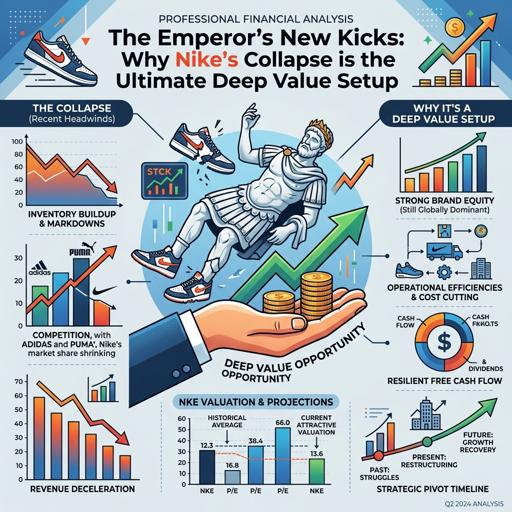
The mainstream financial media loves a fallen angel, and right now, the eulogies for NIKE, Inc. (NKE) are writing themselves. At $52.37, the stock is languishing at a multi-year low, having bled out nearly 30% over the trailing twelve months. The technicals are flashing screaming oversold signals, with the Relative Strength Index (RSI) sitting in the basement at 24.7. Earnings are compressing, margins are shrinking under the weight of North American tariffs, and the company has just announced $300 million in severance charges.
To the algorithmic trend-followers and momentum tourists, Nike is a falling knife. But if you look under the hood—past the alarming headlines and into the granular SEC filings, options flows, and insider maneuvers—a very different narrative emerges. Nike is not dying; it is undergoing a ruthless, necessary, and deeply contrarian operational reset.
Here is why the capitulation in Nike presents one of the most compelling risk-reward setups in the market today.
The Death of the DTC Fantasy and the Return to Reality
For years, Wall Street rewarded Nike for its aggressive Direct-to-Consumer (DTC) pivot. The premise was simple: cut out the middlemen, sell directly through the Nike app and owned stores, and reap higher gross margins.
The Q2 2026 earnings report (period ending November 30, 2025) finally laid bare the limitations of this strategy. NIKE Direct revenues fell by 8%, while wholesale revenues grew by 8%. Total revenue was flat on a currency-neutral basis ($12.4 billion), but diluted EPS plummeted 32% year-over-year to $0.53.
The market punished the stock for the DTC miss and margin compression (down 300 basis points to 40.6%). But here is the contrarian truth: The failure of the DTC-only model is the best thing that could have happened to Nike.
By re-engaging with wholesale partners, Nike is clearing the pipes. Inventories quietly decreased by 3% to $7.7 billion in the same quarter. Nike is pushing volume back through the channels that actually move product at scale. This isn't a retreat; it's an acknowledgment of retail physics. The brand is rebalancing its portfolio, and the inventory drawdown proves the wholesale engine is working exactly as intended.
Surgical Restructuring: Out with Marketing, In with Operations
If you want to know what a board of directors really thinks, look at who they hire and who they fire.
In December 2025, Nike filed an 8-K detailing a massive C-suite shakeup. They eliminated the role of Executive Vice President, Chief Commercial Officer. Simultaneously, they elevated Venkatesh Alagirisamy—the former Chief Supply Chain Officer—to Chief Operating Officer.
This is a profound philosophical shift. Nike is moving away from a bloated, marketing-heavy executive structure to one led by supply chain logistics and operational efficiency. When margins are under pressure from tariffs and lower average selling prices, you don't need a Chief Commercial Officer spinning narratives; you need a supply chain mechanic tightening the bolts.
Following this, Nike announced a $300 million pre-tax charge extending into early 2026, primarily for employee severance. This is the "Win Now" action plan in motion. Stripping layers of middle management and consolidating geographic leadership under the CFO will result in a leaner, more agile enterprise.
Follow the Smart Money: Insiders Are Quietly Reloading
While retail investors and momentum funds were panic-selling the Q2 earnings miss in late December, the ultimate insiders were making their moves.
On December 22, 2025, Director Robert Holmes Swan stepped in and bought 8,691 shares on the open market at $57.54. But the real tell occurred a week later. On December 29, 2025, Swoosh, LLC—the holding company famously associated with co-founder Phil Knight—acquired 5,000,000 shares of Class A Common Convertible stock.
When the founding architects of a business are restructuring their multi-million-share holdings and independent directors are buying the blood in the streets, you have a classic divergence between price action and intrinsic conviction.
Securing the Fortress Balance Sheet
Critics will point to the March 2026 8-K filing regarding Nike's new $1 billion 364-day unsecured revolving credit facility as a sign of liquidity panic. This is a misread.
This facility, which carries no financial covenants, simply replaces a prior, identical $1 billion facility that was sitting completely undrawn. In a volatile macro environment, securing a $1 billion liquidity backstop at SOFR + 0.595% is not a sign of distress; it is standard corporate hygiene for a $77 billion behemoth preparing to execute a turnaround unhindered by short-term working capital constraints.
Technical Exhaustion and Options Market Tells
The tape currently looks horrific, but it is exhibiting the classic hallmarks of seller exhaustion.
- The stock has triggered repeated "Half-yearly low" and "Monthly low" alerts consecutively throughout February and March 2026.
- December 19, 2025, saw the stock trade an astronomical 108.6 million shares—over 7 times its 20-day moving average. This was a textbook capitulation volume climax.
Furthermore, the options market is telling a nuanced story. Put/Call ratios for Open Interest remain elevated in the 0.80–0.90 range, indicating heavy downside hedging. However, a deeper dive into institutional filings (13F-HRs from February 2026) reveals that massive market makers like SIG, Citadel, and Jane Street are holding tens of millions of call options alongside their puts. The volatility surface is being farmed by institutions while retail throws in the towel.
The Verdict
Nike is executing a textbook turnaround playbook: take the ugly medicine all at once. They are writing off the bad news, slashing the bloated corporate headcount, promoting operational specialists over salespeople, and pivoting back to the wholesale channels that actually clear inventory.
At $52 a share, you are not buying the invincible growth darling of 2021. You are buying a cash-generating, globally dominant brand trading at deep-value multiples, guided by a management team that has finally woken up to reality.
The crowds are dumping Nike because the rearview mirror looks terrible. But in the stock market, you get paid for looking out the windshield. The turnaround is underway, the deadwood is being cleared, and the bottom is quietly being forged.
Sponsored