In This Article:
MPWR
Sponsored
The AI Halo Effect vs. The Dark Pool Reality: Why Monolithic Power Systems is Running on Fumes
BearishStrongChange from report: -26.0%1M: +6.6%3M: -8.7%
Published on 2026-05-15 by TradeFomo
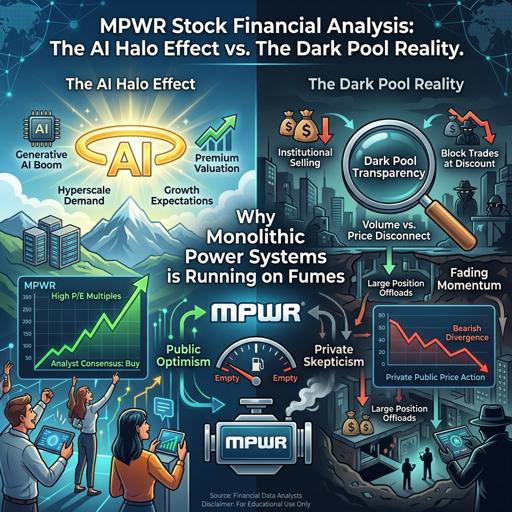
Wall Street is currently mesmerized by anything tangentially related to artificial intelligence and enterprise servers. Monolithic Power Systems (MPWR) recently posted a record Q1 2026 revenue of $804.2 million, a 26.1% year-over-year growth largely driven by the AI narrative. The stock went parabolic, skyrocketing from the $1,000 range in late March to a yearly high of $1,661.10 by May 11.
But when you strip away the euphoric analyst price targets and peer into the SEC filings, the options flow, and the dark pool microstructure, a vastly different narrative emerges. The smart money is quietly heading for the exits, leaving the retail crowd and passive index funds holding the bag at the absolute top.
The Passive Bid and the Great Executive Cashing Out
In the stock market, liquidity is a zero-sum game: for every massive seller, there must be a willing buyer. Between April 29 and April 30, Vanguard entities filed Schedule 13Gs revealing they had amassed massive new stakes totaling over 12% of the company (approximately $9.4 billion in value). This blind, passive index accumulation provided the ultimate exit liquidity for MPWR’s C-suite.
If the internal outlook is so stellar, why are the executives dumping shares at an unprecedented rate? On May 6, Deming Xiao, EVP of Global Operations, liquidated 29,000 shares for a staggering $48.3 million. Saria Tseng, the EVP and General Counsel, aggressively unloaded tens of millions of dollars worth of stock throughout March and April via 10b5-1 plans. We also saw heavy selling from directors Eileen Wynne and Jeff Zhou, as well as EVP Maurice Sciammas. When the entire executive suite is systematically hitting the bid right as passive index funds are forced to buy, it is a glaring red flag. They are monetizing the AI hype, not investing in it.
Decoding the Microstructure: The Hidden Institutional Fade
To truly understand the institutional sleight of hand occurring beneath the surface, we must synthesize four critical market microstructure metrics: the TRF ratio (off-exchange volume ratio), the off-exchange short volume percentage, the Volume Z-score, and the 5-day Rolling Close Location Value (CLV). When viewed together, these indicators strip away the illusion of price action to reveal hidden institutional long/short behavior, abnormal fund flows, and severe volume-price divergences. Typically, if the TRF ratio and the Volume Z-score print extreme values on the exact same day, it signals the ignition of a new trend. We saw exactly this immediately surrounding the April 30 earnings report: the Volume Z-score exploded to a massive 2.83, and by May 1, the TRF ratio hit the 98th percentile with exceptionally low off-exchange shorting (dropping to the 16th-28th percentile). This massive off-exchange print initiated the bullish parabolic leg.
However, the tape has now viciously flipped. On May 11, as the stock printed a new yearly high of $1,661, the off-exchange short volume percentage silently spiked to the 80th percentile. Institutions were using the euphoric retail liquidity to load up on hidden short exposure. Concurrently, the rolling CLV trend—which reflects the long versus short power of closing positions—has begun to break down rapidly. By May 14, the daily CLV had collapsed to a weak 0.29, pulling the rolling average down with it. Add the fact that the Volume Z-score has now plunged to an extreme low of -2.35, and the reality becomes undeniable: the volume-price divergence is deafening. The initial surge was fueled by heavy off-exchange buying, but the current highs are characterized by an absolute liquidity vacuum, deteriorating closing strength, and stealth institutional shorting. The smart money has stopped buying and started fading the rally.
Options Market Euphoria: Retail Squeezing the Top
The options market data provides the perfect corroboration of this late-stage euphoria. Back in February and March, the daily total options premium traded in MPWR hovered between $1 million and $6 million. Fast forward to late April and early May, and the daily options premium has exploded to between $60 million and $75 million.
More tellingly, the Put/Call Open Interest (OI) ratio has steadily compressed from a cautious 1.38 in March down to 0.99 by May 14. This shift indicates that the speculative crowd has heavily skewed toward upside calls, chasing the momentum. The over-leveraged long positioning in the derivatives market is creating a top-heavy structure. Technical indicators like the RSI were flashing overbought conditions for two consecutive weeks in late April, and a "Dead cross above zero" was detected on May 5, signaling that the underlying momentum is exhausted.
The Overlooked Red Flag: February's Financial Restatement
In the frenzy of a bull market, investors often ignore fundamental cracks. On February 27, 2026, MPWR filed an 8-K announcing the restatement of its financial statements for FY 2024 and interim 2025 due to a $195 million error related to deferred income taxes.
While management was quick to label this an "unintentional, non-cash error" that doesn't impact operational revenue, experienced investors know that restatements are indicative of internal control weaknesses. It shatters the premium of trust that is usually priced into a stock trading at these astronomical valuations. It is highly suspect that just months after a major accounting restatement, the executive team is executing their largest coordinated stock liquidation in recent history.
The Verdict: An Air Pocket Awaits
Monolithic Power Systems is a great company that has undoubtedly benefited from the secular tailwinds of AI and enterprise data. But price is what you pay, and value is what you get. The stock has been pushed to a precarious extreme by blind passive flows and retail options speculation.
The underlying microstructure data is screaming that the trend is exhausted. With institutional off-exchange shorting spiking at the highs, closing power breaking down, and trading volume evaporating into a vacuum, the stock is completely unsupported at current levels. The insiders have already cashed their checks. The smart money is quietly positioning for the downside. When the passive bids dry up and the options gamma squeeze unwinds, MPWR will find an air pocket. Gravity always wins.
Sponsored