The Kitchen Sink Quarter: Why Molina Healthcare's Panic Sell-Off is a Classic Mispricing
BullishStrongChange from report: +49.8%1M: +33.7%3M: +71.3%
Published on 2026-03-27 by TradeFomo
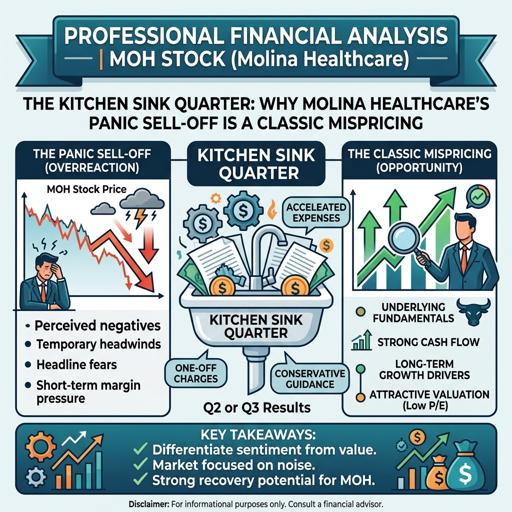
If you want to find generational value in the stock market, you have to look where the algorithms are panic-selling and the human analysts are too afraid for their jobs to catch the falling knife. Right now, there is no better example of this than Molina Healthcare (MOH).
Shares of Molina, which traded near $300 in the summer of 2025, recently collapsed to a multi-year low of $122.65. On February 6, 2026, the stock plunged over 25% in a single session on 10.3 million shares of volume—nearly 7.5 times its historical average. The market essentially priced in an imminent bankruptcy.
But when you strip away the headline noise, look past the algorithmic dumping, and actually read the SEC filings, a completely different narrative emerges. Management is aggressively amputating a toxic business unit, resetting baseline expectations, and setting the stage for a massive margin recovery.
Here is the data-driven case for why Molina is the ultimate contrarian buy at $138.
The Anatomy of a Collapse
The Ugly Earnings and The "Trough" Narrative
The catalyst for the February bloodbath was Molina's Q4 2025 earnings report. The company posted a GAAP loss of $3.15 per diluted share. But what truly terrified Wall Street was the forward guidance. Management guided for 2026 adjusted earnings of "at least $5.00 per diluted share"—a brutal contraction from the $11.03 adjusted EPS reported for the full year 2025.
During the earnings call, management explicitly called 2026 a "trough year" for Medicaid industry margins. Wall Street is violently allergic to the word "trough," preferring linear, uninterrupted growth. When growth breaks, institutional capital dumps the stock blindly. But value investors know that a declared trough is the prerequisite for a cyclical bottom.
Peeling Back the Credit Amendment Panic
In the middle of the earnings carnage, Molina dropped an 8-K filing detailing an amendment to its Credit Agreement. They temporarily reduced their minimum interest coverage ratio to 1.75:1.00 for 2026, gradually stepping it back up to 3.00:1.00 by late 2027.
When quantitative risk models scan a filing and see a lowered interest coverage ratio, they immediately flag a "liquidity crisis." But human eyes reveal a different story. In November 2025, Molina successfully completed an $850 million senior notes offering at a reasonable 6.500%, replacing an older revolving credit facility. The credit amendment isn't a desperate gasp for air; it is a calculated, pre-negotiated runway extension designed to absorb a massive one-time shock.
Excising the Rot: The Medicare Advantage Exit
That shock is the strategic amputation of a toxic asset. In that exact same February 8-K, Molina announced an estimated $93 million non-cash, pre-tax impairment charge in Q1 2026 to exit the Medicare Advantage Prescription Drug (MAPD) product.
They are taking the pain upfront to eliminate an underperforming drag and refocus on their highly profitable dual-eligible Medicare members. When you parse the abysmal $5.00 EPS guidance for 2026, management explicitly noted that this figure is burdened by $2.50 per share in costs related to new contract implementations and the MAPD exit.
This is textbook "kitchen-sinking." A new, highly conservative reality is being set. If you back out the $2.50 in temporary drag, the baseline EPS is $7.50 in the absolute worst-case Medicaid margin environment.
The Contrarian Bull Case: Valuing the "Trough"
An Absurd Price-to-Sales Disconnect
Let's talk about basic market math. At $138 a share, Molina’s market cap sits at roughly $7.1 billion. Yet, management’s guidance for 2026 premium revenue is approximately $42 billion.
We are looking at a managed care giant trading at a Price-to-Sales (P/S) ratio of under 0.17x. The market is valuing the company as a decaying asset, completely ignoring its massive, sticky revenue base.
The Forgotten Florida Catalyst
In the panic to sell the stock, the market has completely memory-holed a massive structural win. In November 2025, Molina was awarded a new Florida Medicaid Contract. They were the sole plan selected for a specific statewide segment expected to serve 120,000 enrollees. The state's total program premiums are estimated at $5 billion, with the contract locked in through December 2030. Wall Street is currently ignoring a multi-billion dollar revenue pipeline simply because it is obscured by short-term MAPD exit costs.
Follow the Smart Money (and the Insiders)
If the ship were truly sinking, the insiders would be fleeing. Instead, they are backing up the truck.
In mid-February 2026, as the stock’s Relative Strength Index (RSI) hit a deeply oversold 19 and fear was at its absolute zenith, Director Richard Zoretic stepped into the open market and bought 800 shares at $125.16. At the same time, CEO Joseph Zubretsky and COO James Woys were loading up through the company's 2025 Equity Incentive Plan. Insider open-market buying during peak capitulation is the purest buy signal in modern finance.
Furthermore, the 13G and 13F filings from the end of 2025 show relentless institutional accumulation. Vanguard (6M shares), BlackRock (6.9% stake), Capital World Investors (6.8% stake), FMR LLC (5.8% stake), and the quants at AQR Capital Management (5.4% stake) have all built massive positions. The smart money isn't selling; they are holding the line.
The Technical Setup: Exhaustion
From a technical standpoint, the capitulation looks complete. Following the brutal February sell-off, the stock has stabilized and formed a base in the $135–$145 range. On March 24, 2026, the MACD flashed a "Golden Cross below zero"—a classic momentum shift indicator signaling that selling pressure is entirely exhausted. Additionally, short interest, which peaked around 8.5% of the float in late 2025, has steadily dropped to 6.32% as shorts quietly cover to lock in profits.
The Verdict
Wall Street is currently treating Molina Healthcare like a terminal patient. In reality, it is a patient recovering from a planned, albeit painful, surgery. The company is trading at less than 0.2x forward sales, insiders are buying the bottom, and the EPS floor has been artificially depressed by a necessary exit from a toxic product line.
When the market wrongly extrapolates short-term transitional pain into permanent structural decline, generational value is created. Molina's 2026 is undoubtedly a trough. But troughs are where fortunes are made. By 2027, when the Medicaid margin cycle normalizes, the Florida contract is fully operational, and the MAPD impairment is a distant memory, the investors who bought the $138 panic will be heavily rewarded.