The Anatomy of a Mispriced Biotech: Why Mesoblast’s $14 Capitulation is a Screaming Buy
BullishStrongChange from report: +5.7%1M: +8.3%3M: +8.6%
Published on 2026-03-24 by TradeFomo
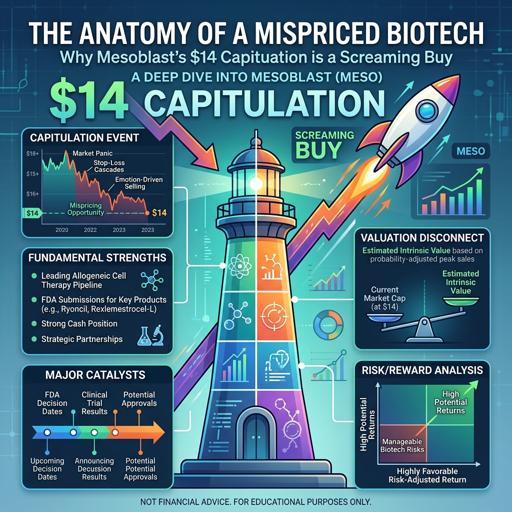
If you want to find asymmetric returns in the market, you have to look where the crowd is panicking but the insiders are greedy. Right now, the crowd is throwing the baby out with the bathwater in the biotechnology sector, and Mesoblast Ltd (MESO) is exhibiting a textbook divergence between price action and fundamental reality.
Over the last three months, MESO has bled out, dropping nearly 24% from its January 2026 highs of $20.96 down to a half-yearly low of $14.02 on March 23. Technical signals are flashing "dead crosses," and retail investors are likely getting flushed out. But if you look under the hood at the SEC filings, the capital structure, and the commercial revenue growth, a completely different narrative emerges.
This isn't a dying clinical-stage biotech. It is a commercial-stage powerhouse that just de-risked its balance sheet, and its largest insider is aggressively buying the dip.
The "Insider Banker" and the Capital Structure Coup
The most critical—and perhaps most overlooked—event for Mesoblast happened in late December 2025. For years, one of the biggest overhangs on MESO was its toxic and expensive debt, specifically a senior secured loan from Oaktree Capital Management.
On December 30, 2025, Mesoblast announced it had repaid the Oaktree debt and a portion of its NovaQuest facility. How? By drawing $75 million from a new $125 million credit line provided by its largest shareholder and director, Dr. Gregory George.
Let’s be clear about what this means: Dr. George essentially stepped in as the company’s private banker. He provided a five-year facility at a fixed interest rate of 8.00% with a five-year interest-only period. In the current macroeconomic environment, an 8% fixed rate for a biotech company is incredibly cheap. More importantly, this new facility does not encumber Mesoblast's intellectual property and allows for repayment at any time without penalties.
But Dr. George didn’t stop there. According to a Schedule 13G/A and Form 6-K filed in March 2026, he went into the open market between March 3 and March 6 and bought 5.64 million ordinary shares and 542,633 American Depositary Shares (ADS) for a total consideration of $16.37 million. He now controls 22.36% of the company.
When a director buys out predatory institutional debt with his own facility and drops another $16 million into the stock on the open market, it is not a blind gamble. It is a calculated takeover of the capital structure ahead of a major inflection point.
Ryoncil: From Science Project to Cash Cow
The market is currently pricing MESO as if it is still burning cash on a purely speculative pipeline. The reality is that Mesoblast has successfully crossed the chasm from R&D to commercialization.
Following the FDA approval of Ryoncil® (remestemcel-L) for pediatric steroid-refractory acute graft-versus-host disease (SR-aGvHD) in March 2025, the revenue ramp has been nothing short of spectacular. For the first half of fiscal 2026 (ended December 31, 2025), Mesoblast reported total revenue of $51.3 million—a massive surge from just $3.1 million in the prior year. Ryoncil alone generated $48.7 million in net revenue with a staggering $44.2 million gross profit.
They have already onboarded 49 transplant centers and secured coverage for 280 million U.S. lives. The company is guiding for full-year Ryoncil net revenues between $110 million and $120 million. Despite this, the market has sold the stock down to a $2.3 billion valuation.
But the pediatric market is just the beachhead. The real catalyst is the adult SR-aGvHD market, which is 3 to 4 times larger. Mesoblast recently announced a collaboration with the BMT CTN to initiate a pivotal Phase 3 trial for Ryoncil as a first-line regimen in adults. If the pediatric success translates to adults, the total addressable market expands exponentially.
The Sleeper Catalyst: An Opioid Alternative for Chronic Back Pain
While Wall Street is hyper-focused on Ryoncil, there is a sleeper catalyst in the pipeline that could dwarf the GvHD indication entirely: Rexlemestrocel-L for chronic discogenic low back pain (CLBP).
The FDA has already granted Rexlemestrocel-L a Regenerative Medicine Advanced Therapy (RMAT) designation. But the contrarian angle here lies in the data the FDA is willing to look at. In recent filings, Mesoblast confirmed that the FDA will accept a 12-month reduction in pain intensity for product efficacy, and crucially, opioid reduction data may be included in the product labeling.
Previous Phase 3 data showed that patients treated with Rexlemestrocel-L were more than three times as likely to cease opioid use by 36 months compared to controls. With the U.S. desperately searching for non-opioid treatments for chronic pain, this is a multi-billion dollar indication. The confirmatory Phase 3 trial (NCT06325566) is currently recruiting and slated for primary completion in late 2026. If this hits, the current valuation will look like a rounding error.
The Capitulation Volume: A Technical Flush Out
Let’s tie the fundamentals back to the current price action. On March 23, 2026, MESO traded 1.23 million shares, dropping to $14.02. To put this in perspective, this volume is nearly 6 times the 5-day moving average and over 4 times the 20-day moving average.
In technical terms, this is a capitulation volume signature. Retail and weak hands are being shaken out at the exact moment the stock hits its half-yearly low. Historically, volume spikes of this magnitude at multi-month lows, devoid of any fundamentally damaging news, represent smart money stepping in to absorb the panic selling.
Furthermore, the options market is notably skewed. The open interest heavily favors calls over puts, with major institutional players like Citadel, Susquehanna, and Jane Street holding massive call positions. The smart money derivatives are positioned for upside, not a continued breakdown.
The Asymmetric Verdict
Mesoblast is currently suffering from a severe dislocation between its stock price and its underlying business reality. The market is selling MESO down to $14, completely ignoring:
- A $110M+ high-margin revenue run-rate for its lead asset.
- The elimination of toxic debt, replaced by cheap, insider-backed financing.
- An insider who just deployed over $16 million in open-market purchases.
- A pipeline asset that could become a frontline non-opioid treatment for chronic back pain.
When you see retail panicking on high volume while the company's largest insider is quietly restructuring the debt and buying millions of shares, you take notice. The capitulation to $14 isn't a warning sign; it's an invitation.