In This Article:
MDGL
Sponsored
The 24% Short Trap: Why Madrigal Pharmaceuticals (MDGL) is Orchestrating the Biotech Squeeze of the Decade
BullishStrongChange from report: +4.6%1M: +1.8%3M: +3.3%
Published on 2026-03-27 by TradeFomo
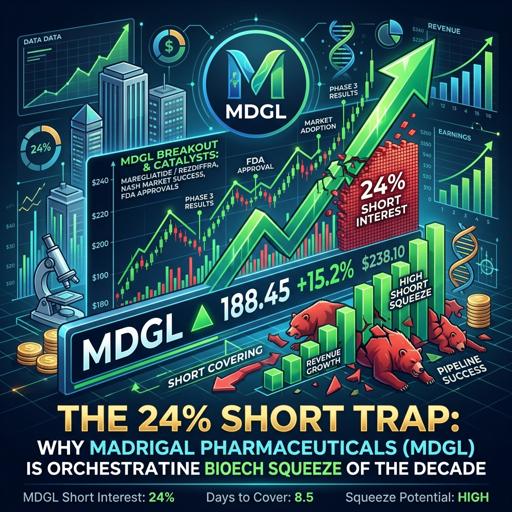
If you spend enough time looking at the structural mechanics of the market, you start to recognize when the herd is not just wrong, but dangerously exposed. Right now, the institutional short sellers crowding into Madrigal Pharmaceuticals (MDGL) are sitting on a powder keg.
As of late March 2026, MDGL is trading at $518.76. Yet, a staggering 23.92% of the float—nearly 4 million shares—is sold short. The mainstream bear thesis is generic and lazy: they look at the recent run-up, the perceived threat of GLP-1 weight-loss drugs curing everything including liver disease, and a slew of insider selling forms, and they assume the top is in.
They are fundamentally misreading the clinical, legal, and structural data. Here is why Madrigal is quietly building a commercial juggernaut, and why the shorts are about to be carried out on stretchers.
The GLP-1 Trojan Horse: Assimilation, Not Annihilation
The primary bear argument against Madrigal’s MASH/NASH drug, Rezdiffra (resmetirom), is that the GLP-1 receptor agonists (like Wegovy and Zepbound) will cannibalize the market by addressing the root metabolic causes of liver disease. Shorts are betting on obsolescence.
What they missed was the strategic masterstroke buried in Madrigal's Q3 and recent 8-K updates. Madrigal isn’t fighting the GLP-1 wave; they are assimilating it. By closing a global licensing agreement with CSPC Pharma for an oral GLP-1, Madrigal is positioning itself for combination therapies. Rezdiffra is an aggressive, liver-directed therapy. Paired with a GLP-1, Madrigal now owns the complete metabolic and fibrotic treatment stack. The "threat" has been internalized into a pipeline expansion.
The Roche Amendment: A Moat Fortified Until 2045
If you want to find mispriced equities, read the boring legal filings that algorithmic sentiment trackers ignore. On January 30, 2026, Madrigal filed an 8-K detailing an amendment to their agreement with F. Hoffmann-La Roche.
This wasn’t a standard boilerplate update. Madrigal secured full and exclusive control over all patent term adjustments and extensions for Rezdiffra, while simultaneously ensuring that Roche’s royalty reductions for "No Patent" won't apply as long as an extension is filed. Furthermore, Madrigal recently listed a new patent in the Orange Book providing protection into 2045.
Shorts modeling a standard 10-to-12-year patent cliff are working with broken discounted cash flow (DCF) models. Madrigal just extended its commercial monopoly by a decade.
The Revenue Inflection is Already Here
Biotech companies usually stumble during commercialization. Madrigal is accelerating.
While automated data scrapers are getting confused by laggy SEC quarterlies, Madrigal's February 2026 8-K revealed the truth: Q4 2025 net sales hit $321.1 million, bringing full-year 2025 revenue to a staggering $958.4 million. They already have over 29,500 patients on Rezdiffra. They have launched in Germany following European Commission approval. Furthermore, they are sitting on nearly $1 billion in cash and marketable securities. There is no dilution risk here; they have up to $500 million in senior secured credit to fund operations. The company is fully capitalized to execute.
The Insider Selling Mirage
Bears love to point at Form 4s. "Look at the Founder and CEO dumping shares!" It’s a compelling headline until you actually read the footnotes.
Yes, Founder and Director Rebecca Taub has sold shares. But a deep dive into her 144s and Form 4s shows these are systematic, pre-planned Rule 10b5-1 sales and tax-withholding transactions. Even after these sales, Taub maintains direct and indirect ownership of well over 1.1 million shares (largely through SQN, LLC).
More importantly, look at CEO William Sibold. In early December 2025, Sibold earned 50,000 shares of common stock through Performance Restricted Stock Units (PRSUs). Why? Because he hit aggressive stock price appreciation hurdles. His subsequent "sales" were purely automatic dispositions to cover tax withholdings. The executives are being heavily compensated in equity for driving the stock price up, not cashing out because they see a top.
Anatomy of the Impending Squeeze
The structural setup on the tape right now is violent.
- Days to Cover: Average daily volume for MDGL has been hovering around 300,000 shares. With 3.93 million shares short, we are looking at roughly 13 days to cover. In a momentum market, a 13-day short ratio is a death sentence for bears.
- The March 26 Volume Anomaly: On March 26, 2026, MDGL experienced a massive, abnormal volume spike—1.37 million shares traded (4.5x the moving average), pushing the price to a monthly high of $518.76. This is the footprint of institutional accumulation absorbing the short selling.
- The Options Market Knows: Look at the options summary for the late March and April expiry chain. The Put/Call Open Interest ratio is sitting at 0.43. Let me translate that: there are more than twice as many outstanding call options as put options. Despite the heavy short interest in the underlying equity, the "smart money" derivatives market is aggressively positioned for an upward breakout.
The market has mispriced Madrigal as a speculative, single-drug biotech vulnerable to GLP-1 disruption. The data proves it is a fully-funded, near-billion-dollar revenue machine with a 2045 patent moat, assimilating its competitors, and structurally primed for a massive short squeeze. When the 4 million short shares realize they are trapped, the race to the exit will be historic.
Sponsored