In This Article:
LITE
Sponsored
The $50 Billion Optics Illusion: Why Lumentum's 10x Run is a Siren Song
BearishStrongChange from report: +14.6%1M: +16.2%3M: +13.6%
Published on 2026-03-23 by TradeFomo
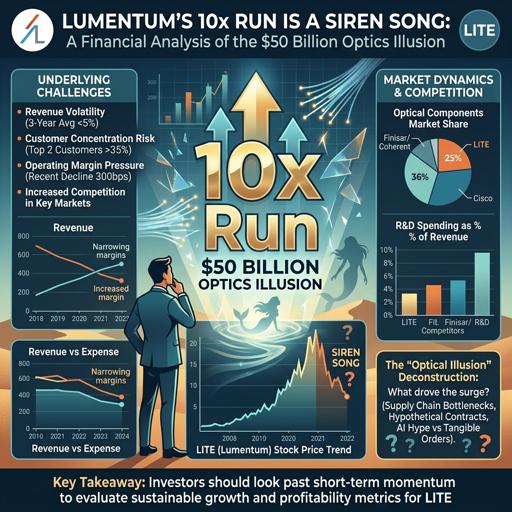
The market has a persistent, dangerous habit of mistaking a tech giant’s strategic supply-chain maneuver for a blank check of infinite growth. Lumentum Holdings Inc. (LITE) has just achieved a staggering $50 billion market capitalization, representing an astronomical 1,000% return from its $77 lows in June 2025.
Retail momentum chasers and algorithmic trend-followers are aggressively bidding up this stock on the back of the "AI optics" narrative. But if we peel back the layers of SEC filings, insider trading patterns, and structural profit margins, a much more sobering reality emerges. The current pricing of Lumentum is priced for a utopia that hardware economics simply will not support.
The NVIDIA Anointment: A Strategic Masterstroke, But For Whom?
The catalyst for Lumentum's final blow-off top occurred on March 2, 2026, when the stock surged to an all-time high of $787.45. The headline that broke the market was a $2 billion private placement investment from NVIDIA to develop advanced optics technologies for AI infrastructure.
Retail investors saw "NVIDIA" and blindly hit the buy button. But read the fine print of the 8-K filing: NVIDIA did not buy common stock at market value. They purchased Series A Convertible Preferred Stock.
The Captive Supplier Dynamic
NVIDIA’s $2 billion injection is earmarked for R&D and a new U.S.-based manufacturing facility. NVIDIA is essentially using Lumentum as an outsourced, captive manufacturing arm to secure its own optical interconnect supply chain. The Preferred Stock comes with dividend rights, liquidation preferences, and a one-for-one conversion feature.
When a hardware titan like NVIDIA takes a massive preferred stake in a component supplier, they are doing it to control their own costs and secure capacity—not to expand the supplier's profit margins. Lumentum's pricing power against its newly minted preferred-shareholder-slash-largest-customer will be practically nonexistent. NVIDIA is protecting its own moat; retail investors buying LITE's common stock at $700+ are simply subsidizing NVIDIA's CAPEX.
Follow the Smart Money: Institutional Accumulation vs. Insider Exodus
If Lumentum is entering a new paradigm of infinite profitability, why are the actual architects of the business heading for the exits?
Institutional Front-Running
In early 2026, smart institutional money positioned themselves perfectly. On February 5, 2026, FMR LLC (Fidelity) filed an amended Schedule 13G showing they had aggressively increased their stake to 13.5% of the company (9.61 million shares). They saw the writing on the wall and bought the rumor.
The February Insider Liquidity Event
Conversely, Lumentum's executives used this institutional bid to aggressively derisk their personal portfolios—just weeks before the NVIDIA deal was made public.
On February 12, 2026, Vincent Retort, EVP of Module Business Unit R&D, executed a massive liquidation of 35,545 shares, walking away with approximately $21.3 million at prices ranging from $575 to $602. Wupen Yuen, President of Global Business Units, consistently unloaded blocks of shares throughout November and February. Even Matthew Sepe, the Chief Accounting Officer, announced his retirement and dumped shares.
Company insiders were more than happy to cash out in the $500–$600 range. They didn't hold out for the NVIDIA premium because they intimately understand the realities of hardware margins.
The Valuation Disconnect
At the current price of $706.35, Lumentum commands a $50.08 billion market cap. Let’s look at the underlying cash flows supporting this monolith.
In Q1 FY26 (reported November 2025), Lumentum posted net revenue of $533.8 million. Even if we generously extrapolate their Q2 guidance into a nearly $2.6 billion annualized run-rate, the company is trading at an egregious 19x forward sales.
This is a hardware components manufacturer with a GAAP gross margin of 34%. In Q1 FY26, despite a massive 58% year-over-year revenue growth, Lumentum generated a paltry $4.2 million in GAAP net income. Valuing a 34% gross margin hardware supplier at 19x sales is a mathematical anomaly that will violently correct once the AI euphoria subsides.
Technical Exhaustion: The Distribution Phase Has Begun
The technical indicators are flashing deep crimson, suggesting that the "smart money" distribution phase is already well underway.
- Abnormal Distribution Volume: On Friday, March 20, 2026, Lumentum traded 22.86 million shares—a massive 4.5x multiple of its 3-month average volume. Despite this explosive volume, the stock closed down $8.52 for the day. High volume on downward price action near all-time highs is the textbook definition of institutional distribution.
- Momentum Breakdown: A MACD "dead cross above zero" flashed on March 5, immediately following the NVIDIA news. The momentum has structurally broken.
- RSI Reversal: The stock flashed repeated RSI overbought signals throughout February (hitting an extreme 83.2 on February 25). That rubber band is now snapping back.
- Options Market Frenzy: Total open interest has exploded to over 170,000 contracts. Implied Volatility (IV) remains dangerously elevated, and recent options summaries show heavy Put/Call open interest ratios, indicating that whales are quietly buying downside protection.
The Verdict
Lumentum is a phenomenal engineering company building the critical optical infrastructure required for the next generation of data centers. But a great company does not automatically equate to a great stock.
At $50 billion, LITE has become a vehicle for wealth transfer from retail momentum chasers to early institutional accumulators and company insiders. NVIDIA has masterfully secured its supply chain, while retail investors are left holding the bag at 19x sales. When the music stops, the multiple compression on this low-margin hardware supplier will be severe. Don't be the exit liquidity.
Sponsored