The Great Robinhood Heist: Buy the Dip Insiders Created
BullishStrongChange from report: +57.4%1M: +9.7%3M: +68.5%
Published on 2026-04-03 by TradeFomo
Loading content...
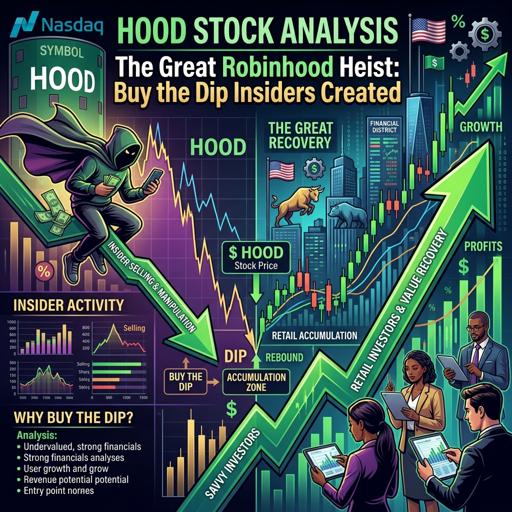
Robinhood (HOOD) has been absolutely bludgeoned over the past six months. From a euphoric peak of over $150 in October 2025, the stock has cascaded down to an April 2026 low in the mid-$60s. If you only looked at the chart, you’d assume the underlying business was imploding.
But the fundamentals tell a completely different story. In February 2026, Robinhood reported Q4 2025 revenues of $1.28 billion and full-year revenues of $4.5 billion. Operating income in recent quarters has been staggering, with net deposits surging, Robinhood Gold subscriptions at record highs, and the platform's crypto and options businesses printing cash.
So, what caused the 55% crash? Follow the insiders.
While retail investors were cheering the record 2025 earnings, Robinhood's executives were quietly rushing for the exits through pre-arranged 10b5-1 plans.
This coordinated, massive supply overhang broke the back of the stock's momentum. The insiders cashed out hundreds of millions of dollars at the absolute peak. It was a perfectly executed liquidity event that left public shareholders holding the bag.
To understand what is happening right now at the $68 level, we have to look off-exchange and jointly analyze the interplay among these four metrics: trf_ratio (off-exchange trade ratio), short_pct (off-exchange short volume ratio), vol_z_score (volume z-score), and rolling_cpv (rolling close position value). Together, these four metrics can reveal hidden institutional shorting or buying activity off-exchange, abnormal capital flow, and price-volume divergence signals. If trf_ratio and vol_z_score both hit recent extremes on the same day, it often signals the start of a new trend. The trend of rolling_cpv reflects the shifting balance of bullish vs. bearish positioning at close.
On March 31, 2026, the vol_z_score spiked to a highly elevated +1.39 alongside a massive trading volume of 35.9 million shares, and the trf_ratio surged to an extreme 45.2%. This combination indicates exceptional off-exchange institutional activity. However, the short_pct on this dark pool volume was notably low at 41.5%. This price-volume divergence implies that the bulk of this off-exchange flow was institutional accumulation, not short selling. Concurrently, the rolling_cpv staged a sharp recovery, rising from a deeply bearish 0.20 on March 27 to 0.501 on March 31. This shows that intraday selling pressure has been thoroughly absorbed and bulls are regaining control at the closing bell. Based on recent trends across all four metrics, provide a synthesized judgment: my synthesized judgment is that the six-month downtrend has exhausted itself, and smart money is aggressively establishing long positions off-exchange, signaling a powerful imminent reversal.
Usually, a 55% drop in a high-beta tech name attracts a swarm of short sellers hoping to ride the momentum to the bottom. Not here. Short interest peaked at 6.83% of the float back in September 2025, right before the stock hit its local top.
As of mid-March 2026, short interest has collapsed to just 3.93%. The "smart" bears have been actively covering their shorts all the way down. They aren't pressing their bets in the $60s because they see the exact same fundamental value proposition we do. When the shorts stop selling and the institutions start accumulating in the dark pools, the path of least resistance is up.
If the dark pool accumulation wasn't enough of a tell, Robinhood management explicitly tipped their hand late last month. On March 24, 2026, alongside a new $3.25 billion credit facility, the company announced a massive $1.5 billion share repurchase program.
Let the hypocrisy of that sink in. Insiders diluted the market and dumped their personal shares when the stock was trading between $110 and $150. Now that the stock is trading around $68—less than half the price—the company is deploying its robust corporate balance sheet to buy back $1.5 billion worth of stock. It’s ruthless, it’s highly capital efficient, and it’s incredibly bullish for anyone buying at these depressed levels.
The quantitative signals are flashing green. Technical indicators flagged multiple "potential bottom" alerts in late March based on multi-timeframe lows, and the RSI recently dropped into deeply oversold territory. In the options market, open interest remains massively skewed toward calls, with a Put/Call Open Interest ratio of just 0.62 across 1.75 million open contracts as of April 1. The derivatives market isn't bracing for a crash; it's coiling for a massive bounce.
Robinhood is a wildly profitable business that suffered a mechanical price collapse due to insider 10b5-1 selling programs. The smart money is absorbing the last of the retail panic off-exchange, the short sellers have quietly exited, and the company is stepping in with a $1.5 billion bid to sweep up the cheap shares.
The insiders got out at the top. I'm getting in at the bottom.