In This Article:
HALO
Sponsored
The Disconnect in HALO: Why the Crowd is Misreading Halozyme's $61 Bottom
BullishStrongChange from report: +81.0%1M: +2.8%3M: +24.2%
Published on 2026-03-28 by TradeFomo
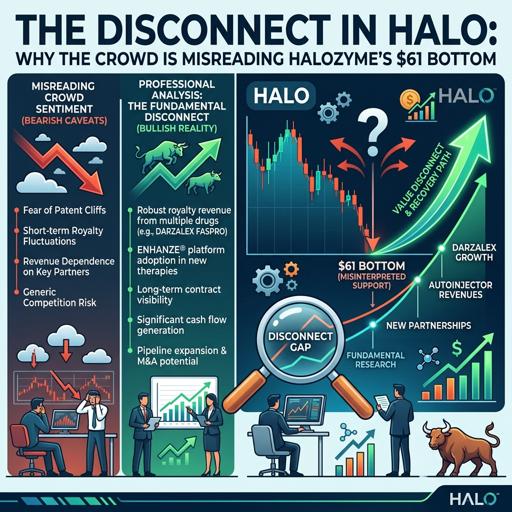
The market is a machine that constantly processes information, but it doesn't always process it correctly. Right now, Halozyme Therapeutics (HALO) is a prime example of a fundamentally misunderstood stock. Trading at $61.63—down nearly 25% from its early February 2026 highs of ~$81—retail investors and algorithmic momentum traders are panicking. The charts look broken, the moving averages have flashed "dead crosses," and surface-level scanners are screaming about massive institutional dumping and insider sales.
But when you strip away the noise and dig into the actual SEC filings, the financial guidance, and the underlying mechanics of the short interest, a completely different narrative emerges. Halozyme isn't a dying biotech; it is a cash-printing juggernaut trading at an absurdly cheap valuation, and the shorts are walking blindly into a trap.
Here is what the crowd is missing.
The Illusion of the Institutional Exodus
If you rely on automated alerts, you probably saw a terrifying headline on March 27, 2026: Vanguard Group Files Amendment Reporting 0% Ownership in Halozyme.
On the surface, seeing the world's second-largest asset manager go from holding 11.5 million shares to exactly zero overnight is enough to trigger a retail stampede. But if you actually read the Schedule 13G/A filed on that date, it explicitly states this is the result of an "internal realignment" that occurred in January 2026. Vanguard's subsidiaries and business divisions will now report beneficial ownership on a disaggregated basis.
Vanguard didn't dump HALO. They changed their accounting structure. The shares are still there, held by the same subsidiaries pursuing the exact same investment strategies. Panic selling on a bureaucratic paperwork shift is exactly how retail transfers its wealth to institutional value buyers.
The Insider "Selling" vs. The Hidden $115 Floor
Another bearish talking point revolves around CEO Helen Torley and her recent stock sales. Yes, Form 4 filings from early March 2026 show Torley selling shares in the $68-$70 range.
But context is everything. These sales are purely mechanical, executed under a Rule 10b5-1 trading plan adopted a year ago (March 2025) to cover taxes and exercise aging options (some expiring in 2026 and 2027 at an $8.11 and $12.07 strike price).
If you want to know what the Board of Directors actually thinks HALO is worth, look at the 8-K filed on December 9, 2025. The Compensation Committee approved a $10 million performance-based restricted stock unit (PSU) grant for Dr. Torley. This grant does not vest based on time; it vests based entirely on aggressive stock price targets.
The lowest tier for this grant to begin vesting is a stock price of $115. The subsequent tiers are $130, $145, and $170. If the stock stays at its current $61 level, the CEO gets absolutely nothing from this massive grant. The Board is effectively signaling that they believe the company's baseline fundamental value is nearly double the current trading price.
An 8x Forward P/E Biotech is an Anomaly
The biotechnology sector is generally characterized by high multiples, driven by the promise of future drug pipelines. Halozyme is entirely different. They are the picks-and-shovels of the industry. Their ENHANZE® technology, and now their newly acquired Hypercon™ technology (via the $750M Elektrofi acquisition and $400M Surf Bio acquisition in late 2025), is the gold standard for subcutaneous drug delivery.
Let's look at the math. In January 2026, Halozyme raised its full-year 2026 guidance significantly. They are projecting total revenue between $1.71 billion and $1.81 billion, and Non-GAAP diluted EPS of $7.75 to $8.25.
At the current price of $61.63, Halozyme is trading at a forward P/E of roughly 7.7x.
Let that sink in. You have a biotech company with a near-monopoly on a critical delivery technology, generating $1.1B+ in adjusted EBITDA, and it is being priced like a stagnant legacy auto manufacturer. The market is pricing in catastrophic failure, yet Halozyme just posted record Q3 2025 revenues ($354M, +22% YoY) and guided for massive top-line expansion in 2026.
The Short Seller's Trap
So why the heavy discount?
Part of the pressure comes from the $1.5 billion Convertible Senior Notes offering in November 2025. Arbitrageurs routinely short the underlying equity of convertible debt to hedge their delta. But the more insidious driver is the fear surrounding the CMS (Centers for Medicare & Medicaid Services) IPAY 2028 Medicare price negotiations. Shorts are betting that government price caps on partner drugs will compress Halozyme's royalty streams.
Management already addressed this directly in their October 2025 8-K, explicitly stating that the CMS guidance will have no impact on its royalty revenue in 2028 and minimal impact thereafter, specifically noting that heavy hitters like DARZALEX FASPRO® and Opdivo® are excluded from Part B negotiations due to orphan drug designations.
Despite this, short interest has crept up to 11.88% of the float (roughly 13.7 million shares) as of mid-March 2026. Short volume ratio (SVR EWMA) has consistently sat above 60% during the recent leg down. The shorts are heavily exposed at the absolute bottom of a technical multi-timeframe low.
The Squeeze Mechanics
When you combine an 11.88% short interest with a company trading at 7.7x forward earnings, the setup becomes explosive. The fundamental downside is incredibly protected by the raw cash flow Halozyme generates. As the company continues to integrate Elektrofi and Surf Bio, any new partner announcements or positive earnings surprises will force these shorts to cover in a heavily institutionalized float.
The Bottom Line
The market has mispriced HALO due to a perfect storm of technical breakdowns, misunderstood SEC filings, and unfounded regulatory fears. Technical indicators from late March 2026 are already flashing "potential bottom" and "multi-timeframe low" signals.
When a stock drops 25% on optical illusions while the underlying earnings power accelerates to $8.00 per share, it is a rare gift. The Board is targeting $115 to $170. The shorts are betting on a fundamental collapse that simply isn't in the data. Eventually, the cash flow will force a violent rerating.
Sponsored