In This Article:
GLW
Sponsored
The AI Glass Delusion: Unpacking Corning’s $177 Billion Mirage
BearishStrongChange from report: -24.3%1M: -9.6%3M: -15.5%
Published on 2026-05-12 by TradeFomo
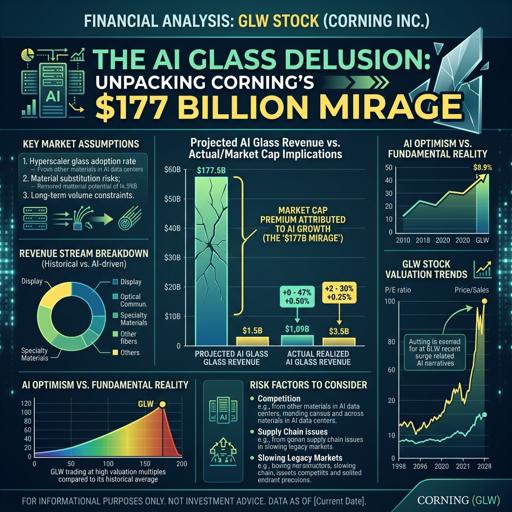
Sometimes the market hands you a masterclass in mass hysteria. Right now, that masterclass is being taught by Corning Inc. (GLW).
Over the past few weeks, we have witnessed a 170-year-old glass and ceramics manufacturer transform into an artificial intelligence meme stock. Driven by an unrelenting narrative that optical fiber is the next critical bottleneck for generative AI data centers, Corning’s stock has gone parabolic, soaring past $207 per share and inflating its market capitalization to an eye-watering $177 billion.
Retail investors are aggressively chasing the momentum, emboldened by the recent May 6th announcement of a strategic partnership with NVIDIA. But if you look past the press releases and dig into the market microstructure, the options chain, and the off-exchange prints, a much darker, contrarian reality emerges. The smart money is not buying the AI glass revolution—they are using it as liquidity to exit.
The "NVIDIA Halo" is a Margin Trap
The catalyst for this recent blow-off top was the 8-K filed on May 6, 2026, announcing that Corning and NVIDIA are partnering to expand U.S. manufacturing for AI infrastructure. The headlines screamed "10x capacity expansion" and "accelerating demand." But read the fine print of the capital structure.
NVIDIA isn't just handing Corning free revenue; they are securing capacity by purchasing $500 million in warrants, giving NVIDIA the right to buy up to 15 million shares at $180, and another 3 million shares for literal fractions of a penny ($0.0001). NVIDIA is locking in their supply chain costs while diluting Corning's existing shareholders. Furthermore, this "partnership" requires Corning to build three new manufacturing facilities in North Carolina and Texas. That is billions in heavy capital expenditure for hardware that notoriously suffers from margin compression over time. The market is pricing Corning as if it will command software-like SaaS margins, completely ignoring the cyclical, capital-intensive reality of laying physical fiber.
Follow the Insiders, Not the Headlines
If this NVIDIA deal was truly the beginning of a multi-year golden era for Corning's valuation, the C-suite would be holding onto their equity with a death grip. They are doing the exact opposite.
The SEC Form 4 filings over the last few days read like an evacuation plan. On May 6, the very day the NVIDIA partnership was announced to the public, Executive VP John Zhang dumped 15,000 shares. The next day, CFO Edward Schlesinger liquidated over 22,000 shares. On May 8, Vice Chairman Lewis Steverson unloaded 27,750 shares at an average price of $196. When executives aggressively sell right into the biggest fundamental PR catalyst the company has had in years, you should pay attention. They know that a $177 billion valuation on a company that generated just $371 million in net income in Q1 2026 is a mathematical anomaly that cannot be sustained.
Anatomy of a Distribution: The Off-Exchange Footprint
To truly understand the illusion of this rally, we must examine the dark pools and the microstructure of the tape. By synthesizing the TRF ratio (off-exchange share of trading), the off-exchange short ratio, the volume Z-score, and the rolling close location value, we can lift the veil on hidden institutional behavior. When the TRF ratio and the volume Z-score trigger simultaneous extremes on the same day, it historically signals the violent birth of a new trend—or in this case, an exhaustion top. On May 6, the volume Z-score exploded to a massive +3.58 standard deviations above the mean, confirming extreme anomalous activity. Simultaneously, the off-exchange short ratio surged into the 91st percentile (peaking at the 93rd percentile by May 7). While retail traders were furiously hitting the ask on public exchanges, institutional players were quietly absorbing that liquidity in the dark pools, masking their aggressive short and distribution positioning. The ultimate smoking gun, however, is the rolling close location value. Despite the stock gapping up day after day, the 5-day rolling close location value actually plummeted to a dismal 0.30 during the core of the rally, before slightly recovering. This severe volume and price divergence—where the stock opens at daily highs but faces relentless intraday selling pressure to close near the bottom of its range—is the classic footprint of smart money offloading their inventory. Institutions are methodically feeding the retail frenzy, shorting into the strength, and systematically fading the euphoria.
The Options Euphoria
The options market confirms this extreme state of retail exuberance. Looking at the option summaries, the put/call volume ratio completely collapsed during this run-up. By May 8, the put/call volume ratio hit a staggering low of 0.32, with nearly 140,000 total contracts traded.
This is the definition of a crowded trade. When call-buying reaches this level of absolute hysteria, market makers are forced to hedge by buying the underlying stock, creating a synthetic gamma squeeze. But gamma squeezes are temporary. Once the options expire or the momentum stalls, the dealers will un-hedge, removing the artificial floor beneath the stock.
The Valuation Disconnect
Let’s return to the math. Corning’s Q1 2026 financials reported a solid 18% core sales increase, heavily carried by the 36% jump in the Optical Communications segment. That is a great quarter for a legacy hardware company. But at a $177.8 billion market cap, the stock is trading at roughly 100 times forward earnings.
You do not pay 100x earnings for a company that makes glass and fiber optics, no matter whose AI chips are running through them. The macroeconomic reality is that building fiber networks is a race to the bottom in pricing power. The market has completely decoupled Corning’s underlying cash flows from its equity price, driven entirely by the "AI infrastructure" narrative.
When the dust settles, gravity always reasserts itself. The insiders are out. The institutional dark pool prints show aggressive distribution. The retail options crowd is historically over-leveraged on the long side. If you are holding Corning at these levels, you aren't investing in AI—you are providing exit liquidity for the people who actually understand the math.
Sponsored