In This Article:
DUOL
Sponsored
The Stealth Squeeze: Why the Street is Dead Wrong About Duolingo
BullishStrongChange from report: +2.5%1M: +4.9%
Published on 2026-08-13 by TradeFomo
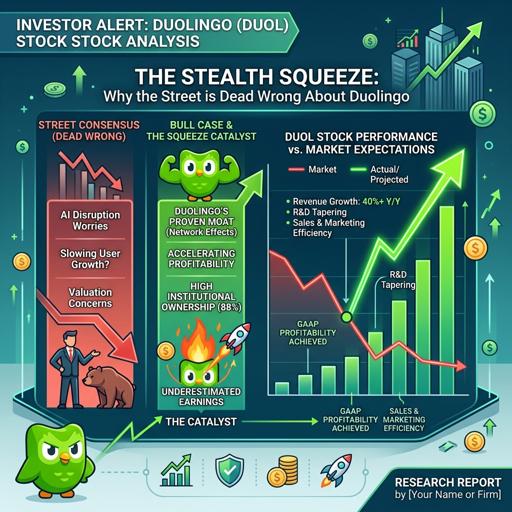
Most tourists on Wall Street look at a chart, see a stock down over 60% over the past year, and assume the thesis is dead. They read surface-level price action, skim a few headlines, and completely miss the underlying structural mechanics dictating the tape. Duolingo (DUOL) is currently providing a masterclass in market deception. While retail investors have been shaken out by volatility, a look beneath the surface reveals that some of the most sophisticated funds are engineering a massive stealth accumulation.
Fundamentals and the Institutional Raid
On the surface, Duolingo's Q2 2026 earnings were stellar. Daily Active Users (DAUs) surged by 23% year-over-year, and revenue climbed 18% to $298.5 million. Yet, it's not just the fundamental acceleration that matters—it's who is buying. Following the stock's recent dip, massive institutional whales came out of the woodwork. AQR Capital Management just filed a 13G revealing a brand-new 5.8% stake (2.33 million shares). Vanguard similarly declared a new 5.1% position. When quantitative and passive titans are hoovering up over 10% of the float while retail panics, you need to pay attention to the plumbing.
The Dark Pool Tells a Story of Hidden Accumulation
Let’s look under the hood at the off-exchange flow. By synthesizing the TRF ratio (off-exchange volume share), OTC short volume percentage, volume Z-score, and rolling close location value (rolling CLV), a glaring pattern of hidden institutional accumulation emerges. On August 6th, the volume Z-score exploded to a massive 3.37, perfectly coinciding with a punishing spike in OTC short selling (where the short percentage hit the 88th percentile). Typically, this level of aggressive off-exchange shorting should structurally crater a stock. Instead, the rolling CLV barely flinched, swiftly surging from 0.53 to nearly 0.78 in the subsequent sessions. This divergence is the hallmark of a classic bear trap—smart money institutions were quietly absorbing the aggressive short selling, providing an unshakable bid. When we see the TRF ratio and volume Z-score exhibiting near-term extremes in close proximity (such as late July's TRF ratio spikes to the 100th percentile followed by early August's volume blowouts), it is generally a potent signal that a major trend reversal is being established. The relentless upward march of the rolling CLV confirms that buyers are entirely dominating the final hours of trading, trapping the shorts and signaling a powerful stealth accumulation phase.
The Options Market: Gamma Flips and Explosive Upside Skew
Now, turning to the derivatives market, the options time-series data tells a story of textbook market maker repositioning. We observed the net GEX (net Gamma exposure) plunge into deep negative territory (-3.05M on August 5th and -1.47M on August 6th). This negative Gamma environment temporarily amplified downside volatility, forcing the price to its local bottom of $122.58. However, the subsequent, violent flip back to positive GEX (+1.35M on August 7th, scaling to +1.84M by August 12th) acted as a precise price inflection point, entirely neutralizing the bearish momentum. Throughout this turbulence, net DEX (net Delta exposure) remained massively positive—currently sitting at +125M—indicating that the broader institutional directional bias never wavered from being aggressively long. Furthermore, the OTM put/call OI ratio collapsed from a fearful 1.42 in late July to 0.81 during the August 6th bottom, signaling that institutions brilliantly monetized their tail-risk hedges at the exact lows and are no longer bracing for a crash. Looking at the current snapshot, near-term Gamma is heavily dictating the action: the August 21st expiration alone commands over +1M in net GEX, keeping the price anchored. Interestingly, market makers have established a bizarrely inverted front-month put wall at $140 and a call wall at $131, creating a tightly coiled, compressed pricing zone. But the real tell is in the volatility term structure and implied volatility skew—the 0-5 day options show Call IV exploding to an absurd 2.11 (compared to just 1.19 for puts). Options players are heavily skewing their pricing toward an imminent, violent upside breakout, paying a massive premium for near-term calls while ignoring downside risk.
The Verdict: A Coiled Spring
Duolingo is currently a textbook anomaly where price action is lying, but the volume and derivatives data are screaming the truth. The fundamentals are accelerating, quantitative institutions are buying hand over fist, and the options market has completely flushed out the weak hands. The shorts who piled in on August 6th are now trapped beneath a rising floor of positive Gamma. Expect the pressure to build until it breaks violently upward through the $140 level.
Sponsored