In This Article:
CTMX
Sponsored
The Anatomy of a Biotech Shakeout: Why CytomX’s Post-Offering Bleed is a Dark Pool Mirage
BullishStrongChange from report: -42.7%1M: -27.4%3M: -24.9%
Published on 2026-04-17 by TradeFomo
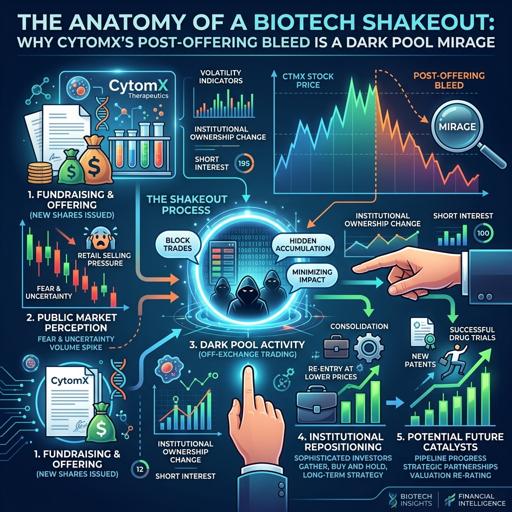
If you want to understand how retail investors get repeatedly fleeced in the biotechnology sector, you only need to look at the surface-level narrative surrounding CytomX Therapeutics (CTMX) over the last thirty days.
To the untrained eye, the chart looks like a classic "pop and dilute" graveyard. The stock surged to a 52-week high of $8.21 on March 16, 2026, backed by a monumental 121 million shares in trading volume. The catalyst? Positive Phase 1 dose expansion data for their oncology asset, Varsetatug masetecan (Varseta-M), in colorectal cancer.
Just three days later, management executed the inevitable biotech playbook: a massive $234.4 million secondary offering at $5.30 per share. Predictably, the weak hands panicked. The stock bled down into the mid-$4.00s, and retail traders moved on to the next shiny object, assuming the 700% one-year run was officially dead.
But if you ignore the surface noise and look at the subterranean tape—specifically the off-exchange footprints and institutional filings—a completely different, highly asymmetric narrative emerges. The $5.30 offering wasn't a top. It was a line in the sand for a new class of apex predators.
Decoding the Tape: The Hidden Institutional Accumulation
To see what the "smart money" is actually doing, we have to look away from the lit exchanges and analyze the confluence of four critical market microstructure metrics: the Off-Exchange Trade Ratio (TRF), the Off-Exchange Short Percent, the Volume Z-Score, and the Rolling Close Location Value (CLV). When analyzed together, these indicators strip away the noise and expose hidden liquidity, revealing whether off-exchange trading is being used for stealth distribution (dumping) or stealth accumulation (buying).
A massive divergence occurred in the tape starting around April 8, 2026. On that day, the Off-Exchange Trade Ratio (TRF) spiked to an extreme 96.6th percentile, indicating that almost all trading was being routed through dark pools and off-exchange facilities. Simultaneously, the Off-Exchange Short Percent plunged to the absolute floor, hitting the 3.3rd percentile. This is a violent anomaly. When you see maximum TRF volume paired with minimum shorting, alongside a muted Volume Z-Score (0.18), you are witnessing massive, stealthy institutional net-long accumulation. The whales were actively absorbing the post-offering retail panic without tipping off the public order book. Confirming this bullish absorption, the Rolling CLV—which measures where the stock closes relative to its intraday range—began a relentless upward march from a neutral 0.44 to a highly bullish 0.67 by mid-April. Institutions weren't just buying; they were ensuring the stock closed near the highs of the day, signaling aggressive overnight conviction. This four-metric confluence is a classic precursor to a major trend reversal.
The Smart Money Rotation: Out with the Indexers, In with the Sharks
The dark pool data told us a whale was accumulating in early April. Exactly one week later, the SEC filings proved it.
On April 16, Steve Cohen’s Point72 Asset Management dropped a Schedule 13G revealing a brand-new 5.0% stake in CytomX, holding 10.86 million shares. Point72 does not deploy capital of that magnitude into a post-offering biotech unless they see a severe mispricing.
But Cohen isn't the only one taking advantage of the liquidity event. In early March, Kynam Capital Management acquired a 5.29% stake. Furthermore, FMR LLC (Fidelity) has been ruthlessly averaging up, increasing their stake by over 33% earlier this year to hold a staggering 14.6% of the company (24.68 million shares).
Conversely, Vanguard zeroed out their 8.4 million share position entirely by mid-March. We are witnessing a profound shareholder base rotation. Passive indexers and retail traders have been flushed out, replaced by aggressive, alpha-seeking hedge funds who specialize in biotech M&A and late-stage clinical readouts.
The Fundamental Floor
With the stock currently trading at $4.89, the market is offering a rare arbitrage opportunity. The public can currently buy CTMX at roughly an 8% discount to the $5.30 price that institutional syndicates just paid to inject $234 million into the company.
That cash injection fundamentally de-risks the balance sheet. CytomX reported ending 2025 with $137 million, but with the new offering, their cash runway now extends deep into the second quarter of 2027. This provides ample runway to fully fund the registrational trial design for Varseta-M in late-line colorectal cancer, as well as combination studies with bevacizumab and Keytruda. The existential dread of biotech bankruptcy has been entirely removed from the equation.
The Misunderstood Options Market
Even the derivatives market is flashing signs of a coiled spring. Look at the open interest build-up. Throughout March, call volume was astronomical, pushing implied volatility to the brink. As the stock consolidated into April, put/call ratios on volume temporarily spiked as retail sought downside protection, but open interest remains heavily skewed toward long-term upside bets. The option market makers are pricing in a significant volatility expansion, and the downside is tightly capped by the recent institutional cost basis.
The Verdict
Wall Street has a habit of mispricing biotechnology stocks immediately following large capital raises. The algorithmic selling creates a mechanical drawdown that ignores the fundamental shift in the company's enterprise value and survival probability.
CytomX is no longer a cash-strapped biotech hoping for a miracle. It is a fully funded oncology player with validated Phase 1 data, backed by Steve Cohen and Fidelity. The off-exchange tape proves that while retail was licking its wounds from the post-offering dilution, the real money was quietly buying every share available below $5.00.
Trading at $4.89, CTMX is a coiled spring trading below institutional par. When the dark pool accumulation inevitably bleeds over into the lit markets, the gap back to the $6.00-$8.00 range will likely close faster than most anticipate. Ignore the surface noise; trust the tape.
Sponsored