Cogent Biosciences (COGT): The 500% Miracle Drug and the Smart Money's Quiet Exit
BearishStrongChange from report: -10.6%1M: +3.9%3M: +9.2%
Published on 2026-04-01 by TradeFomo
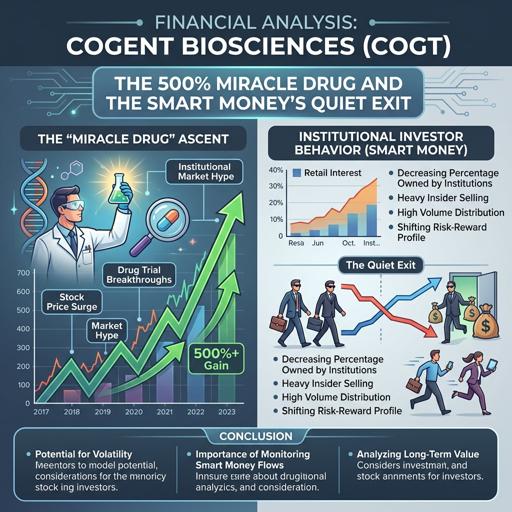
If you want to understand the lifecycle of a biotech blockbuster, look no further than Cogent Biosciences (COGT). Over the past year, COGT has delivered an eye-watering +493.9% return, transforming from a quiet mid-cap into a $5.48 billion behemoth. The retail crowd is exuberant, sell-side analysts are busy revising their price targets upward, and the narrative is flawless: their lead asset, bezuclastinib, just crushed its Phase 3 PEAK trial in Gastrointestinal Stromal Tumors (GIST) and delivered stellar Phase 2 results for Systemic Mastocytosis (SM).
On the surface, this looks like a buy-and-hold forever setup. But if you peer beneath the clinical data and dive into the SEC filings, the options flow, and the capital structure, a very different story emerges. A classic contrarian setup is forming. The drug is undeniably a clinical success—but the stock is currently priced for perfection, and the "smart money" is quietly, methodically heading for the exits.
Here is the data-driven case for why the easy money in Cogent Biosciences has already been made, and why retail investors buying here might just be providing exit liquidity.
The Structural Ceiling: Dilution and Delta-Hedging
To understand the current price action, we have to rewind to November 2025. On November 10, Cogent announced phenomenal Phase 3 PEAK trial results, showing a 50% reduction in the risk of disease progression or death compared to sunitinib monotherapy. The stock instantly gapped up from the $14 range to over $33.
How did management respond to this monumental valuation bump? They immediately went to the ATM.
On November 13, 2025, Cogent capitalized on the euphoria by pricing a massive dual-offering: an equity raise of roughly $324 million (selling shares at $31.00) and a $230 million convertible senior notes offering (1.625% due 2031).
While a $546 million capital injection secures their cash runway through 2027, the convertible notes fundamentally alter the stock's trading dynamics. Right now, COGT has a stubbornly high short interest of 15.6 million shares (14.22% of the float) as of mid-March 2026.
Retail investors often misinterpret this. You will see chatter on message boards about a "massive short squeeze" brewing. It isn't. This short interest is largely structural. When a biotech company issues convertible notes, institutional arbitrageurs buy the notes and short the underlying common stock to delta-hedge their positions. This creates an invisible, heavy ceiling on the stock. It’s not a squeeze setup; it’s an arbitrage cage.
Follow the Whales: The Insiders and Early Backers Are Distributing
The most glaring warning sign for COGT at its current $5.48 billion valuation is the behavior of its largest stakeholders. When the people who know the company best start dumping blocks of stock, we need to pay attention.
The Fairmount Funds Exit
Fairmount Funds Management LLC has been a massive early backer of Cogent. But look at their Form 144 and Schedule 13D/A filings from Q1 2026:
- January 22, 2026: Fairmount sold 3.5 million shares in a block trade at $36.40, cashing out $127.4 million.
- March 31, 2026: Fairmount converted 28,000 shares of Series A Convertible Preferred Stock into 7 million shares of Common Stock. On the exact same day, they dumped all 7 million shares at $34.66, cashing out another $242.6 million.
Within a single quarter, Fairmount has liquidated 10.5 million shares for roughly $370 million, reducing their ownership stake from 9.9% to 8.6%. This is textbook institutional distribution. They are converting preferred shares strictly to access liquidity on the open market.
The C-Suite Cash Out
It is not just institutional backers. Look at the C-suite’s Form 4 filings from late December 2025, right after the stock peaked in the low $40s following the APEX/SUMMIT data readouts:
- CEO Andrew Robbins: Disposed of 367,497 shares at $39.45.
- CMO Jessica Sachs: Sold 82,642 shares at an average of $38.70.
- CSO John Robinson: Sold 90,000 shares at an average of $38.74.
- CFO John Green: Sold 77,000 shares at $38.68.
Yes, a portion of these sales were mechanically tied to covering tax withholdings for vested performance RSUs. However, the sheer volume of shares hitting the bid from insiders right as the stock achieved its all-time high creates significant friction for any further upward momentum.
The Purgatory Phase: Why H1 2026 Will Be a Grind
Biotech stocks trade on the anticipation of clinical data and regulatory approvals. Cogent just delivered a flawless string of clinical victories in Q4 2025. Bezuclastinib works. The combination therapy for GIST is superior to the standard of care.
But what comes next?
We are now entering the classic "Biotech Purgatory." The company has stated they will submit a New Drug Application (NDA) for GIST and AdvSM in the first half of 2026. During the NDA filing and FDA review period, there is a distinct lack of needle-moving catalysts. The clinical suspense is gone; now comes the bureaucratic waiting game.
From a technical perspective, the stock is showing clear exhaustion. After peaking at $42.25 in mid-December 2025, COGT has steadily drifted down into the $35-$38 range. The MACD registered a dead cross above zero in late January and again in late February. While recent technicals show a mild "golden cross below zero" forming in late March, the stock is struggling to reclaim the $40 psychological level. The heavy overhead supply—driven by institutional selling and convertible arb hedging—is suppressing rallies.
The Verdict: A Great Drug, A Capped Stock
There is a profound difference between a successful biotechnology product and a high-upside stock. Bezuclastinib is a triumph of precision medicine that will likely generate substantial revenue.
However, at $38.49 per share and a $5.48 billion market cap, the market has already aggressively discounted years of future cash flows. The retail market is buying the narrative of the clinical data, but the smart money—led by Fairmount Funds and the C-suite—is aggressively monetizing that exact same narrative. Furthermore, the $230M in convertible notes ensures that delta-hedgers will dynamically suppress volatility, keeping the stock range-bound.
If you bought COGT in early 2025 at $4.50, congratulations on a historic trade. But if you are establishing a new position here in April 2026, ask yourself: Who am I buying these shares from?
The data strongly suggests you are buying them from the very insiders and early whales who engineered the run-up. Proceed with extreme caution.