In This Article:
CNC
Sponsored
The $6.7 Billion Mirage: Why Centene's (CNC) Manufactured Crisis is the Ultimate Bear Trap
BullishStrongChange from report: +83.9%1M: +51.3%3M: +86.6%
Published on 2026-04-03 by TradeFomo
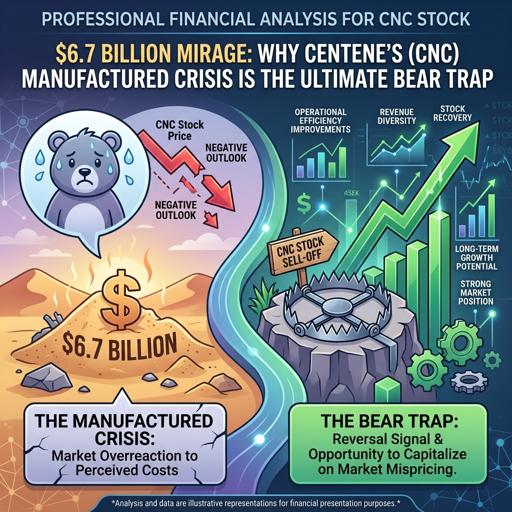
When Wall Street presents you with an accounting artifact wrapped in an algorithmic panic, you do not run. You look at the balance sheet, decode the off-exchange microstructure flows, and take the other side of the trade. Centene Corporation (CNC) is currently the poster child of market inefficiency—a fundamentally cash-gushing healthcare giant that has been priced like a distressed asset due to a headline accounting illusion.
Here is why the smart money is quietly accumulating the float while retail and passive funds capitulate.
A Masterclass in Deck-Clearing Accounting
In Q3 2025, Centene recorded a massive $6.7 billion non-cash goodwill impairment. The optics were brutal: GAAP diluted EPS collapsed to a horrific loss of $(13.50). Institutional mandates and automated risk models cannot parse the difference between cash burn and non-cash goodwill resets; they simply trigger indiscriminate selling.
Consequently, legacy mutual funds violently puked their shares into the abyss. Filings show that FMR LLC dumped 87% of its position (over 23.5 million shares), and Norges Bank liquidated 73% (19.4 million shares).
But goodwill impairments do not consume a single cent of actual cash. If you look at the Q3 2025 balance sheet, Centene was sitting on $17.18 billion in cash and equivalents. Against the current market cap of just $16.6 billion, the market is pricing the core operations of a $194 billion revenue company at an extreme distress discount. With management reaffirming 2026 adjusted EPS of greater than $3.00, CNC is trading at roughly 11x forward adjusted earnings, completely ignoring the fortress cash position that they are already using to prematurely retire $1 billion in 2027 senior notes.
The Great Quantitative Hand-Off
While the mutual funds were shaking out at the absolute bottom, the most sophisticated quantitative money stepped into the void. AQR Capital Management, notorious for exploiting deep-value statistical anomalies, filed a Schedule 13G revealing they had soaked up the liquidity, building a massive 6.47% stake (31.7 million shares) by the end of 2025.
More importantly, corporate insiders are fully aligned with a massive repricing. Rather than bailing, executives are locking in. CEO Sarah London holds over 889,000 performance and restricted stock units, with the performance units only becoming exercisable if the stock price reaches $100 per share for 20 consecutive days. The board of directors is not managing this company for a dead-cat bounce to $40; they are structurally positioned for a triple from current levels.
Decoding the Microstructure: The Exhaustion of the Bears
Let us dedicate a specific paragraph to jointly analyze the interplay among these four metrics: trf_ratio (off-exchange trade ratio), short_pct (off-exchange short volume ratio), vol_z_score (volume z-score), and rolling_cpv (rolling close position value). Together, these four metrics can reveal hidden institutional shorting or buying activity off-exchange, abnormal capital flow, and price-volume divergence signals. On March 10, 2026, when Centene’s stock plummeted nearly 16% to $36.40, the vol_z_score erupted to an extreme +4.49 alongside a massive surge in the trf_ratio to nearly 45%, with the short_pct concurrently spiking above 41%. If trf_ratio and vol_z_score both hit recent extremes on the same day, it often signals the start of a new trend—in this instance, an aggressive off-exchange institutional shorting algorithm designed to shake out weak hands following a seemingly benign guidance reaffirmation at the Barclays conference. However, the trend of rolling_cpv reflects the shifting balance of bullish vs. bearish positioning at close. Over the past week, the rolling_cpv has steadily climbed from a depressed 0.25 on March 23 to a commanding 0.627 by April 1. Simultaneously, the vol_z_score has collapsed into negative territory (-0.72), indicating profound seller exhaustion. Based on recent trends across all four metrics, my synthesized judgment is that the covert shorting frenzy has entirely burned out; institutional bears are out of ammunition, and stealth accumulation is now dominating the closing auction, setting the stage for a violent structural reversal.
The Options Market's Silent Divergence
If the equity tape is still painting a picture of fear, the options market has already moved on. Looking at the latest options summary data, the total put/call open interest ratio is sitting at an incredibly depressed 0.36.
This means that for every put contract held, there are nearly three calls. Options traders are heavily skewed toward the upside, betting that the downside is structurally floored by the cash pile and share repurchases. When the underlying equity market is bearish but the derivatives market is overwhelmingly bullish, you trust the derivatives market.
Final Thoughts
Centene is a classic deep-value trap for the bears. A non-cash impairment catalyzed an institutional wash-out, driving the valuation to a point where the enterprise value implies bankruptcy, while the actual cash flows support a massive turnaround. The algorithmic shorting has exhausted itself, smart money has taken the reins, and insider incentives are tied to a $100 price tag. The asymmetry here is generational.
Sponsored