In This Article:
CIEN
Sponsored
The Optical Illusion: Why Ciena’s Parabolic Run is a Trap
BearishStrongChange from report: -14.3%1M: +28.9%3M: +11.3%
Published on 2026-04-01 by TradeFomo
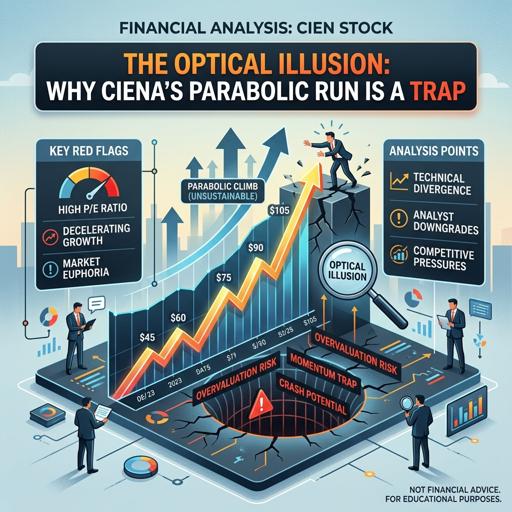
If you want to understand the late stages of a thematic market mania, you don't look at the undisputed kings of the cycle. You look at the downstream beneficiaries—the cyclical, low-margin hardware companies that the market has suddenly re-rated as secular, high-margin software monopolies.
Ciena Corporation (CIEN) is the perfect anatomy of this phenomenon.
In June 2025, Ciena was trading at $72. Today, in late March 2026, it sits near $388, having recently touched a high of $437. That is a roughly 500% gain in less than a year, pushing the market capitalization past $54 Billion. The narrative driving this is intoxicating: Ciena acquired Nubis Communications in October 2025, firmly attaching the "AI-driven networking" and "optical interconnect" halos to its corporate profile.
The market has priced Ciena for perfection. The data, however, tells a profoundly different story. If you peel back the layers of SEC filings, derivative market positioning, and insider behavior, the architecture of a massive mean reversion is hiding in plain sight.
The "Adjusted" Reality
The market cheered Ciena’s Q1 2026 results, celebrating the 8-K headline that touted an "Adjusted EPS" of $1.35 and year-over-year revenue growth. But when you look at the raw GAAP numbers underlying this AI-fueled renaissance, the reality is sobering.
GAAP Net Income for Q1 2026 was a mere $44.5 million. The preceding quarters saw net incomes of $19.4 million, $50.3 million, and $8.9 million. Over the trailing twelve months, Ciena has generated roughly $123 million in actual GAAP net income. At a $54.6 Billion market cap, the stock is trading at a trailing GAAP Price-to-Earnings multiple of over 440x.
Even if we generously apply their heavily massaged "Adjusted" metrics and project them forward flawlessly, you are paying software-as-a-service (SaaS) multiples for a capital-intensive communication equipment provider. Historically, the optical networking space is notorious for boom-and-bust capex cycles. The current AI infrastructure build-out is a powerful tailwind, but it does not alter the fundamental laws of hardware economics.
The Short Squeeze is Dead. The Puts are Alive.
The rocket ship from $200 in December to $400+ in March was not just driven by fundamental buying; it was heavily accelerated by a mechanical short squeeze.
The Short Squeeze Exhaustion
In mid-December 2025, short interest stood at 7.3 million shares (5.19% of the float). As the stock ripped through $250 and $300, shorts were forced to cover. By mid-March 2026, short interest had collapsed to 5.0 million shares (3.58% of the float). The forced buying that provided the jet fuel for this rally is largely exhausted. The marginal buyer today is no longer a desperate short seller; it is late-stage retail and passive capital.
The Derivatives Market is Bracing for Impact
While the equity market blindly buys the AI narrative, the smart money in the options market is aggressively positioning for a downside break. Look at the Open Interest (OI) Put/Call ratios:
- May 2025: Put/Call OI Ratio was extremely complacent at 0.41.
- December 2025: As the stock crossed $200, the ratio inverted, hitting 1.01.
- Mid-February 2026: With the stock pushing $300+, the Put/Call OI ratio spiked to an astounding 1.25.
It is highly unusual for a stock in a parabolic uptrend to see long-term put open interest outpace call open interest by this magnitude. The derivatives market isn't buying the permanence of this rally. They are building a massive wall of downside protection.
The C-Suite Exodus
If the future of Ciena is as bright as its valuation implies, someone forgot to tell the C-suite.
Corporate insiders frequently use 10b5-1 trading plans to automate sales, and some disposition is normal for tax withholding on vesting Restricted Stock Units (RSUs). However, the sheer volume and velocity of discretionary selling at Ciena over the last three months is staggering.
- Gary B. Smith (President & CEO): On January 5, 2026, Smith dumped 83,552 shares in a single day at an average price of ~$229, extracting nearly $19 million. He didn't stop there. He has executed continuous 10b5-1 sales of 2,952 shares every couple of weeks throughout February and March, riding the wave up to $366 per share.
- David M. Rothenstein (SVP & Chief Strategy Officer): Systematically liquidating chunks of 2,500 shares at $220, $300, and $345.
- Jason Phipps (SVP Global Sales): Dumped over 21,000 shares in mid-January for over $5 million.
- Dino DiPerna (SVP Global R&D) & Gage Brodie (SVP Global Products): Both are consistently cashing out tens of thousands of shares in the $300-$400 range.
Insiders are enthusiastically trading their optical hardware company shares for cash while the retail market trades their cash for an "AI proxy."
Technicals Flashing Red
For the momentum crowd, the chart is finally starting to break. On March 30, 2026, the MACD triggered a dead cross above the zero line. This follows a period in late February where the RSI was pinned in the high 70s, screaming "overbought." Furthermore, the massive gap up on February 6, 2026—which saw abnormal volume of 33.4 million shares (over 10x the moving average)—has all the hallmarks of a blow-off top climax.
Conclusion
Ciena is a solid company executing well in a favorable demand environment. But investing is about what you pay for that execution.
A 500% run in a hardware stock over 10 months requires a permanent paradigm shift in margins and cyclicality. The options market is betting heavily against that shift. The short sellers have already been squeezed out, removing the upside catalyst. The technicals are breaking. And the insiders who know the business better than anyone are aggressively heading for the exits.
When the AI-hardware fever breaks, the reversion to historical means for communication equipment stocks is typically swift and brutal. Ciena is an optical illusion, and the mirage is starting to fade.
Sponsored