In This Article:
CAKE
Sponsored
The Cheesecake Factory ($CAKE): Financial Engineering on the Menu
BearishStrongChange from report: +74.5%1M: +8.9%3M: +44.0%
Published on 2026-04-01 by TradeFomo
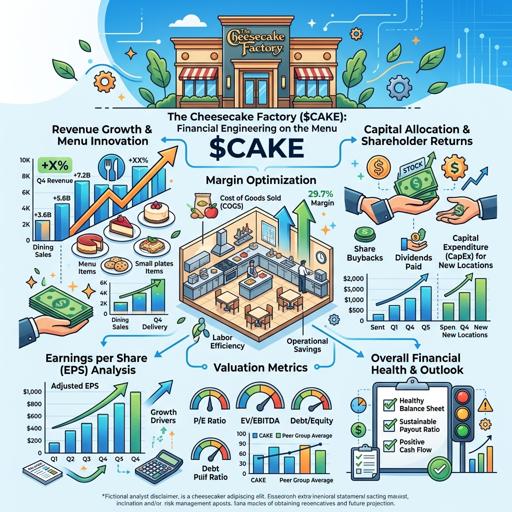
If you only read the headlines, The Cheesecake Factory ($CAKE) looks like a stable, cash-generating machine. On February 18, 2026, the company reported record Q4 2025 revenues of $961.6 million, declared a $0.30 quarterly dividend, and proudly announced a 5 million share increase to its buyback program.
The market initially swallowed the bait, pushing the stock to a half-yearly high of $65.94 by late February. But since then, the stock has tumbled nearly 17%, closing at $54.75 as of March 31. Retail investors are wondering if this is a buy-the-dip opportunity or the setup for a short squeeze.
If you look under the hood at the underlying unit economics, the options market anomalies, and the behavior of the C-suite, a much darker picture emerges. The Cheesecake Factory is currently serving up a masterclass in late-stage financial engineering to mask core business decay.
The Growth Illusion: Masking a Core Decline
In the restaurant industry, the ultimate truth-teller is comparable (same-store) sales. You can artificially inflate top-line revenue by aggressively opening new locations, but if your existing restaurants are bleeding traffic, your business model is contracting.
In their Q4 2025 earnings release, management quietly slipped in a brutal metric: comparable restaurant sales decreased by 2.2%.
To offset this organic decay, CAKE is brute-forcing top-line growth. They announced plans to open as many as 26 new restaurants in 2026. This is an incredibly capital-intensive strategy. They are essentially buying revenue to hide the fact that their core, mature locations are losing their pricing power and foot traffic.
A Debt-Fueled Sugar High
How does a company with shrinking same-store sales afford to build 26 new upscale restaurants, pay a healthy dividend, and buy back 5 million shares of its own stock?
It borrows the money.
On March 31, 2026, CAKE filed an 8-K revealing a Fifth Amended and Restated Loan Agreement. They established a new $400 million revolving credit facility, specifically noting it will be used for "general corporate purposes, including dividends, stock repurchases, and acquisitions." The covenants allow for a Net Adjusted Leverage Ratio of up to 4.25x.
Leveraging up the balance sheet at floating SOFR rates to fund share repurchases while organic sales decline is a massive red flag. It is the textbook definition of sacrificing long-term balance sheet health for a short-term EPS sugar high.
The Smart Money and Insiders Already Ran for the Exits
The most damning evidence against CAKE comes from the people who know the company best: the executives and the institutional options whales.
On February 18, 2026—the exact day CAKE announced its earnings and the massive new buyback program—the options market witnessed a terrifying anomaly. Volume exploded to 18,105 contracts (nearly 10x the moving average), with a staggering put/call volume ratio of 5.56. Somebody with deep pockets saw right through the buyback announcement and aggressively bought puts, betting that the stock was about to crater.
They were right. The stock enjoyed a brief, buyback-driven euphoria, peaking at $65.94 on February 25. And who was providing the sell-side pressure at the absolute top? The C-suite.
- Matthew Clark, CFO: Dumped 7,000 shares at $65.70 on February 25.
- Ashley Hanscom, Principal Accounting Officer: Sold 2,951 shares at $65.63 on February 25.
- Scarlett May, General Counsel: Followed suit, offloading 5,206 shares at $62.94 on March 10.
Let that sink in. The executives orchestrating a debt-funded share repurchase program were personally dumping their own shares into the buyback momentum. They used retail optimism as their exit liquidity.
The 20% Short Squeeze Trap
With short interest sitting at roughly 8.5 million shares (nearly 20% of the float) and the stock printing consecutive "monthly lows" throughout late March, retail traders might view CAKE as a prime short-squeeze candidate.
Do not take the bait.
The short sellers have unwavering conviction here, evidenced by short volume ratios consistently printing above 60% of daily trading volume. They are not covering because the thesis is playing out perfectly: inflation is eating the consumer, same-store sales are down, and the company is levering up to mask the pain.
Furthermore, institutional players are shuffling their exposure. Vanguard’s bizarre March 26 Schedule 13G/A filing noted an internal disaggregation that resulted in zero reported direct ownership at the parent level. The "smart money" is stepping away from the table.
The Verdict
The Cheesecake Factory is a classic value trap. The headline revenue numbers and dividend yield look appetizing, but the recipe is spoiled. Management is using debt to fund buybacks, covering up negative comparable store sales, while quietly cashing out their own equity at the top.
At $54.75, the stock is already down 16% this month, but the MACD dead crosses and persistent heavy put volume suggest the floor is much lower. Until the underlying unit economics stabilize, $CAKE is a falling knife wrapped in a debt-funded buyback illusion. Stay away.
Sponsored