In This Article:
CAI
Sponsored
The Anatomy of a Shakeout: The Generational Mispricing of Caris Life Sciences
BullishStrongChange from report: +104.1%1M: +23.8%3M: +51.0%
Published on 2026-05-13 by TradeFomo
The Optical Illusion of the May 8th Slaughter
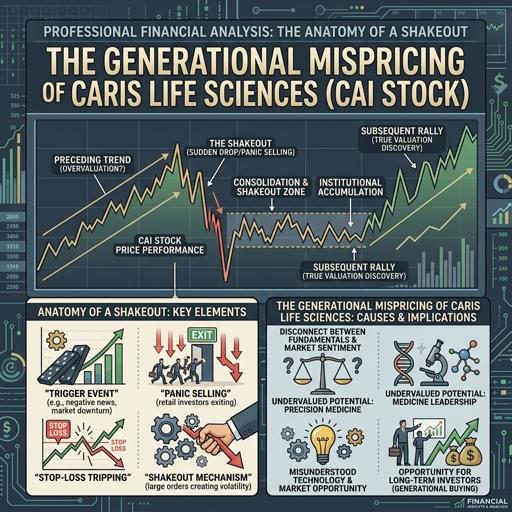
If you merely look at the daily chart of Caris Life Sciences (CAI), you see a horror story. On May 8, the stock suffered a violent 18.6% decapitation, plunging on gargantuan volume (8.87 million shares) and ultimately dragging the price to a yearly low of $15.94 just days later. Technical analysts are screaming "broken support," algorithms have triggered their risk-off triggers, and retail investors have capitulated.
But markets are exceptionally gifted at lying to those who only read the surface.
Contrarian investing isn't about blindly catching falling knives; it's about identifying severe dislocations between price action and fundamental reality. When we cross-reference CAI's recent fundamental milestones with its dark pool activity and institutional filings, a totally different narrative emerges. We are not witnessing the death throes of a biotech company. We are watching a masterclass in institutional liquidity harvesting—a manufactured shakeout designed to steal shares from weak hands.
The Fundamental Disconnect
Ask yourself: does a dying company print 79% year-over-year revenue growth?
In its Q1 2026 earnings released on May 7, CAI reported $216.2 million in revenue, driven by an 85% surge in molecular profiling services. They engineered a miraculous turnaround in profitability, shrinking a $102.6 million net loss in Q1 2025 to a mere $0.5 million today, essentially reaching breakeven. Gross margins exploded from 47% to 65%. They posted a positive Adjusted EBITDA of $26.2 million.
To cap it off, just weeks prior, CAI secured a staggering $1.2 billion credit facility from absolute apex predators in the credit space: Blue Owl Capital and Blackstone. You do not secure $1.2 billion in senior secured credit in this macroeconomic environment unless your cash flow visibility is bulletproof. Yet, the day after printing these flawless numbers, the stock imploded. Why? Because institutions needed liquidity to build massive positions, and in modern markets, you create liquidity by engineering panic.
Decoding the Dark Pool Architecture
To truly understand the mechanics of this engineered selloff, we must examine the hidden market matrix. When analyzing the synchronized movements of the TRF ratio, the off-exchange short selling percentage, the Volume Z-score, and the rolling close location value, a glaring money flow anomaly is exposed. Typically, a violent technical breakdown is accompanied by heavy off-exchange shorting as predators smell blood. Yet, on May 8, when the Volume Z-score went parabolic to an extreme of +4.618, the off-exchange short selling percentage paradoxically collapsed to the 33rd percentile. This severe price-volume divergence is the smoking gun: the massive volume was not a coordinated short attack, but rather extreme retail capitulation crashing into a massive, hidden institutional bid. By May 11, the TRF ratio spiked to a recent zenith just as the stock tagged its yearly low. As a general rule, when the TRF ratio and Volume Z-score exhibit consecutive or localized extremes, it is the classic footprint of a trend reversal being born in the shadows. Furthermore, the rolling close location value—which measures the closing power of bulls versus bears over a 5-day window—refused to pin at absolute zero despite the price destruction. Instead, it formed a resilient baseline and began inflecting upward by May 12. Combined, these four indicators scream that institutions were actively buying the dip via dark pools, absorbing the panic to build long exposure.
The Institutional Feast and Insider Conviction
If the dark pool data is the footprint, the SEC filings are the body. While retail was panic-selling the "bad chart," the smartest money on Wall Street was eagerly swallowing the float.
Recent 13G and 13F amendments filed over the last few weeks reveal a feeding frenzy:
- Fidelity (FMR LLC) doubled down, increasing its stake to an enormous 10.8% (over 30 million shares).
- J.H. Whitney unveiled a massive 6.5% new position.
- TSSP Sub-Fund HoldCo (managed by Sixth Street partners) locked in a 4.8% stake.
- Heavyweights like Vanguard and UBS have actively initiated or bolstered their positions.
But the ultimate "tell" comes from the boardroom. On May 11, the exact day the stock touched its $15.94 yearly low, CAI Director Jeff Vacirca stepped into the open market and purchased 31,050 shares of common stock at an average price of $16.14. Insiders might sell for a dozen reasons—taxes, buying a house, diversification—but they only buy in the open market for one reason: they know the stock is severely mispriced.
The Options Coil
Adding fuel to the fire is the recent options market activity. On May 11 and May 12, the total options amount traded absolutely exploded to over $500,000 per day, compared to a meager $2,000–$30,000 baseline in late April. The put/call open interest ratio sits at an elevated 1.32, indicating heavily skewed downside hedging that is now acting as a coiled spring. If the stock begins to pivot upward based on institutional accumulation, the unwinding of these bearish bets will trigger a localized gamma squeeze, forcing dealers to buy the underlying stock and accelerating the upside momentum.
The Verdict
We are staring at a textbook psychological trap. The May 8th plunge was an optical illusion—a manufactured discount mechanism that allowed multi-billion-dollar funds to back up the truck on a biotech company that just achieved near-breakeven profitability, expanding margins, and massive top-line growth.
When you see off-exchange shorting evaporate during a high-volume crash, while TRF dark pool ratios spike at the lows and insiders deploy personal capital, you ignore the technical analysts drawing downward lines on a chart. Caris Life Sciences isn't breaking down; it is winding up. The weak hands have been successfully shaken out, and the next sustained move will likely be a violent repricing to match its fundamental reality.
Sponsored