In This Article:
ASX
Sponsored
The Semiconductor Mirage: Why ASE Technology's 250% Run is a Gamma-Fueled Trap
BearishStrongChange from report: +28.2%1M: +9.2%3M: +12.2%
Published on 2026-05-14 by TradeFomo
The Facade of Unprecedented Growth
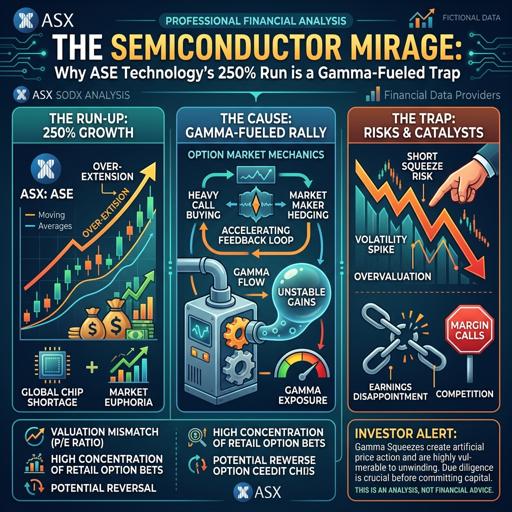
If you look at ASE Technology Holding Co. (ASX) today, you see a darling of the semiconductor boom. Up over 42% in just the last month and an eye-watering 258% over the past year, the chart looks like a flawless one-way ticket to the moon. Technical indicators are screaming "Yearly High" day after day, and the stock is comfortably floating above its 20-day and 60-day moving averages. To the untrained eye, this is a secular growth story. To a seasoned observer of market plumbing, this is a fragile house of cards waiting for a stiff breeze.
The underlying financials tell a story of moderate, albeit solid, growth—Q1 2026 revenues were up 17% year-over-year but actually declined 2.4% sequentially. Yet, the stock is pricing in a paradigm shift that outpaces the fundamentals. This isn't purely rational price discovery; it's a mechanical market anomaly disguised as an unstoppable bull run.
The Gamma Squeeze Mechanics
To understand why the price has disconnected from reality, you only need to look at the options market on May 5, 2026. Total option volume exploded to an abnormal 36,747 contracts—dwarfing the 10-day, 20-day, and 3-month moving averages. But the real smoking gun is the volume put-call ratio of 0.02. That means for every put bought, 50 calls were purchased.
This is the absolute fingerprint of a classic gamma squeeze. Retail and speculative funds are aggressively bidding up out-of-the-money calls, forcing market makers and dealers to delta-hedge by buying the underlying stock. This creates a reflexive feedback loop that drives the price higher, completely divorced from fundamental valuation. It is a synthetic rally, and like all synthetic rallies, it will evaporate the moment the call buying dries up and dealers begin to unwind their hedges.
Decoding the Dark Pools: Unmasking Institutional Distribution
To truly understand the impending reversal, we must look beneath the surface and analyze the linkage between the off-exchange TRF ratio, the OTC short volume percentage, the volume Z-score, and the 5-day rolling close location value. Viewed collectively, these four indicators act as a decoder ring for hidden institutional activity, exposing stealthy short or long positioning, abnormal capital flows, and critical volume-price divergences. A simultaneous occurrence of recent extremes in the TRF ratio and volume Z-score typically heralds the dawn of a new trend, which is exactly what we witnessed on April 24th when a massive volume Z-score blowout (2.026) coincided with an extremely high TRF ratio (83rd percentile), igniting this final parabolic leg. However, the most recent data paints a remarkably sinister picture. As the calendar turned to mid-May, the OTC short volume percentage exploded to extreme highs—hitting the 96th percentile by May 13th—while the rolling close location value remained stubbornly elevated around 0.77, artificially reflecting continued closing strength. This creates a glaring volume-price divergence: despite the rolling CLV indicating that the long side is still winning the daily closing auctions, the suddenly negative volume Z-score (-0.717) and surging off-exchange shorting reveal that smart money is quietly but aggressively laying down massive short bets in the dark pools. Institutions are effectively feeding the retail gamma machine just enough liquidity to keep the closing prices high, while simultaneously executing a massive stealth distribution.
The Insider Exodus
If you want to know if a building is structurally sound, watch the architects. If they are sprinting for the exits, you shouldn't be bidding on the penthouse. Over the past month, we have seen a relentless wave of Form 4 filings from ASX insiders cashing out.
Director Jeffrey Chen has been offloading shares systematically throughout April, dumping blocks of shares day after day. Even more glaringly, Chen Tien-Szu, GM of the Chung-Li Branch, disposed of a massive 530,000 shares right as the stock was breaking into its current parabolic run. These aren't just scheduled tax-loss harvesting sales; this is a calculated, aggressive liquidation by the people who know the company's real operational ceiling. They are using the massive liquidity provided by the retail gamma squeeze to exit their positions at generational tops.
The Contrarian Verdict
The market is currently hypnotized by the momentum of the semiconductor super-cycle, blinding participants to the structural deterioration beneath the surface of ASE Technology. We have an exhausted, RSI-overbought chart propped up by a mechanical options squeeze, massive hidden institutional shorting in the off-exchange facilities, and an exodus of insider capital.
When the options market normalizes and the dealer hedging reverses, the trapdoor will open. The artificial bid will vanish, and the stock will rapidly reprice to its fundamental reality. The data is hiding in plain sight for anyone willing to look beneath the simple moving averages. Don't be the exit liquidity when the music finally stops.
Sponsored