The Cleanroom Squeeze: Why Aeluma’s Cap Table Rotation is a Ticking Time Bomb for Shorts
BullishSpeculativeChange from report: +4.5%1M: +99.1%3M: +59.5%
Published on 2026-04-01 by TradeFomo
Loading content...
If you look at the surface-level data for Aeluma Inc. (ALMU) right now, you would probably run the other way. You see a micro-cap semiconductor stock that has bled out from its 52-week highs of $25 down to the $13 level. You see a CEO selling shares, a major 10% beneficial owner aggressively dumping his position, a newly filed $50 million At-The-Market (ATM) offering, and a short interest that has violently doubled in the last six months.
The crowd is screaming that this company is a toxic dilution trap. The algorithms are shorting every pop.
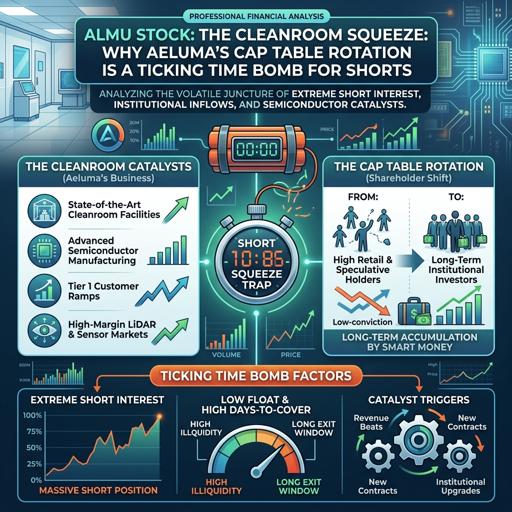
But when you peel back the layers of the actual SEC filings, the financial statements, and the underlying market mechanics, a completely different narrative emerges. This isn't a death spiral. It is a textbook, painful, yet highly lucrative cap table rotation. And the bears—who are now shorting over 20% of the float—are walking blindly into a trap.
To understand the contrarian play, we first have to acknowledge why the shorts are salivating.
Over the last few months, insider activity has looked terrible to the untrained eye. Mark N. Tompkins, a former 10% owner, has been relentlessly offloading stock. Between December 2025 and early February 2026, he dumped hundreds of thousands of shares, eventually crossing below the 10% ownership threshold.
To compound the optics, CEO Jonathan Klamkin executed sales of roughly 50,000 shares in early March 2026 at an average price around $17.70 to $18.40. Director Steven DenBaars also unloaded 25,000 shares in late February.
As if insider selling wasn't enough to spook retail, on March 20, 2026, Aeluma filed an 8-K announcing a massive $50 million At-The-Market (ATM) sales agreement. For a company with a market cap hovering around $233 million, a $50M ATM implies potentially severe dilution.
The short sellers looked at these two factors—insiders cashing out and a massive ATM—and pounced. Short interest surged from 1.1 million shares (8.5% of the float) in September 2025 to a staggering 2.61 million shares (20.24% of the float) by mid-March 2026.
The bears are trading on the assumption that Aeluma is desperate for cash and that insiders are abandoning a sinking ship. The data tells a completely different story.
Let’s look at the actual balance sheet. In their Q2 2026 earnings report (ended December 31, 2025), Aeluma reported a cash and cash equivalents balance of $38.6 million, a massive increase from the $15.7 million they held at the end of the previous year.
What is their cash burn? The GAAP net loss for the quarter was a mere $1.9 million.
Aeluma is sitting on nearly $40 million in liquidity with a sub-$2 million quarterly burn rate. They have an exceptionally long runway. So why file a $50 million ATM? Because in the semiconductor space—specifically in AI, AR/VR, and quantum computing infrastructure—you need a war chest to scale manufacturing readiness and secure massive defense and aerospace contracts (like their recent wins with NASA). The ATM is not a desperation lifeline; it is a strategic weapon to fund rapid commercialization when the time is right. The shorts are treating a growth vehicle like a distressed asset.
Here is the smoking gun that the bears missed. While legacy holder Mark Tompkins was aggressively selling his position—driving the price down and giving shorts a false sense of security—new institutional money was quietly accumulating at the bottom.
On March 31, 2026, a Schedule 13G was filed by George Perry (through Boisei Investments LLC), revealing the acquisition of exactly 1,000,000 shares, representing a 5.6% stake in the company.
This is the definition of a cap table hand-off. Weak, legacy hands exit, suppressing the price and attracting short sellers. Once the legacy seller is exhausted, deep-pocketed institutional money steps in at the floor. Boisei Investments didn't buy 1 million shares of a $13 micro-cap tech stock to lose money. They see the fundamental inflection point.
The combination of the fundamental reality and the technical setup has created a highly asymmetric risk/reward profile.
From a technical standpoint, the selling pressure has reached structural exhaustion. In late March, as the stock drifted into the $12.20 - $13.00 range, our internal price indicators flagged consecutive "quarterly low" and "monthly low" signals. By March 31, multiple timeframes confirmed a potential structural bottom. The daily short volume ratios have been consistently elevated (hovering between 55% and 70%), indicating that the recent downward pressure is almost entirely synthetic (short-driven) rather than fundamental selling.
Short interest sits at 20.24% of the float. That is an enormous liability for the bears in a stock with a $233 million market cap and a newly minted 5.6% institutional holder who just locked up 1 million shares of the float.
When a heavily shorted stock successfully rotates its cap table from a distressed insider to a long-term institution, the available borrow dries up. The moment Aeluma announces a new aerospace contract, an expansion of their AI sensor IP, or even just allows the ATM to sit idle without diluting, the shorts will realize they are trapped in a crowded trade.
The panic to cover 2.6 million shares in a stock that trades roughly 400k-700k shares a day will not be orderly.
Aeluma isn't a dying company diluting itself into oblivion. It is a highly capitalized semiconductor innovator trading at a local bottom due to a temporarily ugly—but highly necessary—cap table rotation. The legacy sellers are out. The smart money is in. The shorts are overextended at 20% of the float.
When the market realizes the ATM is a growth facility rather than a survival tactic, the repricing of ALMU will be violent. Watch the $12-$13 accumulation zone closely; the fuse has already been lit.