The TYK2 Trojan Horse: Exposing the Engineered Squeeze in Alumis Inc. (ALMS)
BearishStrongChange from report: -64.4%1M: +15.1%3M: +24.3%
Published on 2026-04-04 by TradeFomo
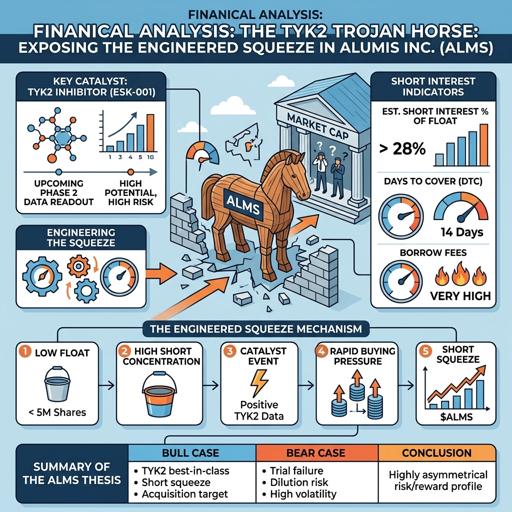
Wall Street loves a redemption story, particularly in the biotech sector where clinical data can turn a forgotten micro-cap into a multi-billion dollar darling overnight. If you glance at the headlines for Alumis Inc. (ALMS), you see a triumphant narrative: a successful Phase 3 readout for their plaque psoriasis drug, a freshly fortified balance sheet from a $345 million secondary offering, and a stock price that has surged over 300% from its late-2025 lows.
But if you strip away the press releases and dig into the SEC filings, dark pool tape, and options flow, a much more cynical reality emerges. What looks like a clinical breakthrough is actually a masterclass in engineered liquidity. The smart money is already heading for the exits, leaving retail bagholders holding the bag.
The Anatomy of an Orchestrated Liquidity Event
To understand the current setup, we have to rewind to November 2025. Alumis was languishing in the $4 to $6 range. The broader market had left it for dead. Yet, the Form 4 filings tell a story of aggressive, pre-meditated accumulation. Between mid-to-late November, heavyweights like Foresite Capital (via James Tananbaum) and Samsara BioCapital (via Srinivas Akkaraju) backed up the truck. Akkaraju acquired hundreds of thousands of shares between $5.25 and $7.20, while Foresite entities vacuumed up over 500,000 shares in the same window.
Less than two months later, on January 6, 2026, Alumis conveniently dropped positive Phase 3 ONWARD1 and ONWARD2 results for their TYK2 inhibitor, envudeucitinib. The stock squeezed violently from an $8.31 close the prior day to an intraday high of $22.30.
Retail traders thought they had discovered the next blockbuster. But the insiders knew better. Just three days later, on January 9, Alumis executed a 17.65 million share public offering at $17.00, raising $345 million. The institutions who accumulated at $6 perfectly utilized the retail-driven liquidity event to recapitalize the company, tripling their money on their recent tranches in a matter of weeks.
The Mirage of Envudeucitinib and the $3 Million Couch Change
The Phase 3 data for envudeucitinib is good—hitting PASI 90 in roughly 65% of patients at Week 24. But "good" does not mean "commercial dominance." The TYK2 inhibitor space is intensely crowded, dominated by Bristol Myers Squibb's Sotyktu and a slew of heavily-funded fast-followers.
Alumis's cash burn is staggering. Their 2025 R&D expenses alone hit an eye-watering $386 million, culminating in a net loss of $243 million for the year. Yes, they now have over $308 million in cash post-offering, but commercialization prep and Phase 3 extension trials will incinerate that runway faster than the market anticipates.
The underlying desperation for capital is hidden in plain sight. On January 2, 2026, Alumis filed an 8-K announcing a Notice of Material Breach and indemnification claim against Climb Bio over a missing $3 million milestone payment. When a $2.4 billion biotech company, burning nearly $400 million a year, initiates a public legal spat over a $3 million milestone, it exposes an intense internal fight for non-dilutive capital. It is the corporate equivalent of a billionaire digging through the sofa cushions for loose change.
Executive Options: The $26.31 Magnet
If you want to know where a stock is going, look at how the executives are compensated. On January 26, 2026, the Alumis C-suite received a massive issuance of stock options. CEO Martin Babler alone was granted 745,875 options. The strike price across the board? $26.31—the exact closing price of the stock that day.
Over the ensuing month, the stock was mechanically bid up on drifting volume to a peak of $30.60 in mid-February, conveniently putting these massive grants into the money and painting a beautiful technical breakout on the chart. But the incentive structure had already done its job. Since that February peak, gravity has taken over.
Follow the Form 4s: The Pro-Rata Supply Shock
The most bearish signal hiding in the filings dropped on April 3, 2026. Foresite Labs and Foresite Labs Affiliates 2021 filed Form 4s disclosing the execution of a "pro rata distribution" of over 2.3 million shares to their members on April 1, for zero consideration.
A pro rata distribution is not an open-market sale, but its market impact is often far worse. It bypasses the public tape and places millions of shares directly into the hands of Limited Partners (LPs). When LPs receive an in-kind stock distribution after a company's equity has ripped 300% in six months, they do exactly what any rational fiduciary would do: they liquidate to lock in their returns. This creates a massive, invisible wall of incoming supply.
Beneath the Surface: Dark Pools and Capital Flows
To truly decode the reality of this stock's valuation, we must jointly analyze the interplay among these four metrics: trf_ratio (off-exchange trade ratio), short_pct (off-exchange short volume ratio), vol_z_score (volume z-score), and rolling_cpv (rolling close position value). Together, these four metrics can reveal hidden institutional shorting or buying activity off-exchange, abnormal capital flow, and price-volume divergence signals. During the massive January 6 gap-up, the vol_z_score exploded to 8.49. However, the trf_ratio registered at 38.4%, and within that dark pool activity, the short_pct spiked to a staggering 63.4%. Institutions were relentlessly shorting into the retail buying frenzy. This distribution was confirmed by a deeply depressed rolling_cpv of 0.259, meaning bears forcefully took control by the close, walking the stock down from its $22.30 high. If trf_ratio and vol_z_score both hit recent extremes on the same day, it often signals the start of a new trend. We saw this exact trigger again on March 30: the vol_z_score spiked to 3.44 alongside a trf_ratio surge to 42.1%, initiating the recent 18% sell-off. The trend of rolling_cpv reflects the shifting balance of bullish vs. bearish positioning at close, and its inability to push meaningfully above the 0.50 median in early April confirms enduring weakness. Meanwhile, the short_pct quietly re-elevated to 62.4% by April 2. Based on recent trends across all four metrics, my synthesized judgment is that smart money is actively distributing and stealth-shorting on every uptick, setting the stage for a severe structural correction.
The options market confirms this dark pool thesis. In the weeks prior to the March 30 "sell-the-news" drop, the put/call volume ratio spiked to wildly abnormal levels—hitting 3.97 on March 17 and 2.49 on March 27. Someone was quietly loading the boat with puts right before the floor gave out. Furthermore, reported short interest has ballooned from 2.8 million shares in late October 2025 to 8.96 million shares (12.61% of the float) by mid-March 2026. The smart money isn't covering; they are pressing the short.
The Contrarian Verdict
Wall Street analysts are currently selling a euphoric story of a blockbuster TYK2 inhibitor with a pristine balance sheet. But the data tells a story of a crowded trade, an unsustainable cash burn, and an impending wall of LP supply from pro rata distributions.
The current $23.37 price tag is an illusion propped up by the recency bias of clinical data and executive option targets that have already been met. With dark pool metrics screaming distribution and off-exchange short ratios holding above 60%, the smart money is already at the exits. Retail traders buying ALMS here aren't investing in a biotech revolution; they are providing the exit liquidity for the institutions that bought at $6.