In This Article:
ADMA
Sponsored
The Anatomy of a Mismatch: Why ADMA Biologics' Panic Selloff is a Contrarian Goldmine
BullishStrongChange from report: -1.5%1M: +18.2%3M: -9.5%
Published on 2026-03-27 by TradeFomo
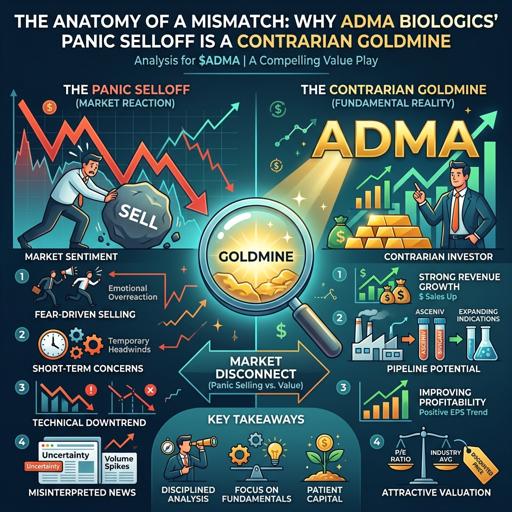
In the markets, truth is often obscured by optics. When you see a stock lose nearly half its value in a matter of weeks on record-breaking volume, the instinct is to assume the underlying business is fundamentally broken. But if you look under the hood of ADMA Biologics (ADMA), you don't find a broken company. You find a perfect storm of insider optics, algorithmic misinterpretation, and structural market inefficiencies that have created a rare, asymmetric buying opportunity.
As of March 26, 2026, ADMA is trading at $8.29, down from the $16 level just weeks ago. The 14-day RSI sits at a deeply oversold 16.98. The herd is running for the exits, trading 34 million shares in a single session. Let's break down exactly why they are wrong, and why the smart money is quietly taking the other side of this trade.
The Classic "Red Flags" That Trapped the Herd
If you screen for red flags, ADMA triggered all of them in rapid succession over the last six weeks.
First, the Chief Financial Officer, Brad Tade, announced his retirement on February 25, 2026. A CFO transition is blood in the water for short sellers. Right on cue, short interest spiked from 19.1 million shares in late February to 25.8 million shares by March 13—representing over 11% of the float.
Second, the optics of insider activity looked terrible to the untrained eye. On March 2, the company announced a massive $125 million Accelerated Share Repurchase (ASR) program, funding it via a credit facility, essentially buying back stock at an initial reference price of $15.57. Meanwhile, CEO Adam Grossman was systematically selling his own stock. On March 16, he exercised options at $5.40 and immediately dumped shares at $15.16. To the retail crowd and momentum algos, this looks like classic "do as I do, not as I say" behavior—the CEO uses the company's balance sheet to prop up the stock while cashing out his personal chips.
When the stock began to slip on March 23, the panic selling initiated. But the mechanics of what is happening now tell a completely different story.
The VWAP Masterstroke: Why the Crash is Actually Bullish
The herd assumes the $125 million buyback at $15.57 was a terrible capital allocation error by management. They don't understand how an Accelerated Share Repurchase actually works.
While ADMA received an initial delivery of 6.4 million shares (80% of the expected total at $15.57), the final number of shares retired is determined by the volume-weighted average price (VWAP) over the term of the ASR (expected to be five months), minus a discount.
Because the stock has violently crashed to $8.29, the VWAP of this ASR is plummeting. The company isn't stuck holding the bag at $15; rather, this crash is actively destroying the float. ADMA will end up retiring significantly more shares than originally modeled. They used debt to launch a buyback, and the market just gave them a 50% discount on the execution. This is highly accretive to remaining shareholders.
The Vanguard Mirage: When Algorithms Panic
On March 26, the heaviest volume day of the crash (34.1 million shares traded, 5x the 20-day average), an SEC Schedule 13G/A was filed by The Vanguard Group. The filing showed Vanguard's ownership dropping from over 38 million shares to exactly 0.
For algorithmic trading bots that scrape SEC filings for sentiment, a major institution dumping 38 million shares is an immediate "sell at any cost" trigger. But if you actually read the footnotes of the filing, Vanguard explicitly states: "The Vanguard Group, Inc. no longer has beneficial ownership of certain securities due to an internal realignment on January 12, 2026, where subsidiaries began reporting beneficial ownership separately."
Vanguard didn't dump the stock. They shuffled the paperwork. Yet, the algorithms and the panic-stricken retail market saw a zero and aggressively sold into the void, pushing the price down an additional 13.9% on the day.
The Fundamental Disconnect
While the market is pricing ADMA like an imminent bankruptcy, the financials represent a thriving, highly profitable biotech operation.
In January 2026, ADMA reported preliminary 2025 revenues of $510-$511 million. Their Q3 2025 GAAP net income was $36.4 million. More importantly, they are projecting over $1.1 billion in annual revenue and over $700 million in Adjusted EBITDA by fiscal 2029, driven by their new yield-enhanced plasma production which significantly expands gross margins.
At the current price of $8.29, ADMA's market cap has been crushed to roughly $1.97 billion. If management executes on their 2029 guidance, you are buying a profitable biotech company at less than 3x forward EBITDA.
Follow the Smart Money: The Options Market Reversal
While retail is panic selling, the options market is telling a fascinating story of capitulation and smart-money accumulation.
On March 23, when the breakdown started, the Put/Call volume ratio spiked to an extreme 5.45 on 7,869 contracts. People were paying any premium for downside protection. Fast forward to the algorithmic panic on March 26: total options volume exploded to 45,355 contracts, but the Put/Call volume ratio collapsed to 0.23.
Let that sink in. On the ugliest down day in a year, call option volume outpaced put option volume by more than 4-to-1. Institutional players recognize the Vanguard filing for the mirage it is, and they are stepping in to buy the blood via highly leveraged, low-premium call options.
The Verdict: A Calculated Asymmetric Bet
ADMA Biologics is currently the victim of a cascading liquidity event. Short sellers smelled blood on the CFO transition, insider sales created terrible optics, technical supports broke, and an algorithmic misinterpretation of a Vanguard 13G/A filing created a crescendo of blind selling.
But the facts remain: ADMA is generating robust cash flow, is structurally improving its margins, and is using this very crash to hyper-charge the accretion of its $125 million share repurchase program. At $8.29, the stock isn't just cheap—it's mathematically dislocated. When the dust settles and the algorithms re-calibrate, the reversion to the mean here will likely be as violent as the downside.
Sponsored