The Anatomy of a Stealth Squeeze: Why Acrivon Therapeutics is Smart Money's Best Kept Secret
BullishStrongChange from report: -11.0%1M: -12.6%3M: -16.2%
Published on 2026-04-24 by TradeFomo
Loading content...
Most retail investors look at clinical-stage biotechs and see a binary roulette wheel. They see cash burn, they see the constant threat of dilution, and they run for the hills. But if you actually understand how to read the plumbing of the stock market—the SEC filings, the dark pool prints, the micro-structural tape—you begin to see when the casino operators are quietly stacking the deck in their own favor.
Acrivon Therapeutics (ACRV) is currently trading around $1.89. On the surface, it looks like just another beaten-down biotech trying to survive in a high-rate environment. But a deep dive into the idiosyncratic data over the last sixty days reveals something entirely different. We are witnessing a textbook, highly coordinated institutional accumulation phase. The trap has been set, the floor has been engineered, and a massive contrarian move is imminent.
Let’s step back to March 1, 2026. Acrivon’s board issued a massive wave of stock option grants to its core executive team—the CEO, COO, CFO, Chief Medical Officer, and Chief Legal Officer. The strike price for these millions of options was set at exactly $1.51.
In the weeks following these grants, the stock drifted down, touching multi-timeframe lows and bottoming out at $1.29 by late March. Mainstream technical analysis would call this a breakdown. I call it a manufactured capitulation. Management knew they had fully secured the rights to their proprietary ACR-368 OncoSignature test after terminating their agreement with Akoya, internalizing their most critical companion diagnostic. Furthermore, they just reported a 52% confirmed overall response rate (cORR) for ACR-368 in endometrial cancer. They locked in their cheap equity right before the fundamental inflection point.
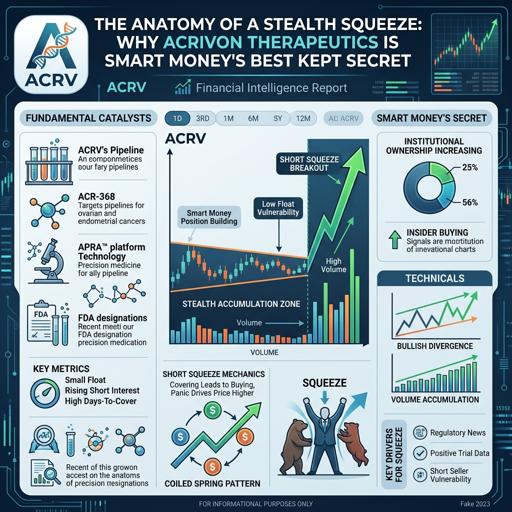
To truly understand what happened this week, we must look at the shadow market—specifically, the comprehensive interplay between the off-exchange volume ratio (TRF ratio), the off-exchange short volume ratio, the volume Z-score, and the rolling close location value. When analyzed together, these four indicators act as a polygraph test for the market, revealing hidden institutional accumulation or distribution, anomalous money flows, and critical price-volume divergences. Historically, when the TRF ratio and the volume Z-score simultaneously print extreme values on the exact same day, it is a high-probability signal that a violent new trend is being born. Meanwhile, the trajectory of the rolling close location value exposes the true balance of power between bulls and bears going into the closing bell. Looking closely at Acrivon's tape on April 22, we saw an absolute micro-structural earthquake: the TRF ratio hit a stunning 100th percentile extreme alongside a volume Z-score explosion to +6.18 standard deviations, screaming that dark pools and off-exchange facilities were overwhelmed with unprecedented order flow. But crucially, the off-exchange short volume ratio plummeted to the 3rd percentile. Institutions weren't hiding to short; they were hiding to desperately accumulate massive long positions. Backing this up, the rolling close location value trended aggressively higher (hitting 0.553, with a daily print of 0.800), proving that buyers were aggressively lifting offers and defending the closing price. My comprehensive judgment based on these four metrics is definitive: the smart money just engineered a multi-month bottom, soaked up millions of shares in the dark, and ignited a major bullish trend reversal.
If the quantitative data points to institutional buying, the SEC filings provide the smoking gun. On April 23, RA Capital Management—one of the most sophisticated healthcare funds in the world—amended their Schedule 13D.
We now know exactly who was causing that massive off-exchange volume anomaly on April 22. RA Capital stepped in and bought 3,888,888 shares directly via an at-the-market (ATM) offering at $1.80 per share. Let that sink in. Instead of the company slowly bleeding ATM shares into the retail market to raise capital and depressing the stock price, a top-tier institutional insider swallowed the entire $7 million block whole. RA Capital now owns 28.8% of the entire company.
When an insider fund of this caliber buys an ATM offering directly at a premium to the recent historical baseline, it is the ultimate contrarian signal. They know that the cash runway is now secured well into Q2 2027, neutralizing the primary bear thesis.
While the "smart money" is accumulating, the stale shorts are trapped. Back in January 2026, short interest on ACRV peaked at an absurd 52% of the float. While some covering occurred during the February and March dip, the latest settlement data heading into April still shows roughly 15% of the float sold short.
These shorts were betting on ACRV running out of cash and diluting the market into oblivion. Instead, RA Capital just absorbed the dilution in a private block transaction, the off-exchange short volume has evaporated, and the technicals have flashed a massive volume-driven breakout. With upcoming estimated primary completion dates for both Phase 1 and Phase 2 trials approaching later this year, there is no fundamental downside left for the shorts to hide behind.
Acrivon Therapeutics is not a gamble; it is a meticulously structured asymmetric bet. The executives locked in their upside at $1.51. RA Capital threw down $7 million to lock the float at $1.80. The off-exchange volume metrics confirm a complete absence of institutional selling pressure and a ravenous appetite for accumulation.
Biotech investing is often a game of information asymmetry. Right now, the retail market is entirely asleep to what just happened under the hood of Acrivon. By the time the broader market digests the implications of the volume anomalies and the insider ATM absorption, the stock will likely be trading in a completely different zip code. Watch the tape closely—the quiet accumulation phase is over, and the repricing phase has just begun.