The Alchemy of Abivax: Why Wall Street's Hidden Prints Reveal a Biotech Powder Keg
BullishStrongChange from report: -11.9%1M: -20.5%3M: +3.4%
Published on 2026-05-12 by TradeFomo
Loading content...
Most retail investors look at clinical stage biotech companies through a single, highly distorted lens: the binary outcome of a clinical trial. They obsess over p-values, FDA feedback, and patient enrollment data. While those elements matter, they often blind the market to the actual mechanics of stock price discovery—capital structure engineering and dark pool institutional flows.
Abivax SA (ABVX) is currently trading around $122.13, up almost 17% over the last year. The mainstream financial media sees a company with a promising Phase 3 candidate for Ulcerative Colitis (obefazimod) burning through R&D cash. But if you strip out the noise and look at the recent SEC filings combined with off-exchange quantitative flow data, a completely different narrative emerges. We are witnessing a masterclass in balance sheet optimization and stealth institutional accumulation.
To understand the current setup, we have to look at the May 4th and May 7th SEC filings. Abivax executed a $90 million repurchase of outstanding royalty certificates from heavyweights like TCG Crossover and Sofinnova. They paid for this with $45 million in cash and a $45 million vendor’s loan, settled via a private placement of 403,347 American Depositary Shares (ADSs) priced at $111.57.
The superficial retail take is immediate panic: dilution and cash burn.
The contrarian reality is exactly the opposite. Abivax is sitting on a war chest of €530.4 million, granting them a cash runway deep into Q4 2027. By spending a fraction of their cash and issuing a mere 0.5% in equity dilution to buy back these royalty rights, the company is materially extinguishing a massive future overhang on their revenue.
More importantly, look at who is taking the equity. Institutions like Sofinnova aren't just letting go of guaranteed royalty yields out of charity. They are willingly converting their royalty debt into equity at $111.57 because they know the upside of the common stock ahead of the Q4 2026 NDA submission vastly outweighs the clipped yield of the certificates. They are locking up the float.
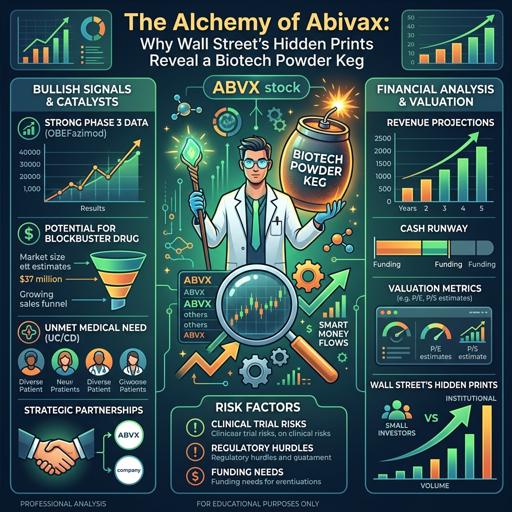
To truly understand the institutional undercurrents, we must synthesize the linkage between the TRF ratio (the off-exchange trading proportion), the off-exchange short selling ratio, the volume Z-score, and the rolling closing position value. When combined, these four metrics strip away retail noise to reveal hidden institutional accumulation, stealth shorting, or imminent price-volume divergences. Specifically, when the TRF ratio and the volume Z-score simultaneously print extreme values, it is a historical hallmark of a regime change—a violent birth of a new trend engineered in dark pools. The rolling closing position value acts as the directional compass of this volume, tracking the genuine balance of power at the closing bell. If we look at Abivax’s late April data, the off-exchange short selling ratio was choking the tape at the 88th to 95th percentiles while the rolling closing position value collapsed to near zero, indicating aggressive hidden distribution. However, during the first week of May, this dynamic violently reversed. The volume Z-score spiked to a multi-week high (+1.3 standard deviations) concurrently with a massive expansion in the TRF ratio, signaling that institutions were moving heavy volume off-exchange. Crucially, the off-exchange short selling ratio plummeted to the 3rd percentile by May 6, while the rolling closing position value surged back to peak levels. This specific multi-dimensional footprint indicates that the off-exchange facilities were no longer being used to suppress the stock with synthetic shorts; instead, they were masking aggressive institutional covering and net-long accumulation, effectively igniting the new bullish momentum we are now seeing.
The dark pool data aligns perfectly with the broader short interest trends. In late January 2026, short interest in Abivax peaked at over 3.65 million shares. By mid-April, it had bled down to 2.56 million. The shorts are trapped. They bet against the company's cash burn, failing to anticipate the proactive debt-to-equity restructuring at $111.57, which essentially established an institutional floor on the stock.
Furthermore, the derivatives market is heavily tilted. Looking at the options summaries for May 2026, the put-to-call open interest ratio is hovering persistently between 0.52 and 0.56. For every put option held, there are nearly two call options open. Total open interest has swelled past 86,000 contracts as of May 8th. The street is positioning for a massive asymmetric move upward, pricing in the reality that the balance sheet is suddenly remarkably clean.
Abivax is not your standard biotech lottery ticket. The technicals are flashing multi-timeframe bottoms and recent monthly highs, but the real story is in the ledger. When insiders and elite crossover funds (TCG, Sofinnova, Invus) orchestrate a cap table cleanup that removes royalty burdens, and the dark pool data simultaneously transitions from extreme off-exchange shorting to aggressive off-exchange accumulation, the writing is on the wall.
The shorts are being systematically suffocated while institutions quietly front-run the upcoming clinical catalysts. The tape is telling you exactly what the smart money is doing.